
Author profile
Carl Sagan: books, reviews, and where to start
Carl Sagan could explain the scale of the universe without making it feel cold or turning science into a substitute for wonder.
Biography and criticism
Science as a way of knowing and a reason to care
Cosmos made Sagan famous, but that calm television voice came from real scientific work, years spent thinking about planetary missions, and a gift for finding the one image people would remember.
Brooklyn curiosity becomes planetary science
Carl Edward Sagan was born in Brooklyn in 1934 to a working-class Jewish family. The 1939 New York World's Fair, library visits, and an early fascination with stars helped turn curiosity into vocation. At the University of Chicago he moved through a broad education before completing doctoral work in astronomy and astrophysics. His scientific career included research on planetary atmospheres and surface conditions, teaching at Harvard and Cornell, and sustained involvement with NASA missions including Mariner, Viking, Voyager, and Galileo.
Sagan's research helped explain the high surface temperature of Venus through a greenhouse atmosphere and contributed to discussions of seasonal changes on Mars and the chemistry of Titan. He was not simply a broadcaster who borrowed authority from science. He was a practicing scientist who understood how uncertain evidence becomes a model and how a model should remain open to correction. That experience shaped his best popular writing, where confidence in method coexists with impatience toward claims that avoid testing.
The voice of Cosmos
Cosmos, first broadcast in 1980 and accompanied by the book, made Sagan one of the world's most recognizable scientific educators. The series joins astronomy to the history of ideas, moving from the scale of galaxies to the lives of people who changed how humanity understands nature. Sagan refuses to present discovery as a clean march of facts. Science appears as a human practice vulnerable to vanity, persecution, institutional error, and courage.
Sagan's grand tone works because he keeps returning to concrete examples. A calendar compresses cosmic history. A photograph of Earth argues for political humility. The elements in a body connect stellar evolution to ordinary life. Sometimes the rhetoric makes intellectual history seem smoother than it was. More often, it gives people a reason to care about knowledge they may never use in their jobs.
Skepticism without contempt
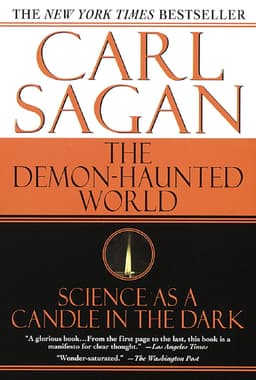
The Demon-Haunted World is Sagan's clearest defense of critical thinking. Its lasting virtue is moral tone. He understands why extraordinary claims attract people who feel ignored, frightened, or hungry for meaning. Refuting a belief is not enough if the refutation humiliates the believer and leaves the underlying need available to the next fraud. The baloney-detection tools are practical, but the deeper lesson is that skepticism should protect human dignity rather than become a performance of superiority.
Sagan also used his public position politically. He argued against nuclear proliferation, helped develop and publicize research on nuclear winter, and advocated planetary exploration as a long-term human project. Pale Blue Dot brings those concerns together. Once Earth is a speck in a photograph, claims about one nation or group owning the future start to look absurd. For Sagan, our smallness was a reason to take better care of one another, not a reason to give up.
Contact and the limits of proof
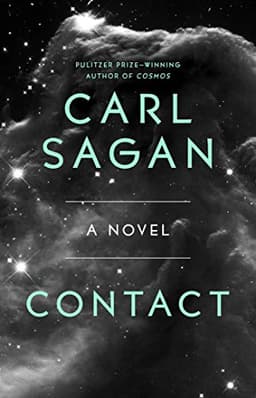
Contact, Sagan's only novel, follows radio astronomer Ellie Arroway as she searches for extraterrestrial intelligence and fights to be taken seriously by the institutions around her. The scientific process drives the plot, but religious longing is not treated as simple stupidity. The real conflict is easy to understand: an experience can convince the person who had it and still fail every test of evidence for everyone else.
The Dragons of Eden shows Sagan at his most speculative and historically bounded. Its attempt to bring brain science and evolution together is still interesting, but parts need modern correction. Broca's Brain is a deliberately mixed collection, and not every subject holds his attention equally well. Billions and Billions begins with numbers and ends with personal writing about illness and mortality, including Ann Druyan's account of his death in 1996. Sagan lasted as more than a reassuring television memory because he showed that intellectual honesty did not require emotional coldness.
Where to begin
A good place to start with Carl Sagan
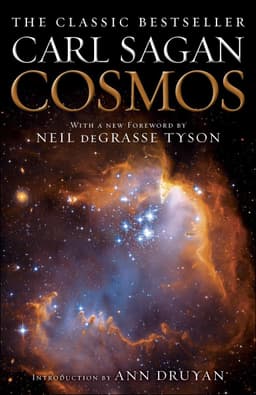
Cosmos
4.7 / 5Cosmos remains a generous introduction to scientific thinking because Sagan treats knowledge as a human achievement without treating humanity as the center of nature.
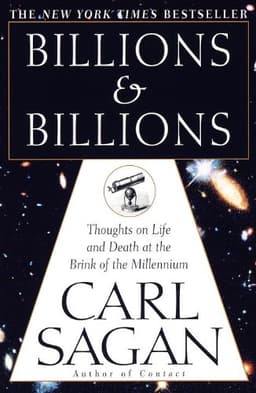
Billions and Billions
4.4 / 5Billions and Billions begins with numbers and ends with mortality. Its policy essays vary in strength, but Sagan's final insistence on evidence, tenderness, and shared responsibility is deeply affecting.
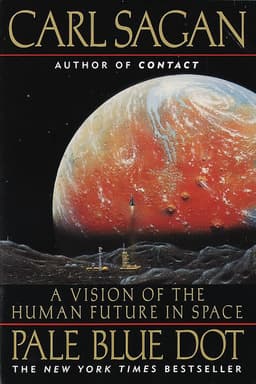
Pale Blue Dot
4.6 / 5Pale Blue Dot turns the view of Earth from space into a disciplined argument for humility, exploration, and long-term responsibility.
Reading order and buying help
Reading guides featuring Carl Sagan
Bibliography
Books by Carl Sagan
Reviews and book guides open on Book Review Guide. The full list comes from the linked bibliography source.
Reviewed
Cosmos
Reviewed
The Demon-Haunted World
Reviewed
Pale Blue Dot
Reviewed
Contact
First published 1985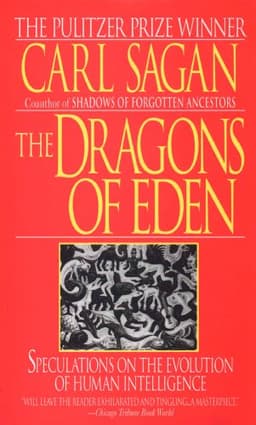
Reviewed
The Dragons of Eden
First published 1977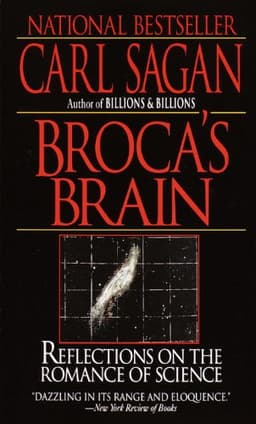
Reviewed
Broca's Brain
First published 1979Reviewed
Billions and Billions
First published 1997Books on this site
Carl Sagan reviews and guides
19974.4 / 5
Billions and Billions
Thoughts on Life and Death at the Brink of the Millennium
Billions and Billions begins with numbers and ends with mortality. Its policy essays vary in strength, but Sagan's final insistence on evidence, tenderness, and shared responsibility is deeply affecting.
As an Amazon Associate, I earn from qualifying purchases.
19794.2 / 5
Broca's Brain
Reflections on the Romance of Science
Broca's Brain is uneven as a collection but excellent at showing why science needs memory, criticism, and public accountability as much as it needs wonder.
As an Amazon Associate, I earn from qualifying purchases.
19854.5 / 5
Contact
A Novel
Contact turns first contact into a test of evidence, institutions, and private certainty. Its ideas outgrow some stiff dialogue, but Ellie Arroway gives the speculation a searching human center.
As an Amazon Associate, I earn from qualifying purchases.
20134.7 / 5
Cosmos
A Personal Voyage
Cosmos remains a generous introduction to scientific thinking because Sagan treats knowledge as a human achievement without treating humanity as the center of nature.
As an Amazon Associate, I earn from qualifying purchases.
19944.6 / 5
Pale Blue Dot
A Vision of the Human Future in Space Review
Pale Blue Dot turns the view of Earth from space into a disciplined argument for humility, exploration, and long-term responsibility.
As an Amazon Associate, I earn from qualifying purchases.
19974.7 / 5
The Demon-Haunted World
Science as a Candle in the Dark Review
The Demon-Haunted World is an unusually humane defense of skepticism, treating critical thinking as public equipment rather than intellectual superiority.
As an Amazon Associate, I earn from qualifying purchases.
19774 / 5
The Dragons of Eden
Speculations on the Evolution of Human Intelligence
The Dragons of Eden is an imaginative record of 1970s thinking about the mind, not a current map of the brain. Sagan's intellectual range remains exciting when his speculation is read with modern correction nearby.
As an Amazon Associate, I earn from qualifying purchases.
20064.4 / 5
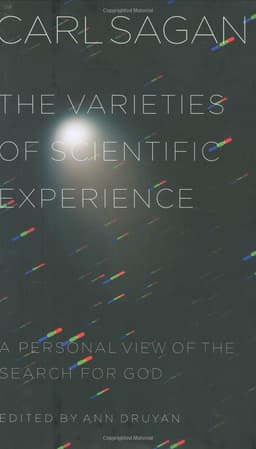
The Varieties of Scientific Experience
A Personal View of the Search for God Review
The Varieties of Scientific Experience makes Sagan's dialogue with religion thoughtful and expansive, though its lecture origins create repetition and uneven depth.
As an Amazon Associate, I earn from qualifying purchases.
Keep exploring