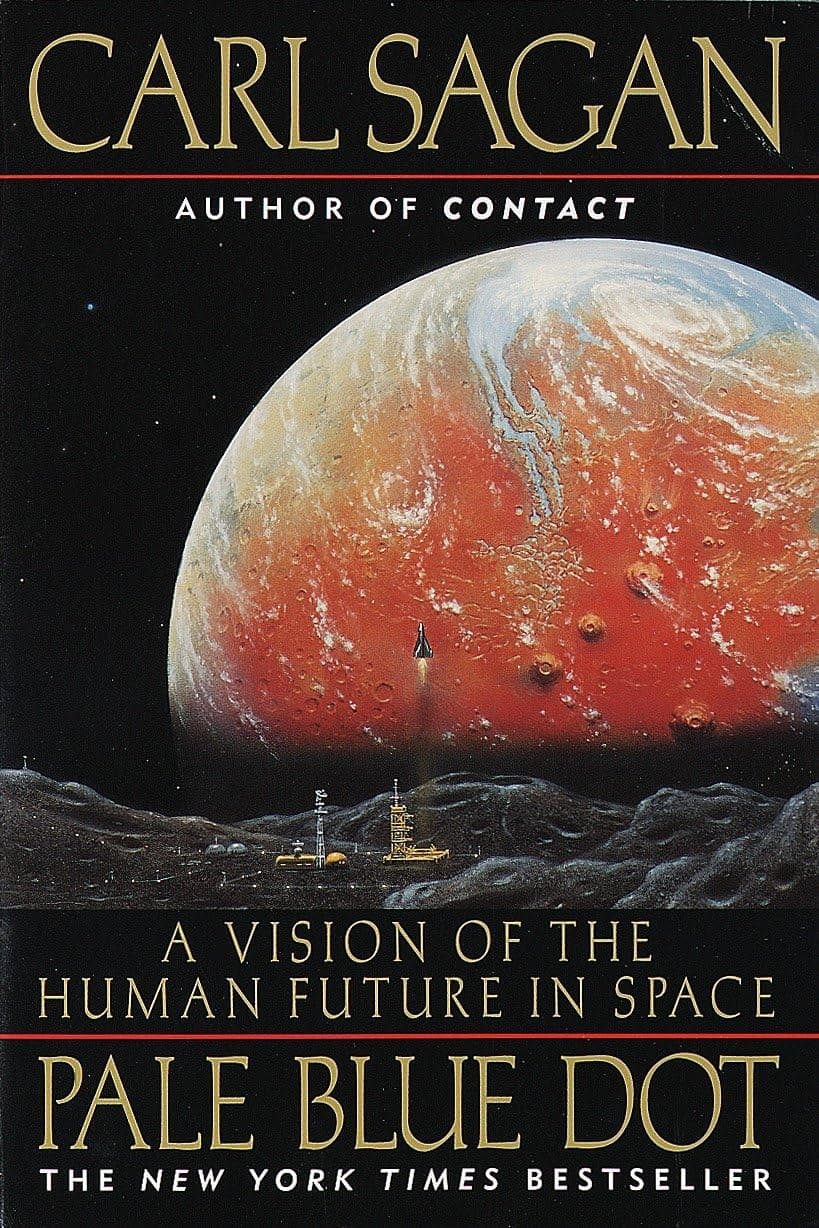
Should you read Pale Blue Dot?
What works
Sagan connects spacecraft history and planetary science to political perspective, asking what exploration is for rather than treating technical achievement as self-justifying.
What may not work for you
Several mission details and future timelines have aged, and the middle can feel like a tour of worlds before the ethical and practical strands reconnect.
What may test your patience
The planet-by-planet survey becomes dense with atmosphere, geology, and mission history; readers drawn mainly by the famous reflection may need patience with the scientific middle.
Does the ending reward the effort?
Yes. The case for becoming a spacefaring species remains conditional and morally serious, rooted in survival and stewardship rather than conquest.
Reading Pale Blue Dot closely
Pale Blue Dot grows out of a single image: the tiny picture of Earth taken by Voyager 1 at the edge of the Solar System. Carl Sagan uses that photograph as a starting point for a wider reflection on space exploration, human vulnerability, and our future beyond this planet.
The book walks through the outer planets, their moons, and the missions that revealed them, always tying scientific detail to bigger questions about politics, ethics, and responsibility. You get clear introductions to planetary science, mission history, and the debates around colonization and planetary defense.
Sagan's main argument is simple but powerful: seeing Earth as a pale blue dot encourages humility and cooperation. Spaceflight is presented not only as a scientific achievement but also as a reminder that our home is small, fragile, and currently unique in its ability to support life.
What has changed since publication
Keep a list of missions Sagan mentions and then search for updates to see what has happened since publication.
Pair chapters on planetary defense with recent discussions of asteroid monitoring and impact risks.
Compare Sagan's hopes for Mars and beyond with current plans from public agencies and private companies.
Three useful comparisons
Cosmos
Cosmos is broader and remains the better general introduction to Sagan. Pale Blue Dot assumes more interest in missions, planetary environments, and humanity's future beyond Earth. Begin with Cosmos for his full public voice; choose this book when exploration and stewardship deserve sustained attention.
Best for: Curious general readers and older teens wanting a humane, accessible route into astronomy, scientific history, and cosmic perspective.
As an Amazon Associate, I earn from qualifying purchases.

Contact
Contact turns cosmic perspective into a first-contact novel where instruments, governments, religions, and private conviction compete to interpret a signal. Choose it for character and institutional drama. Pale Blue Dot is the better choice for real mission history and an explicit argument about becoming responsibly spacefaring.
Best for: Readers who want scientifically literate first contact, a woman astronomer at the center, and serious arguments about evidence, religion, public trust, and humanity's cosmic importance.
As an Amazon Associate, I earn from qualifying purchases.
Billions and Billions
Billions and Billions brings Sagan's environmental and political concerns closer to daily ethical choices, then ends with illness, love, and mortality. It is less cohesive and less focused on space, but more personal. Read it later in his catalog when the person behind the cosmic voice matters.
Best for: Readers who know Sagan's public voice and want a humane final collection about numbers, climate, war, ethics, love, illness, and death rather than another general introduction to astronomy.
As an Amazon Associate, I earn from qualifying purchases.
Make the next decision