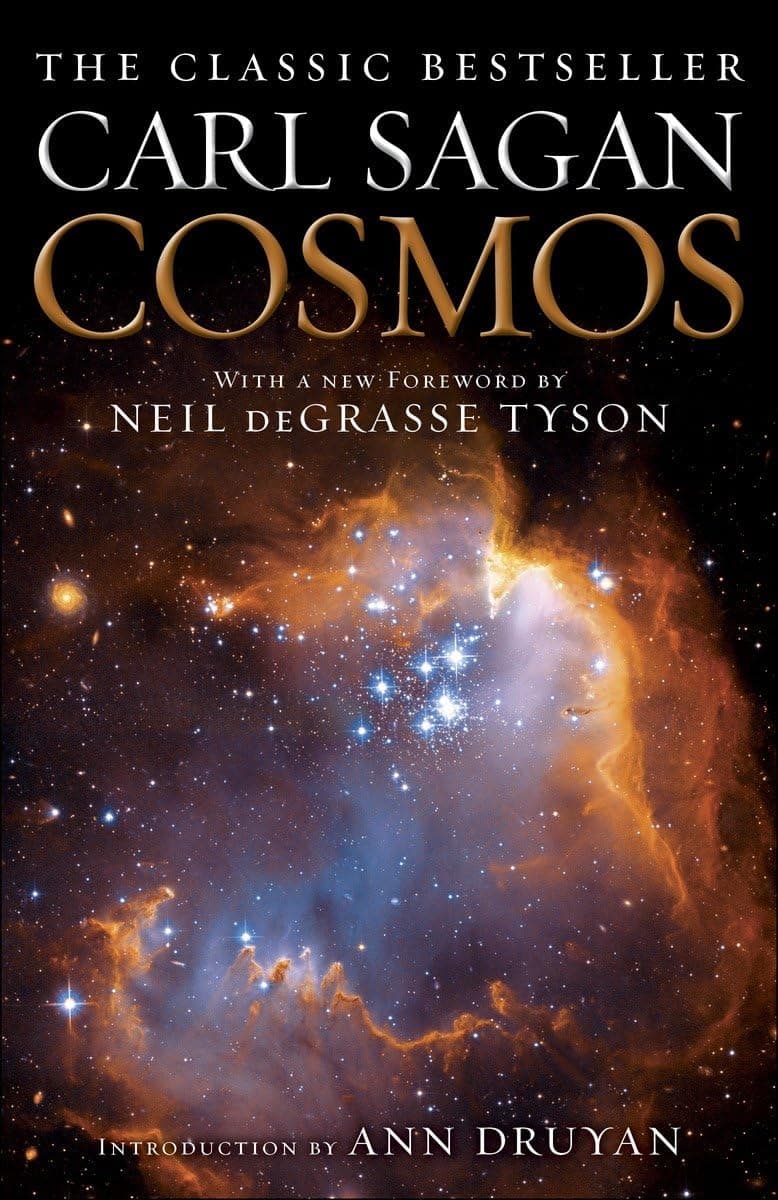
Should you read Cosmos?
What works
Astronomy, evolution, history, and biography reinforce one another, showing how methods of inquiry change both what we know and the scale at which we understand ourselves.
What may not work for you
Some scientific details and future projections are dated, and the rapid movement across disciplines sometimes replaces depth with eloquent overview.
What may test your patience
Readers already comfortable with basic astronomy may find the introductory explanations slow, while newcomers may need to pause when the book jumps from cosmic scale to technical history.
Does the ending reward the effort?
Yes. The final appeal for skepticism and planetary responsibility gathers the scientific journey into an ethical position without claiming that science alone supplies values.
Reading Cosmos closely
Carl Sagan presents astronomy and cosmology as a connected story about how people came to understand the universe. Science, history, and personal curiosity share the page, making the book broader than a conventional introduction to astronomy.
Sagan walks the reader from ancient observatories and early astronomers to modern astrophysics, using clear metaphors and careful explanations. You get introductions to dark matter, stellar life cycles, planetary science, and the history of scientific discovery without needing a strong math background. The result is a popular science book that still feels substantial decades after its first publication.
Cosmos also has a wide cultural scope. Sagan writes about the Library of Alexandria, the Voyager missions, SETI, and the Enlightenment, tying them together into a narrative about why evidence based thinking matters. He argues for curiosity, skepticism, and education as tools that help humanity avoid superstition and panic.
The chapters work as related essays rather than one continuous argument. That makes Cosmos easy to read in sections, but it is a historically important work of popular science rather than a current technical reference. For another Carl Sagan starting point, compare Pale Blue Dot or browse the Carl Sagan bibliography.
How accessible is Cosmos?
The explanations rely more on metaphor, history, and narrative than on equations, so readers do not need an advanced mathematics background.
Its scope is wide and the chapters are idea-dense. Reading them as linked essays can be easier than expecting a linear textbook.
Reader fit and next steps
Cosmos is best suited to curious readers who want astronomy placed alongside scientific history, skepticism, and questions about humanity’s place in the universe.
Continue with The Demon-Haunted World for Sagan’s case for skeptical inquiry, or use Books Like Cosmos for cross-author alternatives.
Three useful comparisons
Pale Blue Dot
Pale Blue Dot narrows the cosmic perspective toward planetary exploration, long-term survival, and the responsibilities created by seeing Earth from far away. Choose it after Cosmos when spacecraft history and humanity's future in space are the questions you most want Sagan to develop.
Best for: Readers interested in space exploration, planetary science, and the moral implications of seeing Earth as one vulnerable world.
Contact
Contact places Sagan's ideas about extraterrestrial intelligence, evidence, and human importance inside a novel shaped by radio astronomy and institutional conflict. Choose it when you want character, uncertainty, and first-contact politics rather than the broad nonfiction history and explanatory tour offered here.
Best for: Readers who want scientifically literate first contact, a woman astronomer at the center, and serious arguments about evidence, religion, public trust, and humanity's cosmic importance.
The Demon-Haunted World
The Demon-Haunted World turns from cosmic overview to practical standards for judging claims, understanding pseudoscience, and protecting public reasoning. It is less visual and less wide-ranging, but more directly usable when skepticism and misinformation matter more than astronomy itself.
Best for: Come for practical critical-thinking tools and a patient response to misinformation, pseudoscience, and scientific illiteracy.
Make the next decision