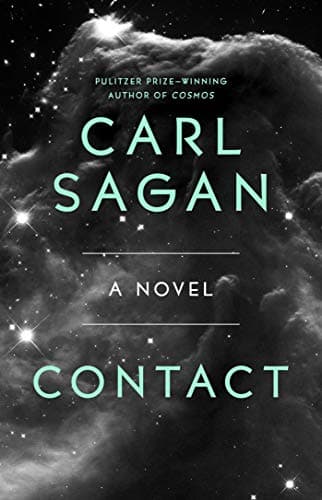
Should you read Contact?
What works
The signal does not bypass scientific practice. It has to be detected, checked, shared, interpreted, funded, protected, and argued over, so discovery changes relationships among observatories, governments, religions, and the public before any machine can be built.
What may not work for you
Several supporting characters carry a position more clearly than a private life, and the romantic material is less convincing than Ellie's scientific work. Long public debates occasionally sound like Sagan arranging a symposium rather than people speaking under pressure.
What may test your patience
The middle slows while committees, security concerns, funding decisions, and competing interpreters gather around the message. The institutional detail is essential to the novel's argument, but it delays the physical consequences readers may expect from a first-contact thriller.
Does the ending reward the effort?
Yes. The close makes public proof and private experience pull in different directions, then leaves Ellie with a quieter scientific question rather than a demand for unquestioning belief. It rewards the novel's commitment to inquiry without making uncertainty painless.
Reading Contact closely
Contact follows Eleanor Arroway from a childhood fascination with radios into a career listening for signals that most institutions consider too improbable to fund seriously. Ellie is not waiting for belief to reward her. She wants a pattern that nature and human interference cannot explain away. When a transmission from Vega begins with a sequence of prime numbers, the excitement comes from how quickly wonder becomes work. Receivers must be checked, observatories must compare data, and every ordinary source of contamination must be excluded before the word intelligence is earned.
Sagan understands that evidence does not enter an empty room. Governments see strategic risk, media systems need a public story, religious leaders ask who has authority to represent humanity, and wealthy patrons can shape which scientific ambitions survive. The signal includes instructions whose scale requires international cooperation and creates an obvious political question: even if the design is understood, who gets to decide whether it should be built? The novel is at its most persuasive when technical and institutional problems cannot be separated.
Ellie gives those arguments a human cost. Her commitment to evidence is not emotional emptiness, although several people treat it that way. She has losses, loyalties, anger at condescension, and a longing for intelligible connection that makes the work personal without turning the signal into therapy. Sagan is less successful with some surrounding characters. A politician, preacher, administrator, or romantic partner can sound like a worldview assigned a body, and long conversations occasionally pause the story so every position can take a turn at the microphone.
The book is more deliberate and institutionally crowded than the film adaptation. Readers expecting a straight line from detection to spectacle may become restless during committee decisions, security disputes, and public argument. That slower material is also what makes the novel distinctive. First contact is not only an engineering event or a private friendship. It is a crisis in who may speak for science, nations, belief, and the species. The wider international scope prevents the discovery from belonging entirely to one country or one heroic operator.
The final movement preserves a demanding distinction between an experience and evidence that can persuade someone who did not share it. Sagan does not abandon scientific standards when they become inconvenient to a character he loves. He also refuses to pretend that the absence of immediate verification settles every question. Contact earns its recommendation by keeping wonder accountable. It is not the fastest first-contact novel and not Sagan's best prose on every page, but its central problem remains unusually mature: what would humanity owe the truth if the most important discovery in history arrived through instruments, politics, and fallible people?
The Vega signal behaves like scientific evidence
Prime numbers make intention plausible, but they are only the beginning. Independent reception, error checking, decoding, and the exclusion of human interference turn recognition into a public process. The story respects how difficult it is to move from an astonishing pattern to a claim other people should trust.
Ellie is not a debate position
Her skepticism grows from practice and from a refusal to accept authority as a substitute for demonstration. Grief and desire still shape her, but the novel does not require romance or religious conversion to make a woman scientist emotionally complete.
Contact would reorganize institutions before daily life
The signal creates questions about secrecy, funding, security, representation, and access long before anyone knows the senders' intentions. Sagan's institutional patience slows the thriller and gives the premise its real seriousness.
Three useful comparisons
The Three-Body Problem
The Three-Body Problem also begins with scientific evidence that opens a civilizational crisis, but it is colder, more puzzle-driven, and far more suspicious about contact. Choose it for darker geopolitical strategy and denser conceptual machinery. Contact gives the observatory, the public response, and the possibility of communication more emotional and institutional room.
Best for: Readers who enjoy hard science fiction, first contact, conceptual mystery, and political history more than character-led adventure.
Project Hail Mary
Project Hail Mary reaches mutual understanding through hands-on experiments between two individuals and moves with much greater comic speed. Contact asks what happens when evidence must pass through laboratories, governments, media, and belief systems before anyone can act. Choose Weir for intimate problem solving and Sagan for the public meaning of discovery.
Best for: The best fit is someone who likes optimistic hard science fiction, first contact, high-stakes problem solving, and an emotionally satisfying partnership.
Cosmos
Cosmos presents Sagan's scientific history and cosmic perspective directly, while Contact tests similar convictions inside a novel where institutions can resist, distort, or demand evidence. Start with Cosmos for his broad nonfiction voice. Choose Contact when you want those ideas embodied by Ellie Arroway and exposed to narrative uncertainty.
Best for: Curious general readers and older teens wanting a humane, accessible route into astronomy, scientific history, and cosmic perspective.
Make the next decision