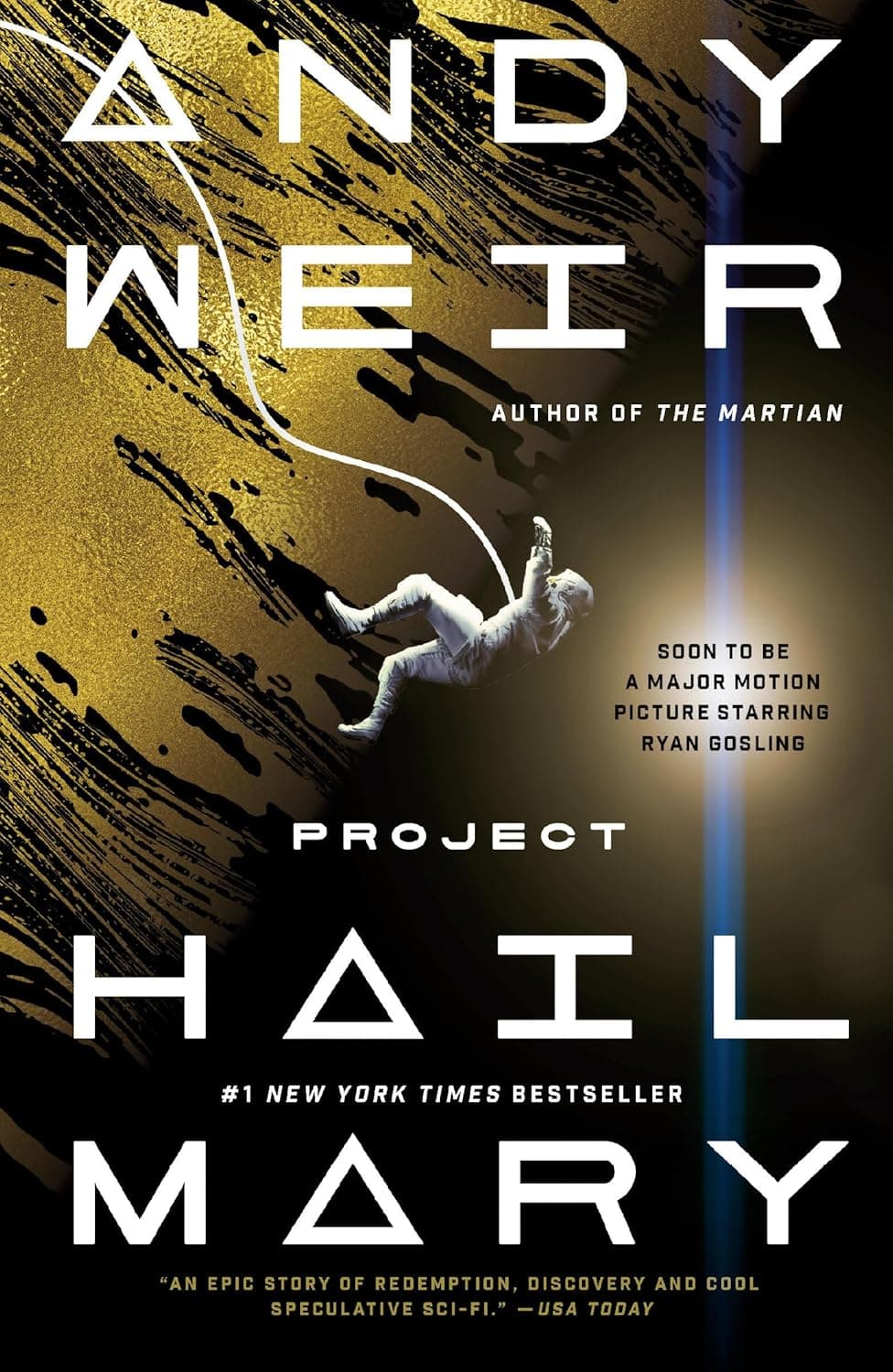
Should you read Project Hail Mary?
What works
Ryland and Rocky must build trust through measurement, language, shared experiments, and incompatible biology, making communication itself the novel's best scientific problem.
What may not work for you
The flashbacks arrange moral information conveniently, several Earth characters are broad, and Ryland's humor sometimes sounds indistinguishable from Mark Watney's.
What may test your patience
The opening amnesia sequence delays context while repeating laboratory inference; it becomes rewarding once the second narrative and mission stakes are established.
Does the ending reward the effort?
Yes. The final choice grows from the central relationship and gives competence a moral purpose beyond completing the assigned mission.
Reading Project Hail Mary closely
Ryland Grace wakes alone on a spacecraft with no memory of who he is or why he is in deep space. As he reconstructs his past, he learns that a mysterious microbe is draining the Sun and that his mission may be Earth's only answer. The opening is a locked-room mystery in a zero-gravity lab, then physics, biology, and engineering drive a much larger survival story.
Structurally, the book alternates between Grace solving problems in the present and flashbacks that fill in how the Hail Mary mission came to exist. Andy Weir leans hard into step by step problem solving, the same way he did in The Martian, but here the stakes jump from one stranded astronaut to an entire species. You watch Grace run experiments, crunch numbers and improvise new tools, yet the narration stays chatty and darkly funny, so long explanations of orbital mechanics or alien microbiology stay readable even if you skim a formula or two.
The emotional hook arrives when Grace realizes he is not the only one fighting this cosmic threat. Without spoiling the exact circumstances, his partnership with an alien engineer becomes the heart of the book. Their attempts to communicate, trade technology and work around wildly different biology turn what could have been a cold puzzle box into a story about trust across species. If you are curious about how the ending lands, think less in terms of a shock twist and more in terms of a hard won choice about loyalty and home that makes sense of everything Grace has learned along the way.
By the time the last chapters arrive, most readers will already have guessed the rough shape of Grace's final decision, yet the details still feel tense and strangely hopeful. The conclusion answers the big plot questions in a clean way while leaving just enough room to imagine what comes next for both civilizations. The novel has already picked up major recognition, including a Dragon Award win and a Hugo nomination, and it now has a film adaptation on the way, which makes sense given how visual and suspenseful many set pieces feel. Project Hail Mary combines a tight thriller plot, meticulous science and a surprisingly warm friendship into one of the more accessible hard science fiction novels of the last decade.
Science, Accuracy and Reading Experience
Weir once again builds his plot out of real physics, chemistry and engineering constraints, so most of the solutions feel like they could exist on a whiteboard in a real lab even when the premise involves fictional microbes that eat starlight.
Science writers and reviewers have pointed out a few nitpicks and speculative leaps, but the overall consensus is that Project Hail Mary still reads as hard science fiction rather than loose space fantasy for most readers.
If you usually bounce off technical detail, you can treat the equations like flavor text and focus on the trial and error process, since the book always shows you why a result matters for Grace's survival instead of getting lost in jargon.
Three useful comparisons
The Martian
The Martian is leaner and more plausible; Project Hail Mary offers greater scale, mystery, and emotional companionship.
Best for: Readers who enjoy problem solving, survival logistics, accessible science, and a protagonist who meets disaster with jokes.
Children of Time
Children of Time treats cross-species understanding across civilizations and deep time, with denser evolutionary worldbuilding.
Best for: Readers who like big evolutionary ideas, nonhuman viewpoints, and long time scales more than a conventional hero's journey.
The Three-Body Problem
Three-Body presents first contact as ideological and cosmic dread; Weir makes it practical, personal, and hopeful.
Best for: Readers who enjoy hard science fiction, first contact, conceptual mystery, and political history more than character-led adventure.
Make the next decision