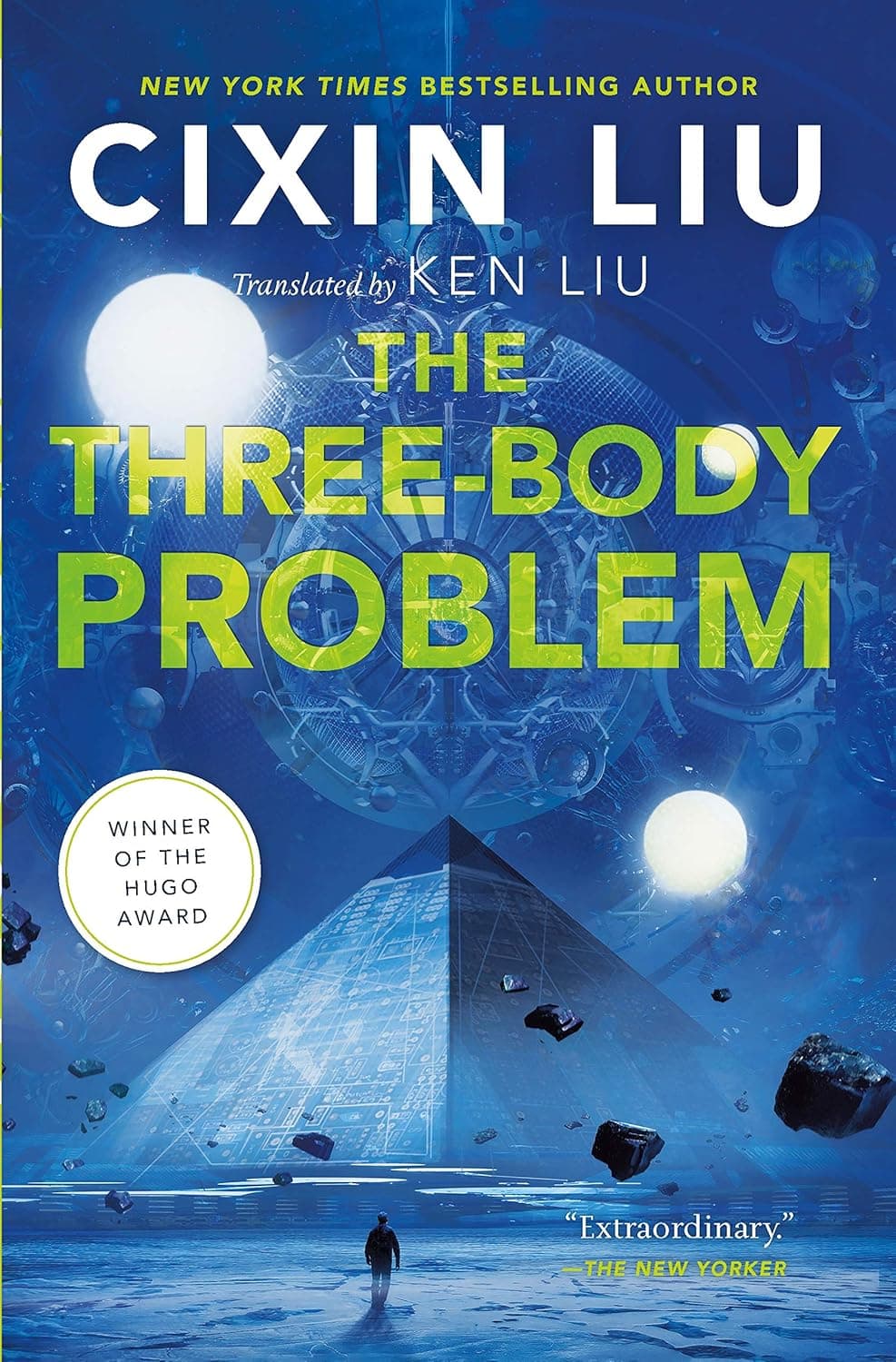
Should you read The Three-Body Problem?
What works
The Cultural Revolution, Red Coast, failing experiments, and the game all ask why intelligent people might lose faith in humanity before an alien threat ever becomes concrete.
What may not work for you
Several contemporary characters are functional rather than psychologically rich, and the late scientific exposition arrives in a block after the mystery has built more organic momentum.
What may test your patience
The virtual-reality sequences repeat failed attempts to model the three suns before their larger purpose is clear; the concepts are rewarding but initially detached from the human investigation.
Does the ending reward the effort?
Yes as a first volume. The reveal reorders the earlier mysteries and expands the scale dramatically, though it is an opening move rather than a self-contained resolution.
Reading The Three-Body Problem closely
The Three-Body Problem begins with an act of first contact during China’s Cultural Revolution and follows its effects into a present-day crisis. Physics experiments stop making sense, scientists die by suicide, and a mysterious VR game points toward an alien system with three suns. The suspense comes from secret projects and divided loyalties rather than space battles.
On the page it reads like hard science fiction that still feels approachable if you are patient. Compared to Dune, there is less invented religion and more real world physics and Chinese history; compared to The Martian, there are fewer step by step engineering problems and more conceptual ideas about quantum tricks, orbital chaos, and what happens when the laws of nature seem to stop working. Ken Liu’s English translation keeps chapters relatively short and clear, so most of the difficulty comes from wrapping your head around the ideas rather than from the prose itself.
The heart of the story sits with people who have either lost faith in humanity or are still trying to believe in it. Ye Wenjie’s experiences during the Cultural Revolution, the secret Red Coast base, and the later Earth Trisolaris Organization all show how trauma, idealism, and despair can push smart people toward extreme positions. The alien Trisolarans are frightening, but the book spends just as much time on how humans argue about whether an advanced civilization would save us, judge us, or erase us.
If you have already watched the 3 Body Problem series, the novel gives you more time inside the Chinese setting, more detail on the Three Body game, and a sharper sense of how each faction thinks. If you read it first, the show becomes easier to follow because you already understand the basic science and the stakes. Either way, this first book sets up a trilogy that keeps widening its focus, from secret labs and oil tankers to questions about how any civilization survives in a hostile universe.
Our science fiction collection and hard science fiction picks offer more big-idea stories about first contact and humanity’s future.
Where the novel is strongest
A timeline that jumps from the Cultural Revolution to modern labs, tying personal trauma and political upheaval to cosmic level stakes.
Hard science fiction that explains just enough physics and orbital chaos to feel grounded without turning every chapter into a textbook.
A first contact scenario where humanity splits into factions that either welcome, appease, or fiercely resist the coming Trisolaran invasion.
Three useful comparisons
Children of Time
Children of Time develops alien intelligence through evolutionary storytelling and offers warmer emotional access despite its long time scale.
Best for: Readers who like big evolutionary ideas, nonhuman viewpoints, and long time scales more than a conventional hero's journey.
Revelation Space
Revelation Space is darker, denser space opera built around an extinction mystery; choose it for Gothic technology and morally difficult characters.
Best for: Patient readers wanting hard science fiction, archaeology, deep time, morally difficult characters, and cosmic danger.
Dune
Dune integrates politics and ecology inside one invented world, while Three-Body roots cosmic crisis more directly in modern history and physics.
Best for: Readers willing to trade immediate intimacy for political, ecological, and religious ideas that become more connected with every chapter.