Author profile
Liu Cixin: books, reviews, and where to start
Liu Cixin writes science fiction at civilizational scale, using physics, engineering, and cosmic danger to test whether human moral intuition can survive a universe of extreme distance and risk.
Biography and criticism
Civilization under the pressure of the cosmos
Liu's most famous novels make ideas physically spectacular, but their deepest unease comes from collective decisions made when no option remains innocent.
An engineer in China's science-fiction revival
Liu Cixin was born in Beijing in 1963, grew up in Shanxi, studied engineering, and worked at a power plant while writing science fiction. He became a major figure in Chinese speculative literature before English translation brought The Three-Body Problem and the Remembrance of Earth's Past trilogy to a broad international audience. Ken Liu's translation of the first volume helped navigate both technical ideas and a narrative structure rooted partly in the Cultural Revolution.
The trilogy begins with scientific mystery and expands toward contact, deterrence, dimensional technology, and the fate of civilizations. Liu repeatedly changes scale until a personal choice and a cosmic strategy occupy the same argument.
The sublime machine and the thin individual
Liu excels at conceptual spectacle: a computer enacted by people, a civilization unfolding protons, a fleet crossing centuries, a solar system confronted by impossible physics. Exposition is often the event. Characters can feel functional beside the ideas, and gendered moral contrasts in the trilogy deserve criticism rather than being excused as scale.
The Dark Forest develops the strategic implications most forcefully, while Death's End pushes awe toward terror. The Wandering Earth stories show his engineering imagination in shorter forms. Begin with The Three-Body Problem and expect a deliberate shift from historical and scientific mystery to cosmic strategy. Liu's fiction is not reassuring humanism. It asks whether the universe recognizes any value humans do not actively defend.
The books in context
How the work develops on the page
These notes connect the biography to specific choices in the books. Each title links to the full spoiler-free review.
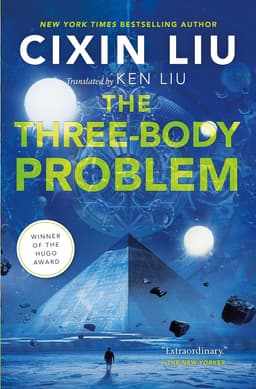
This spoiler free review of The Three-Body Problem by Liu Cixin follows how a single act of first contact during China’s Cultural Revolution slowly ripples into a present day crisis where physics breaks down, scientists die by suicide, and a mysterious VR game points to an alien star system with three suns. Instead of focusing on space battles, the book builds tension through secret projects, ideological fractures, and the slow realisation that humanity is being watched from very far away.
On the page it reads like hard science fiction that still feels approachable if you are patient. Compared to Dune, there is less invented religion and more real world physics and Chinese history; compared to The Martian, there are fewer step by step engineering problems and more conceptual ideas about quantum tricks, orbital chaos, and what happens when the laws of nature seem to stop working. Ken Liu’s English translation keeps chapters relatively short and clear, so most of the difficulty comes from wrapping your head around the ideas rather than from the prose itself.
The heart of the story sits with people who have either lost faith in humanity or are still trying to believe in it. Ye Wenjie’s experiences during the Cultural Revolution, the secret Red Coast base, and the later Earth Trisolaris Organization all show how trauma, idealism, and despair can push smart people toward extreme positions. The alien Trisolarans are frightening, but the book spends just as much time on how humans argue about whether an advanced civilization would save us, judge us, or erase us.
If you have already watched the 3 Body Problem series, the novel gives you more time inside the Chinese setting, more detail on the Three Body game, and a sharper sense of how each faction thinks. If you read it first, the show becomes easier to follow because you already understand the basic science and the stakes. Either way, this first book sets up a trilogy that keeps widening its focus, from secret labs and oil tankers to questions about how any civilization survives in a hostile universe.
If you want to see why this series became a global phenomenon, you can grab your copy of The Three-Body Problem on Amazon and then explore our science fiction collection and hard science fiction picks for more big idea stories about first contact and humanity’s future.
Ken Liu's translation keeps the sentences direct while the structure moves between historical testimony, police investigation, game scenarios, and technical explanation, giving each idea a different frame.
The Cultural Revolution, Red Coast, failing experiments, and the game all ask why intelligent people might lose faith in humanity before an alien threat ever becomes concrete.
Several contemporary characters are functional rather than psychologically rich, and the late scientific exposition arrives in a block after the mystery has built more organic momentum.
The virtual-reality sequences repeat failed attempts to model the three suns before their larger purpose is clear; the concepts are rewarding but initially detached from the human investigation.
Yes as a first volume. The reveal reorders the earlier mysteries and expands the scale dramatically, though it is an opening move rather than a self-contained resolution.
Children of Time develops alien intelligence through evolutionary storytelling and offers warmer emotional access despite its long time scale.
Revelation Space is darker, denser space opera built around an extinction mystery; choose it for Gothic technology and morally difficult characters.
Dune integrates politics and ecology inside one invented world, while Three-Body roots cosmic crisis more directly in modern history and physics.
A timeline that jumps from the Cultural Revolution to modern labs, tying personal trauma and political upheaval to cosmic level stakes.
Hard science fiction that explains just enough physics and orbital chaos to feel grounded without turning every chapter into a textbook.
A first contact scenario where humanity splits into factions that either welcome, appease, or fiercely resist the coming Trisolaran invasion.
Readers who enjoyed the big ideas and politics in Dune but want a story rooted in real physics and recent history.
Fans of The Martian who are happy to trade hands on engineering puzzles for conceptual physics, philosophy, and long term stakes.
Viewers of the Netflix 3 Body Problem series who want the full Chinese context, deeper character work, and more detail on how this trilogy unfolds.
Keep a simple list of key characters and factions so you can track who wants to invite the Trisolarans and who is preparing to fight them.
Pause after major scenes inside the Three Body VR game to sketch what you think is happening in the three sun system before the book explains it.
Pair this novel with popular science like Cosmos or big picture history like Sapiens to compare how fiction and nonfiction think about humanity’s future.
The Three-Body Problem follows scientists, soldiers, and disillusioned idealists from the Chinese Cultural Revolution to the present as a secret first contact with the unstable Trisolaran star system turns physics itself into a warning that an alien invasion is on the way.
Read the complete reviewWhere to begin
A good place to start with Liu Cixin

The Three-Body Problem
4.4 / 5The Three-Body Problem is stronger as a collision of scientific and historical ideas than as intimate drama, but those ideas generate genuine cosmic unease.
Bibliography
Books by Liu Cixin
Reviewed titles open directly on Book Review Guide. Other editions and works remain marked until a full review is published.

Reviewed
The Three-Body Problem
Not reviewed yet
Le Problème A Trois Corps - Tome 2
Not reviewed yet
Le problème à trois corps

Not reviewed yet
Zadacha treh tel
Not reviewed yet
Der dunkle wald (Trisolaris zweiter Teil)

Not reviewed yet
The Dark Forest (The Three-Body Problem Series Book 2)

Not reviewed yet
Loosed Upon the World

Not reviewed yet
Wspomnienie o przeszłości Ziemi 1 Problem trzech ciał
Not reviewed yet
Cixin Liu Three Body Problem Collection 3 Books Set (Hard Cover)
Not reviewed yet
View from the Stars
Not reviewed yet
The Wandering Earth
Not reviewed yet
Collected Short Stories
Not reviewed yet
Three-Body Problem, Vol. 3

Not reviewed yet
Boule de foudre
Not reviewed yet
O fim da morte
Not reviewed yet
Yi hun you shu
Not reviewed yet
Dong wu yuan li de jiu shi zhu
Not reviewed yet
Shi yi fen zhi yi de wen ming
Not reviewed yet
Mercury Sow (Chinese Edition)
Not reviewed yet
Qiu zhuang shan dian
Not reviewed yet
Shen du zhuang ji
Not reviewed yet
Shan yang shi jie
Not reviewed yet
Death's End (The Three-Body Problem Series Book 3)
Not reviewed yet
Hei ke heng xing
Not reviewed yet
Yu zhou tan suo
Not reviewed yet
Mo shi hao jie
Not reviewed yet
Vista Desde Las Estrellas / a View from the Stars
Not reviewed yet
Zui zao de yu zhou, zui hao de di qiu

Not reviewed yet
Koniec smierci
Not reviewed yet
Einstein Equator (Chinese Edition)
Not reviewed yet
Qiong ding zhi xia
Not reviewed yet
Chao xin xing ji yuan
Not reviewed yet
Zhongguo tai yang
Not reviewed yet
Chong zi de shi jie

Not reviewed yet
Wspomnienie o przeszlosci Ziemi 2 Ciemny las

Not reviewed yet
Estuche Trilogía Los Tres Cuerpos

Not reviewed yet
Het einde van de dood
Not reviewed yet
Wo shu jia shang de shen ming
Not reviewed yet
Xing ji yuan zheng
Not reviewed yet
Di san ci zheng jiu wei lai shi jie
Not reviewed yet
Zhan zheng bian zhong
Not reviewed yet
Bai e ji wang shi ; Mo gui ji mu
Not reviewed yet
Xing ji yi min
Not reviewed yet
Tun shi di qiu
Not reviewed yet
Gu du de jin hua zhe
Not reviewed yet
Messengers (Chinese Edition)
Not reviewed yet
Zhongguo ke huan xiao shuo nian xuan

Not reviewed yet
Yu zhou wang shi
Bibliographic records: Open Library.
Reviewed bibliography
Liu Cixin books reviewed here
Every title below has a complete, spoiler-free review. Scores are our editorial ratings, not visitor averages.

20164.4 / 5
The Three-Body Problem
Book 1 of the Remembrance of Earth's Past Trilogy
The Three-Body Problem is stronger as a collision of scientific and historical ideas than as intimate drama, but those ideas generate genuine cosmic unease.
As an Amazon Associate, I earn from qualifying purchases.
Keep exploring