Fifteen years before the first novel
Adrian Tchaikovsky was born Adrian Czajkowski in Woodhall Spa, Lincolnshire, in 1972. His Polish surname was rendered as Tchaikovsky on his British editions, and that spelling became his professional name. The more important continuity in his life is his fascination with the natural world. As a child he was absorbed by natural history, and he later studied zoology and psychology at the University of Reading. He did not become an academic scientist. He qualified as a legal executive and spent years working in commercial dispute law in Leeds, writing around a demanding day job rather than waiting for ideal conditions.
His debut was not an overnight discovery. Tchaikovsky has spoken about trying to publish for roughly fifteen years before Pan Macmillan released Empire in Black and Gold in 2008. The novel grew out of Bugworld, a role-playing campaign he had run at university. That origin helps explain the physical confidence of Shadows of the Apt: its insect-derived peoples are not decorative races pasted onto a conventional map. Their aptitudes, technologies, bodies, rivalries, and inherited assumptions determine how the world works. Ten large novels followed, giving him the kind of long-form apprenticeship few contemporary writers receive in public.
The breakthrough was a civilization of spiders
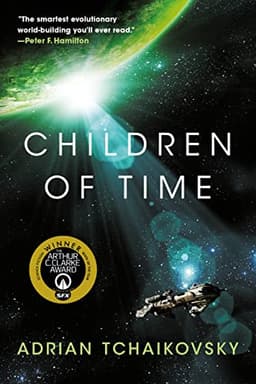
Children of Time changed the scale of Tchaikovsky's readership. Published in 2015 and awarded the Arthur C. Clarke Award the following year, it follows the development of an uplifted spider civilization across generations while the remnants of humanity deteriorate aboard an ark ship. The cleverness of the premise would mean little if the spiders remained a joke. Tchaikovsky instead builds their intelligence from anatomy, instinct, social organization, and selective pressure. Concepts that a human society takes for granted, including gendered authority, individual identity, communication, and technological progress, arrive by different routes.
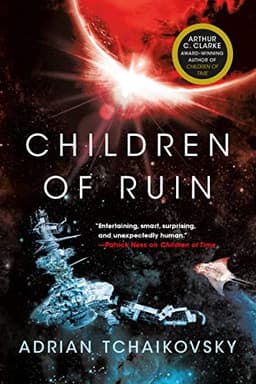
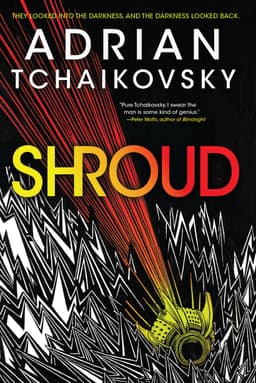
That method continued in Children of Ruin, where octopus cognition is distributed, volatile, and difficult for humans to read, and in later books that test memory, corvid intelligence, parasitic life, and cultural inheritance. The sequence is not a parade of increasingly strange creatures. Its recurring drama is the cost of translation. Characters survive when they stop asking how another mind fails to be human and begin asking what that mind is actually equipped to notice. Shroud pushes the argument further by making the alien environment itself resistant to familiar categories.
A fast writer who does not write the same book twice
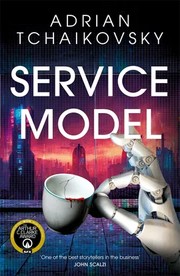
Tchaikovsky publishes at an exceptional pace, but range matters more than volume. The Final Architecture is crowded, crew-based space opera. Dogs of War gives moral and legal weight to engineered animals designed as weapons. Elder Race places a fantasy viewpoint beside a science-fiction viewpoint and lets the same events acquire different meanings. City of Last Chances is a politically messy ensemble novel about occupation, resistance, and compromise. Service Model turns the collapse of a social order into a dryly comic journey undertaken by a robot still searching for someone to serve.
His prose is usually clear, mobile, and willing to explain a difficult idea without making explanation the only pleasure. Action scenes retain a role-player's awareness of bodies, terrain, and competing objectives. Exposition often arrives through a character discovering that an existing model is wrong. His most recognizable move is a shift in sympathy: a creature, machine, or institution first appears threatening because the human viewpoint cannot interpret it, then becomes legible without becoming comfortably human. That is why his alien perspectives feel earned rather than whimsical.
What his books keep arguing
Across fantasy and science fiction, Tchaikovsky distrusts empires that call domination order and systems that treat intelligence as a license to own weaker beings. He is equally suspicious of the lone exceptional hero. Cooperation in his novels is difficult, compromised, and often conducted across species or ideological boundaries, but it repeatedly proves more durable than purity. Evolution supplies him with mechanisms, not moral approval. A trait can be successful and still produce misery. A civilization can be technologically brilliant while remaining trapped by an inherited social instinct.
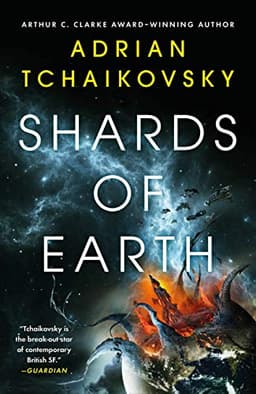
The best place to begin depends on appetite. Children of Time is the fullest statement of his interest in evolution and perspective. Shards of Earth is easier for a reader who wants momentum, banter, and a damaged crew before the larger ideas arrive. Elder Race offers his method in novella form. Readers who start with one should not assume they have found the only Tchaikovsky. His career is compelling precisely because the same ethical curiosity survives repeated changes of scale, genre, and voice.




![Cover of ANTIC LLINATGE [Próxima aparición]](https://covers.openlibrary.org/b/id/13541308-M.jpg)