Should you read Shroud?
What works
Darkness, gravity, instruments, and incompatible perception make every observation provisional; understanding what counts as an individual becomes part of staying alive.
What may not work for you
Technical confinement slows the middle, and the human corporate context is more familiar than the alien intelligence it exploits.
What may test your patience
Long stretches inside the pod depend on readings, hypotheses, and environmental limits rather than visible action.
Does the ending reward the effort?
Yes. The payoff follows from changes in perception and communication, not a sudden translation device or military victory.
Reading Shroud closely
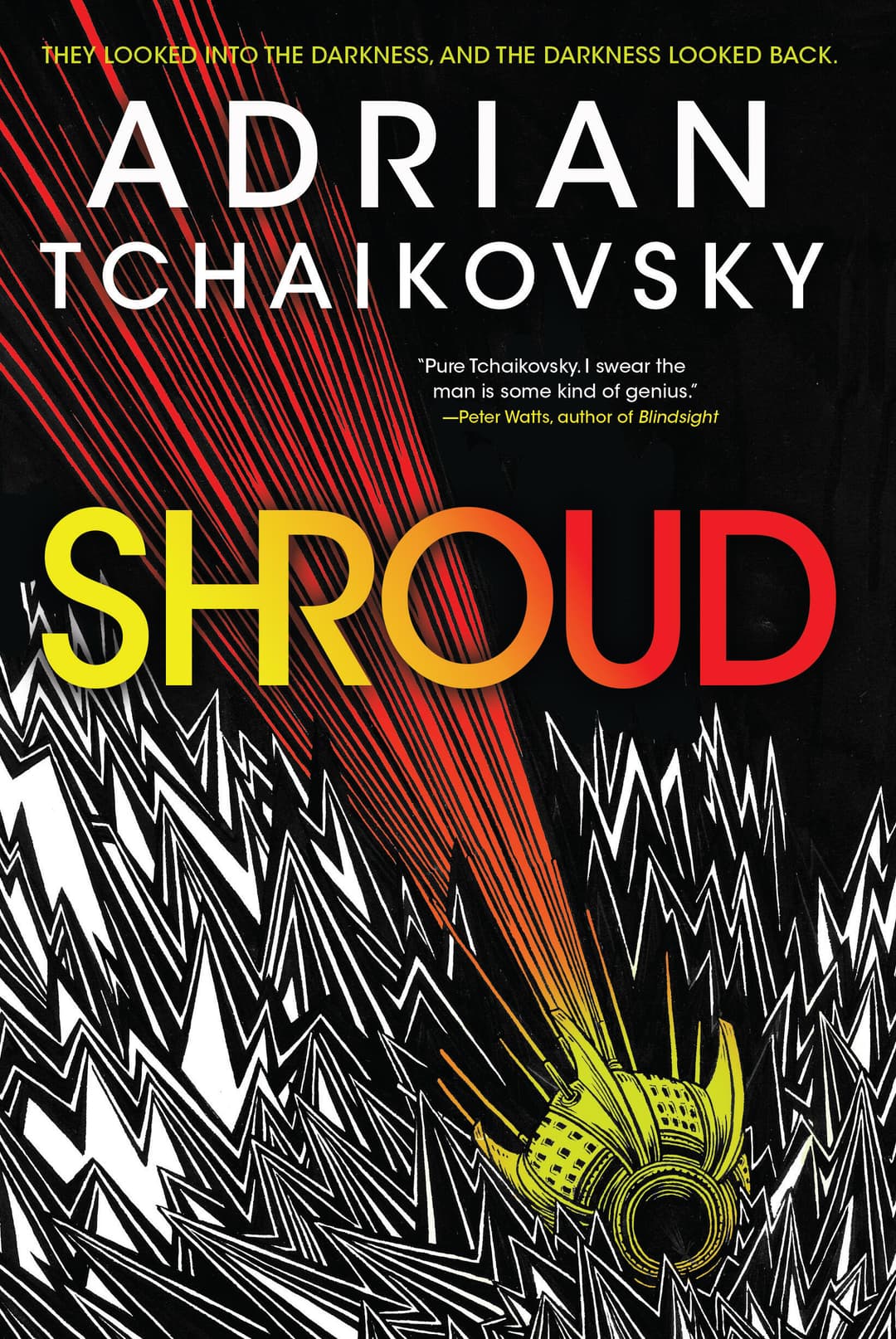
Shroud strands scientists Juna and Mai on a world with crushing gravity, no visible light, and an ecology that communicates across frequencies humans barely understand. The survival problem is immediate, but Adrian Tchaikovsky is just as interested in the danger of assuming that unfamiliar life must think, organize, or recognize intelligence as we do.
The lightless environment makes every observation partial. Juna and Mai depend on instruments and a fragile pod while the life around them is also observing, testing, and learning. That imbalance gives the first-contact story its tension: neither side has a shared language, and even deciding what counts as an individual may be a mistake.
The science is detailed and the journey can feel deliberately claustrophobic, but the density serves the central idea. Shroud is strongest for readers who enjoy alien biology, difficult communication, corporate exploitation, and survival stories where understanding the environment matters more than defeating it.
A genuinely alien point of view
The novel resists giving its extraterrestrial life familiar motives. Perception, memory, and identity work differently on Shroud, so contact becomes an exercise in questioning human categories rather than translating a few words.
Pacing and difficulty
Expect technical explanation, long stretches inside a confined vehicle, and careful attention to ecology. The reward is a world that feels coherent rather than merely strange, though action-first readers may find the middle measured.
Three useful comparisons
Children of Time
Children of Time is broader, more explanatory, and ultimately more hopeful about cross-species understanding.
Best for: Readers who like big evolutionary ideas, nonhuman viewpoints, and long time scales more than a conventional hero's journey.
Children of Ruin
Children of Ruin adds distributed octopus minds and invasive horror within an established series.
Best for: Readers who finished Children of Time and want stranger minds, more horror, and a denser communication problem.
Revelation Space
Revelation Space offers colder Gothic space opera and an archaeological extinction mystery rather than direct ecological contact.
Best for: Patient readers wanting hard science fiction, archaeology, deep time, morally difficult characters, and cosmic danger.