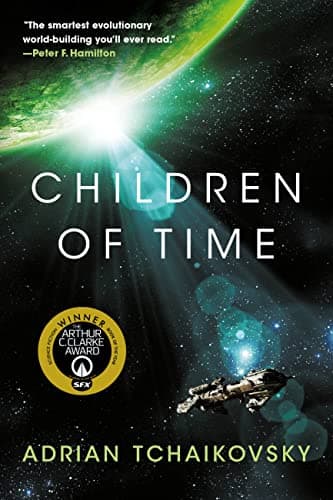
Should you read Children of Time?
What works
The Portiid civilization grows from spider biology instead of wearing human culture as a costume. Webs, vibration, inherited knowledge, sexual dimorphism, and different lifespans shape technology and power in ways that feel surprising but coherent.
What may not work for you
The human crew is thinner than the spider civilization, with several people serving as positions in an argument rather than fully rounded characters. Recycled spider names across generations can also blur together at first.
What may test your patience
The early alternation between a deteriorating ark ship and brief slices of spider evolution delays attachment to either timeline. The structure clicks once recurring names are understood as lineages rather than single individuals.
Does the ending reward the effort?
Yes. The solution is bold, emotionally legible, and prepared by the book's biology rather than introduced as a convenient last-minute answer. It changes the meaning of the conflict without erasing its cost.
Reading Children of Time closely
Children of Time alternates between the remnants of humanity aboard the Gilgamesh and generations of Portia labiata spiders on a terraformed planet. An uplift virus accelerates the spiders' intelligence while their society develops through biology unlike humanity's own.
The enormous time scale never loses its emotional center because scientific discovery, religion, conflict, and cooperation recur through recognizable spider lineages. The eventual contact asks whether intelligence can meet difference without repeating conquest.
Evolution as civilization
Spider anatomy shapes technology, communication, gender, and social power instead of reproducing human culture in disguise.
Three useful comparisons
Children of Ruin
Children of Ruin continues the series with octopus minds and a stronger current of horror. Read it next if the communication problem interested you most, but expect a more fragmented and unsettling structure.
Best for: Readers who finished Children of Time and want stranger minds, more horror, and a denser communication problem.
Revelation Space
Revelation Space offers harder edges, colder characters, and a darker archaeological mystery. Choose it for Gothic space opera and technological dread rather than the cumulative optimism of evolutionary cooperation.
Best for: Patient readers wanting hard science fiction, archaeology, deep time, morally difficult characters, and cosmic danger.
Dune
Dune also makes ecology inseparable from culture and power, but concentrates on one political crisis and a contested messiah. Choose it for dynastic intrigue; choose Children of Time for nonhuman civilization developing across millennia.
Best for: Readers willing to trade immediate intimacy for political, ecological, and religious ideas that become more connected with every chapter.
Make the next decision