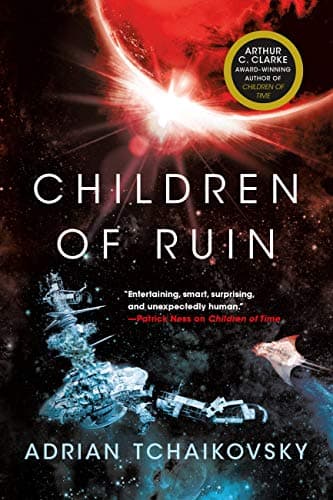
Should you read Children of Ruin?
What works
The octopuses do not think as centralized humans, and their shifting emotional color, limb intelligence, and politics force the narrative to change how intention is described.
What may not work for you
The timelines and returning cast fragment momentum, while the horror thread occasionally overpowers the patient evolutionary development that defines the series.
What may test your patience
Early terraforming history and later expedition threads take time to align, requiring readers to hold several species and eras in mind.
Does the ending reward the effort?
Yes. The climax makes translation, empathy, and biological danger part of the same solution, though the route is more crowded than in book one.
Reading Children of Ruin closely
Children of Ruin follows a new terraforming history in which octopuses become an uplifted civilization while researchers encounter something genuinely alien. Later visitors must interpret both minds before fear and infection destroy every possibility of contact.
The sequel is more fragmented and horror-tinged than Children of Time. Octopus cognition resists centralized intention, while the invasive organism turns the desire to understand others into a terrifying threat.
Thinking without one controlling self
The octopuses' distributed cognition shapes unstable politics and communication, making them more than aquatic humans.
Series order
Read Children of Time first. This book directly develops its civilizations and assumptions about uplift.
Three useful comparisons
Children of Time
Children of Time is cleaner and more cumulative; read it first for the civilizations and emotional foundation.
Best for: Readers who like big evolutionary ideas, nonhuman viewpoints, and long time scales more than a conventional hero's journey.
Shroud
Shroud concentrates first-contact difficulty inside one hostile world and works without series preparation.
Best for: Readers of rigorous first contact, hostile-environment survival, alien cognition, and detailed ecological science fiction.
The Three-Body Problem
Three-Body emphasizes physics, history, and ideological fracture rather than embodied alien viewpoint.
Best for: Readers who enjoy hard science fiction, first contact, conceptual mystery, and political history more than character-led adventure.