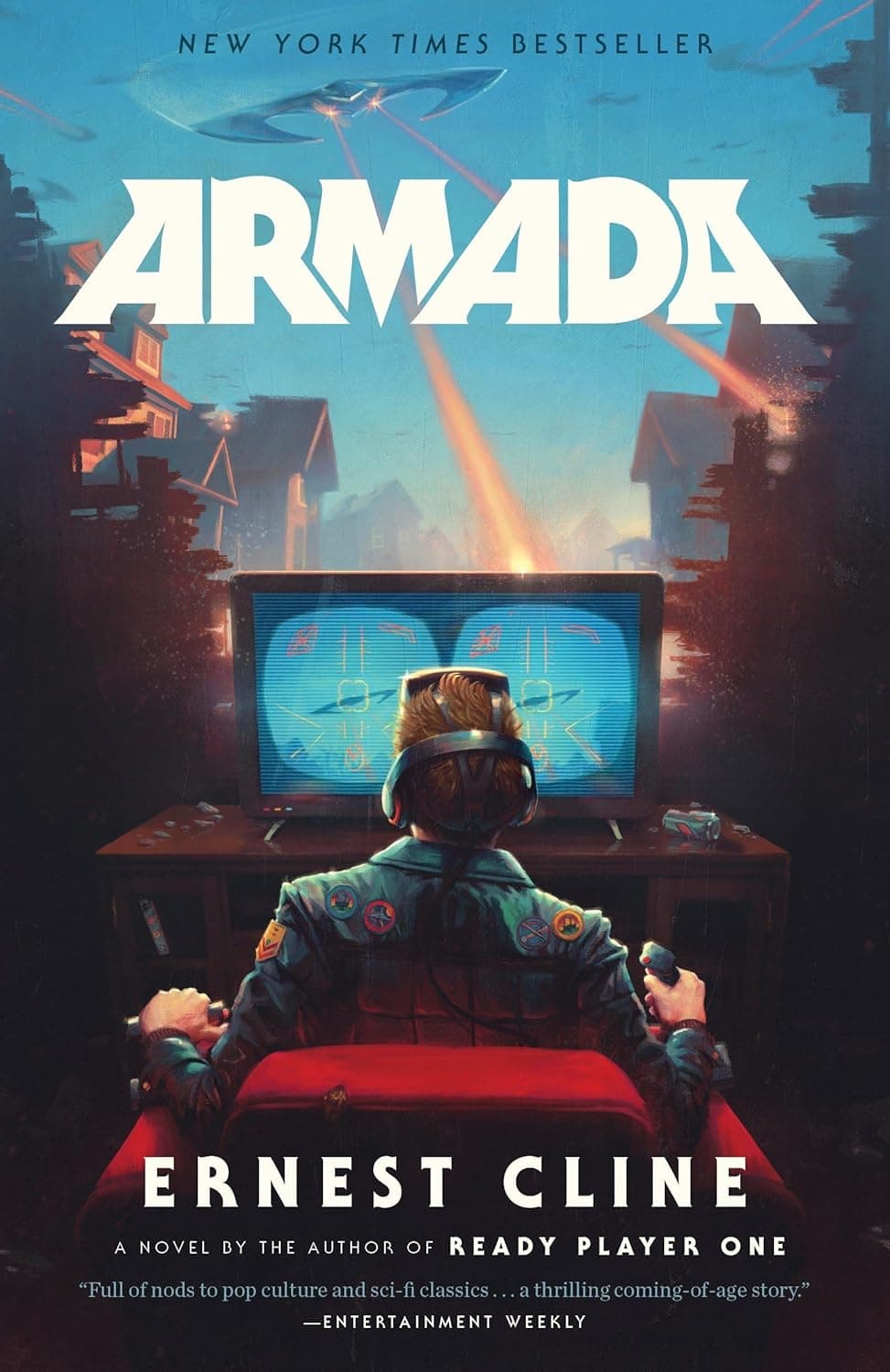
Should you read Armada?
What works
The premise moves rapidly from school frustration to global stakes, and combat knowledge acquired through games becomes an immediately legible skill system.
What may not work for you
The plot leans heavily on familiar invasion stories, supporting relationships are underdeveloped, and major grief and revelation receive little time before the next action beat.
What may test your patience
The opening spends considerable time assuring readers that Zack recognizes the premise's resemblance to older media, which does not make the resemblance less limiting.
Does the ending reward the effort?
The climax answers the conspiracy and completes the mission, but its moral test is introduced too late to carry the philosophical weight intended.
Reading Armada closely
Armada by Ernest Cline follows gamer Zack Lightman, a teenager whose favorite flight simulator turns out to be training for a very real threat. One ordinary school day becomes the start of a global defense effort that suddenly needs his joystick reflexes.
Cline keeps the pacing brisk with short chapters, clear mission objectives, and set pieces that feel like escalating boss fights. The book mixes VR adjacent action with family secrets, high school friction, and questions about escapism versus responsibility. For readers interested in the history that inspired many of its references, the preservation work at The Strong National Museum of Play offers a fun rabbit hole.
Zack's first person narration blends sarcasm, frustration, and genuine excitement, which keeps the tone light even when the stakes rise. Friendships, rivalries, and uneasy alliances give the story a human core, and the emotional beats land hardest when the plot slows down to focus on grief, legacy, and what it means to live up to the stories you admire.
Armada wears its nostalgia openly, with constant nods to arcade classics, science-fiction films, and gaming culture. The references work best for readers who enjoy spotting them and questioning how pop culture shapes Zack's idea of heroism.
Pace, accessibility, and nostalgia
Short chapters, clear mission objectives, and game vocabulary prioritize velocity over atmosphere. The premise is easy to enter, although the opening spends time acknowledging its resemblance to older media rather than escaping that resemblance.
The arcade, science-fiction, and game references are a central part of the appeal rather than background decoration. Readers do not need deep prior knowledge, but they do need to enjoy a reference-heavy voice and pop-culture wish fulfillment.
Why Ready Player One readers may or may not continue
Armada keeps Cline's gamer competence fantasy and reference-driven energy, but replaces Ready Player One's OASIS treasure hunt with alien-war action and a shorter route from school frustration to global stakes.
Choose Armada if the gaming skill, nostalgia, and fast combat mattered most. Stay with Ready Player One if you wanted a more developed puzzle structure, world, and character journey.
Three useful comparisons
Ready Player One
Ready Player One is the stronger choice for readers who want Cline's reference-driven style attached to a more developed puzzle structure and world. Armada swaps the OASIS treasure hunt for faster alien-war action, so readers who enjoyed gamer competence more than puzzle density may prefer it.
Best for: Choose it for a quick virtual-reality quest if heavy 1980s nostalgia and adolescent wish fulfillment sound fun rather than exhausting.
The Martian
The Martian is a better fit if what you want is competence earned through visible scientific constraints and step-by-step problem solving. Armada makes game knowledge immediately useful, but moves faster and spends less time proving how its solutions work.
Best for: Readers who enjoy problem solving, survival logistics, accessible science, and a protagonist who meets disaster with jokes.
The Three-Body Problem
The Three-Body Problem treats alien contact with greater historical and philosophical seriousness, and asks for much more patience with its ideas. Choose Armada for brisk gamer-led action; choose Three-Body for a slower, more unsettling examination of scientific uncertainty.
Best for: Readers who enjoy hard science fiction, first contact, conceptual mystery, and political history more than character-led adventure.