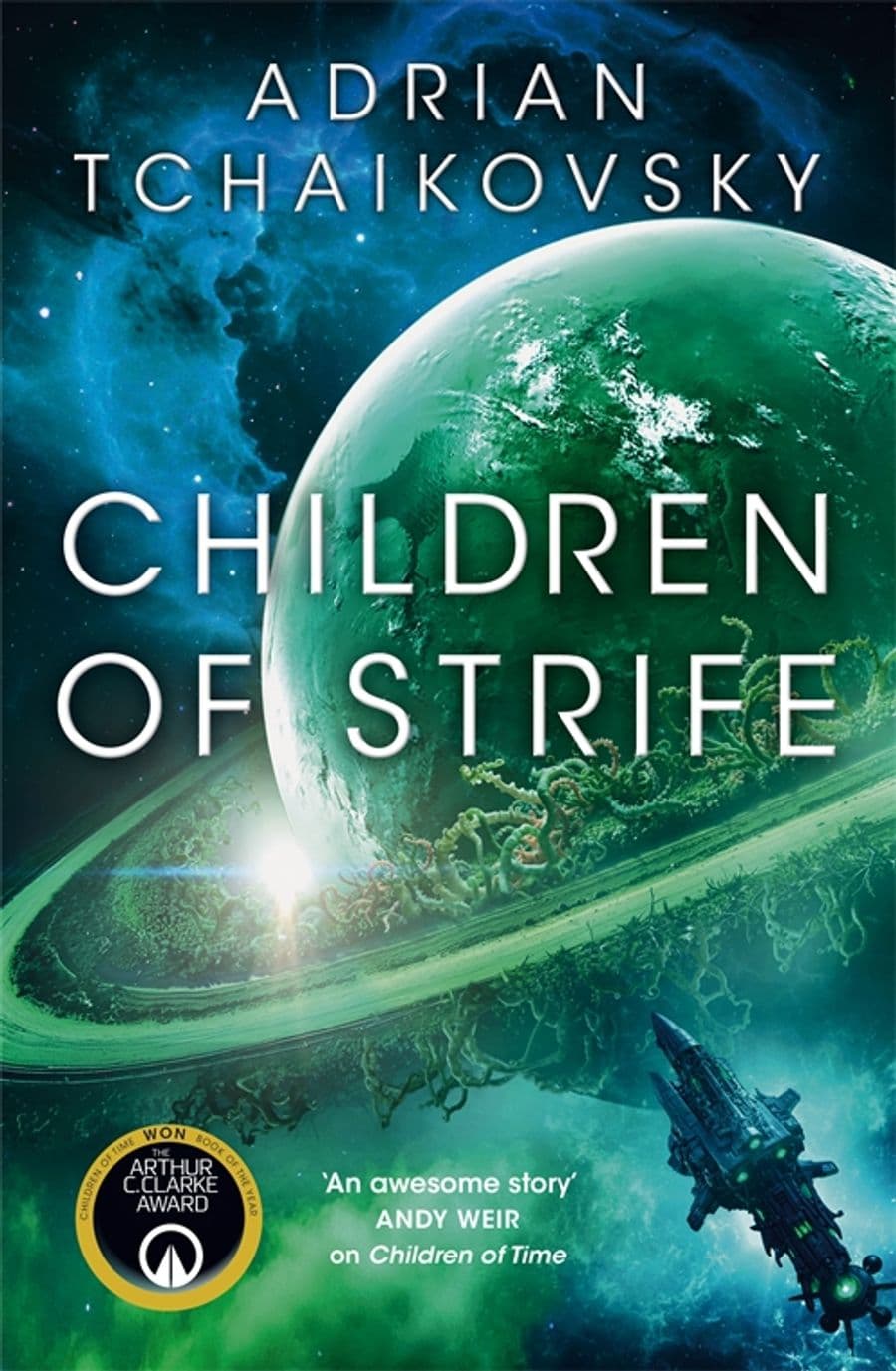
Should you read Children of Strife?
What works
Cato's mantis-shrimp perspective and Kern's long memory keep questions of intelligence, vanity, and designed life from returning to a human default.
What may not work for you
The missing-crew mystery carries more than seven hundred pages, and inherited species, technologies, and debates leave less room for a clean new-reader entry.
What may test your patience
The descent toward the outpost advances through extensive scientific interpretation before the history and present danger align.
Does the ending reward the effort?
The resolution rewards knowledge of the series and its repeated contact failures, though it functions more as another stage in a civilizational argument than a compact adventure payoff.
Reading Children of Strife closely
Children of Strife returns to the long evolutionary history of the Children of Time universe through scientist Alis, mantis-shrimp captain Cato, and the AI Kern. Their research vessel rediscovers a terraforming outpost created by a team whose vanity and conflict left consequences that survived for generations.
When Alis wakes to find most of the crew gone, the remaining group must descend toward a world that once looked like refuge. The search combines a missing-crew mystery with the series' familiar interest in uplift, intelligence, communication, and the unintended societies created when people attempt to design life from above.
At more than seven hundred pages, this is broad, patient science fiction rather than a quick survival adventure. Cato's nonhuman perspective and Kern's long history give the story scale, while Alis brings personal guilt and uncertainty to questions that stretch across civilizations.
A fourth Children of Time frontier
The book builds on the series' accumulated species, technologies, and debates rather than resetting them. Its new outpost becomes another test of whether contact can avoid conquest, projection, and inherited mistakes.
Do you need the earlier books?
Yes. Begin with Children of Time, then read Children of Ruin and Children of Memory. The plot introduces a new crisis, but Kern and the wider civilization carry extensive history into it.
Three useful comparisons
Children of Time
Children of Time remains the cleanest entry and gives one civilization's evolution a stronger structural arc.
Best for: Readers who like big evolutionary ideas, nonhuman viewpoints, and long time scales more than a conventional hero's journey.
Children of Ruin
Children of Ruin introduces stranger cognition and more horror with less accumulated series history.
Best for: Readers who finished Children of Time and want stranger minds, more horror, and a denser communication problem.
Shroud
Shroud offers a standalone, claustrophobic first contact where one alien ecology receives sustained focus.
Best for: Readers of rigorous first contact, hostile-environment survival, alien cognition, and detailed ecological science fiction.