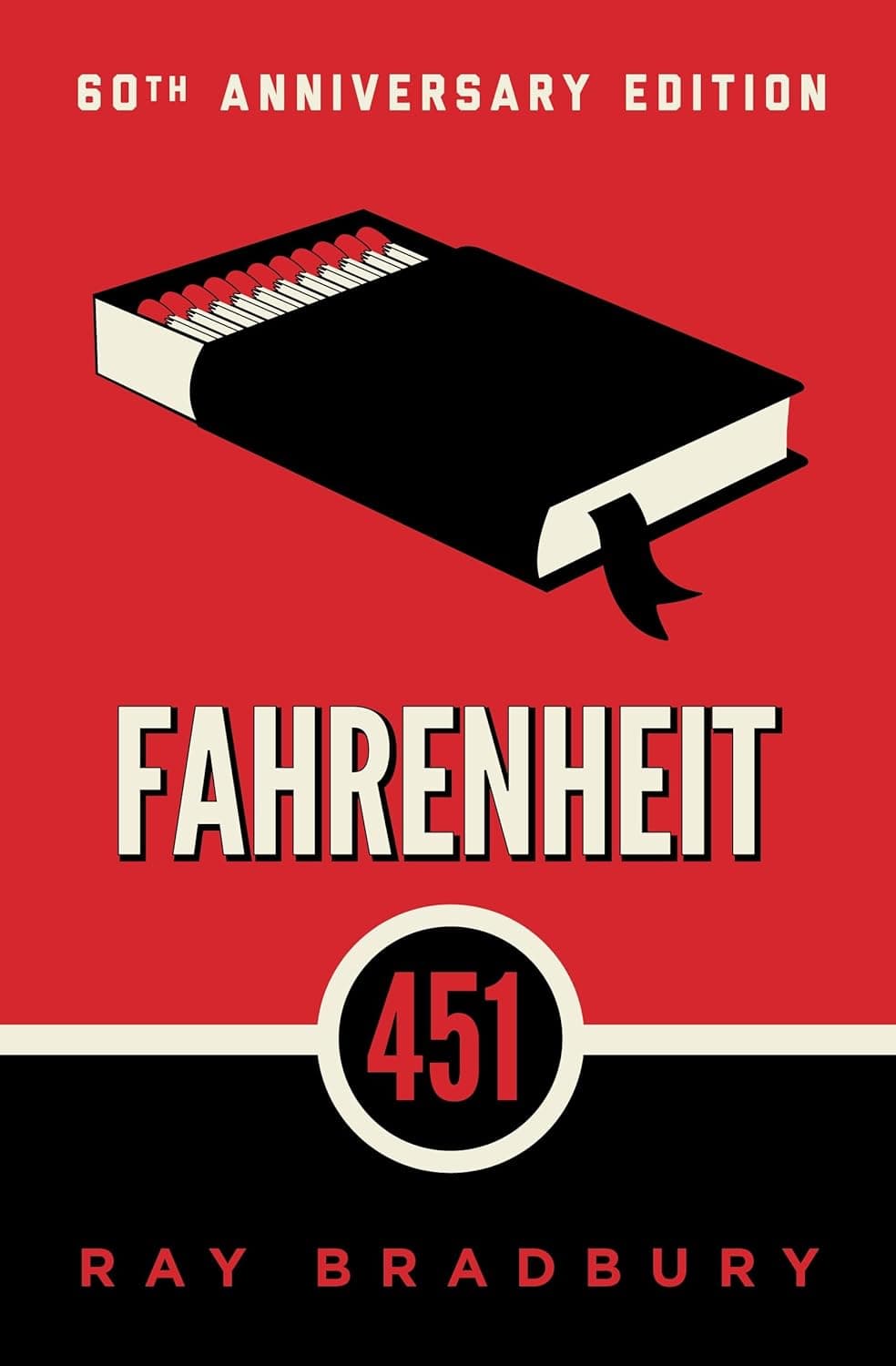
Should you read Fahrenheit 451?
What works
Bradbury understands censorship as a cultural appetite as well as a government policy. The parlour walls, seashell radios, speeding cars, and shortened attention spans make books dangerous because they demand sustained discomfort.
What may not work for you
Montag's transformation is abrupt, and several women exist mainly to awaken or disappoint him. The novel's defense of literature can also become more reverent than analytical.
What may test your patience
The final flight introduces new people and a different rhythm just as the pursuit is peaking. The symbolic turn works, but the transition is less developed than the opening domestic crisis.
Does the ending reward the effort?
Mostly. The conclusion offers a memorable image of preservation and renewal, although it reaches that hope faster than Montag's inner change fully earns.
Reading Fahrenheit 451 closely
Fahrenheit 451 follows fireman Guy Montag, who burns books for a living until small doubts push him to question a society that prefers comfort over curiosity.
Montag's slow awakening drives the story. Routine firehouse raids and staged emergencies give way to private conversations with a curious neighbour and a woman who refuses to abandon her library. Those encounters show how a single uncomfortable question can expose the cracks in an entire system built on distraction.
Bradbury's language mixes surreal, poetic images with blunt warnings about propaganda, passive media, and groupthink. Every alarm, flame, and mechanical hound scene underlines how easy it is to trade reflection for shallow entertainment, a theme that still feels relevant for modern readers and students.
Three useful comparisons
1984
1984 is slower, colder, and more rigorous about political machinery. Choose it for systematic repression; choose Fahrenheit 451 for emotional speed and memorable imagery.
Best for: Readers interested in propaganda, surveillance, political language, and dystopias that offer pressure rather than escapism.
The Book Thief
The Book Thief also treats reading as resistance, but grounds that idea in wartime relationships and a child's developing moral life. It is longer and far more character-centered.
Best for: Best for older teens and adults who want a slow, lyrical wartime novel about a foster family, the uses of language, and the cost of small acts of decency.
The Handmaid's Tale
The Handmaid's Tale uses a fragmented first-person record to show how forbidden language preserves identity. Choose it for bodily politics and memory rather than Bradbury's media-driven parable.
Best for: Readers interested in reproductive control, memory, religious authoritarianism, and narrators whose uncertainty is part of their resistance.
Make the next decision