Portrait of Andy Weir

Author profile

Andy Weir: books, reviews, and where to start

Andy Weir writes survival stories in which calculation, improvisation, and stubborn humor turn scientific knowledge into the action of the plot rather than background decoration.

Born 1972writernovelist

Biography and criticism

Engineering the modern science-fiction page-turner

Weir's route from programmer to self-published novelist shaped both his practical heroes and his unusually direct relationship with readers who enjoy checking the math.

A programmer publishes chapter by chapter

Andy Weir was born in 1972 and grew up in California in a family connected to science and engineering. He worked as a software programmer, including periods in the video-game industry, and wrote fiction outside that career. The Martian began as chapters posted on his website. Readers interested in orbital mechanics, botany, life support, and the practical details of a Mars mission sent corrections. Weir revised in conversation with that audience before releasing an inexpensive self-published ebook in 2011.

The path from web serial to major publication is central to the book's texture. The Martian explains because explanation is part of the entertainment, and it assumes a reader who may enjoy testing a solution. Crown acquired the novel, which was republished in 2014, and Ridley Scott's film adaptation followed in 2015. The success turned Weir into a full-time novelist, but it also created a demanding expectation: every later book would be measured against a survival puzzle whose apparent simplicity concealed extremely careful pacing.

Why problem solving becomes suspense

Mark Watney survives because he breaks impossible danger into answerable questions. Oxygen, calories, distance, communication, and equipment failure become narrative units. Weir generally explains the relevant science before complicating it, so the reader receives both comprehension and surprise. A solution often creates the next problem. That rhythm is more important than technical display. It gives the story the alternating pressure and release of a thriller.

Humor keeps competence from becoming solemn. Watney jokes because the log requires a voice and because panic would consume time. The limitation is monotony. Nearly every crisis is processed through the same glib intelligence, which narrows the emotional range and can make severe isolation feel tidier than it should. Weir's dialogue also tends to distribute similar comic timing across different characters. The machinery is often more individually rendered than the people operating it.

Artemis and the problem of changing scale

Artemis moves from one isolated survivor to a lunar city, a criminal scheme, and a larger supporting cast. It retains Weir's interest in how infrastructure works, especially welding, pressure, transport, and the economics of a settlement. The book is less successful at voice. Jazz Bashara's narration can feel like a constructed performance of irreverence, and the caper exposes weaknesses in social texture that The Martian's isolation naturally concealed.

The novel is still instructive within Weir's career. It shows that his strongest plots require more than scientific accuracy. They need a clear bond between knowledge and immediate consequence. When a calculation determines whether a character breathes, explanation becomes urgent. When worldbuilding pauses to prove that a lunar economy has been considered, the same explanatory impulse can slow the human story.

Project Hail Mary adds another mind

Project Hail Mary returns to isolated problem solving but changes its emotional structure through first contact. Ryland Grace awakens without his memories aboard a mission he does not yet understand. The memory device lets Weir stage discovery twice: Grace solves the ship's immediate conditions while reconstructing the compromises that placed him there. More importantly, the encounter with Rocky turns science into a relationship. Measurement, experiment, language, and shared work become acts of trust.

The novel retains visible contrivances and familiar jokes, yet it expands Weir's idea of competence. Grace cannot survive through individual cleverness alone. He must learn what another intelligence perceives, needs, and risks. This makes Project Hail Mary the strongest starting point for readers who want emotion beside the puzzles. The Martian remains the cleaner demonstration of Weir's method. Together they define his achievement: making scientific reasoning legible enough to produce popular suspense without pretending that knowledge removes danger.

The books in context

How the work develops on the page

These notes connect the biography to specific choices in the books. Each title links to the full spoiler-free review.

This review of The Martian highlights how Andy Weir builds his survival story: astronaut Mark Watney is stranded on Mars and has to stay alive using chemistry, engineering, and a stubborn sense of humour.

Weir's research powers every solution. Readers follow detailed plans for water recycling, potato farming, and improvised communications, all explained in clear, conversational language that turns STEM concepts into page turning problem solving.

Chapters move between Watney's log entries on Mars and NASA teams racing against orbital windows on Earth. That structure keeps the pacing tight and shows how individual grit and large scale collaboration work together during a crisis.

If you want a science heavy survival story that still feels fun, you can grab The Martian on Amazon and explore more titles in our science fiction collection for your next space themed reading weekend.

Weir alternates Watney's informal logs with concise third-person scenes on Earth, using the change in voice to widen information while preserving isolation.

Each solution changes the inventory, risk, and next problem, so calculations and improvised repairs function as plot rather than detachable technical display.

Watney jokes through nearly every register of danger, and the supporting cast often exists to solve or communicate a problem rather than develop beyond the mission.

Long calculations about food, travel, and equipment may tire readers who do not enjoy procedural detail, particularly when a new failure resets recent progress.

Yes. The rescue uses skills, institutional coordination, and constraints established throughout the novel, producing excitement without abandoning its engineering logic.

Project Hail Mary adds first contact, memory structure, and a warmer partnership while keeping the same problem-solving engine.

Jurassic Park also makes technical explanation suspenseful, but focuses on interacting failures and institutional denial rather than one engineer's competence.

Pick a favourite engineering fix from the book and talk about why it works and what could go wrong.

Read the complete review

This spoiler free Project Hail Mary review follows Ryland Grace, a middle school science teacher who wakes up alone on a spacecraft with no memory of who he is or why he is in deep space. As he slowly pieces together his past, he discovers that the Sun is being drained by a mysterious microbe and that his mission is the one thin line between Earth and a slow moving extinction event. The opening reads like a locked room mystery inside a lab in zero gravity, then widens into a save the world story where each clue is rooted in physics, biology and engineering rather than convenient magic solutions.

Structurally, the book alternates between Grace solving problems in the present and flashbacks that fill in how the Hail Mary mission came to exist. Andy Weir leans hard into step by step problem solving, the same way he did in The Martian, but here the stakes jump from one stranded astronaut to an entire species. You watch Grace run experiments, crunch numbers and improvise new tools, yet the narration stays chatty and darkly funny, so long explanations of orbital mechanics or alien microbiology stay readable even if you skim a formula or two.

The emotional hook arrives when Grace realizes he is not the only one fighting this cosmic threat. Without spoiling the exact circumstances, his partnership with an alien engineer becomes the heart of the book. Their attempts to communicate, trade technology and work around wildly different biology turn what could have been a cold puzzle box into a story about trust across species. If you are curious about how the ending lands, think less in terms of a shock twist and more in terms of a hard won choice about loyalty and home that makes sense of everything Grace has learned along the way.

By the time the last chapters arrive, most readers will already have guessed the rough shape of Grace's final decision, yet the details still feel tense and strangely hopeful. The conclusion answers the big plot questions in a clean way while leaving just enough room to imagine what comes next for both civilizations. The novel has already picked up major recognition, including a Dragon Award win and a Hugo nomination, and it now has a film adaptation on the way, which makes sense given how visual and suspenseful many set pieces feel. Project Hail Mary combines a tight thriller plot, meticulous science and a surprisingly warm friendship into one of the more accessible hard science fiction novels of the last decade. If you want more grounded survival storytelling after this, you can move straight into our review of The Martian and compare how Weir handles isolation, humor and problem solving on Mars instead of deep space.

Ryland and Rocky must build trust through measurement, language, shared experiments, and incompatible biology, making communication itself the novel's best scientific problem.

The flashbacks arrange moral information conveniently, several Earth characters are broad, and Ryland's humor sometimes sounds indistinguishable from Mark Watney's.

The opening amnesia sequence delays context while repeating laboratory inference; it becomes rewarding once the second narrative and mission stakes are established.

Yes. The final choice grows from the central relationship and gives competence a moral purpose beyond completing the assigned mission.

A locked room mystery in space that slowly turns into a first contact story without losing the survival tension.

A central friendship between a human scientist and an alien engineer that keeps the book from feeling like pure math homework.

Hard science fiction puzzles that feel grounded enough to be believable yet playful enough that non scientists can follow the gist.

Read the complete review

Where to begin

A good place to start with Andy Weir

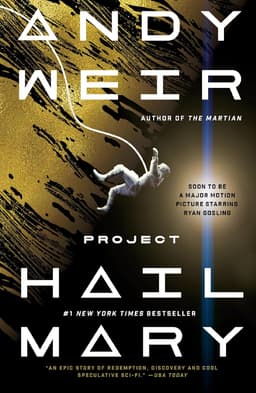
Cover of Project Hail Mary
Our highest-rated review

Project Hail Mary

4.6 / 5

Project Hail Mary expands Weir's puzzle-box science with a genuinely affecting first-contact partnership, though its memory device is visibly engineered for revelation.

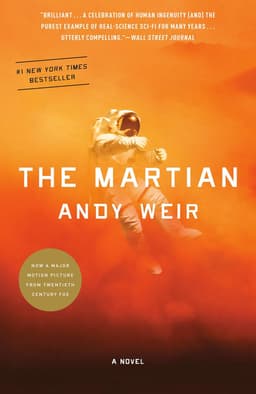
Cover of The Martian
Another route in

The Martian

4.5 / 5

The Martian turns engineering into suspense with unusual clarity, even when Mark Watney's relentlessly glib voice narrows the emotional range.

Reading order and buying help

Reading guides featuring Andy Weir

Idea-led readingAccessible books, big ideasAuthor discoveryAuthors with similar reading profilesReading dataReading pace by genreHopeful science fictionOptimistic science fiction

Bibliography

Books by Andy Weir

Reviewed titles open directly on Book Review Guide. Other editions and works remain marked until a full review is published.

Cover unavailable

Not reviewed yet

The Egg

Bibliographic records: Open Library.

Reviewed bibliography

Andy Weir books reviewed here

Every title below has a complete, spoiler-free review. Scores are our editorial ratings, not visitor averages.

Cover of The Martian

20144.5 / 5

The Martian

Hard Science Fiction Survival Review

The Martian turns engineering into suspense with unusual clarity, even when Mark Watney's relentlessly glib voice narrows the emotional range.

Read the review
See current formats on Amazon

As an Amazon Associate, I earn from qualifying purchases.