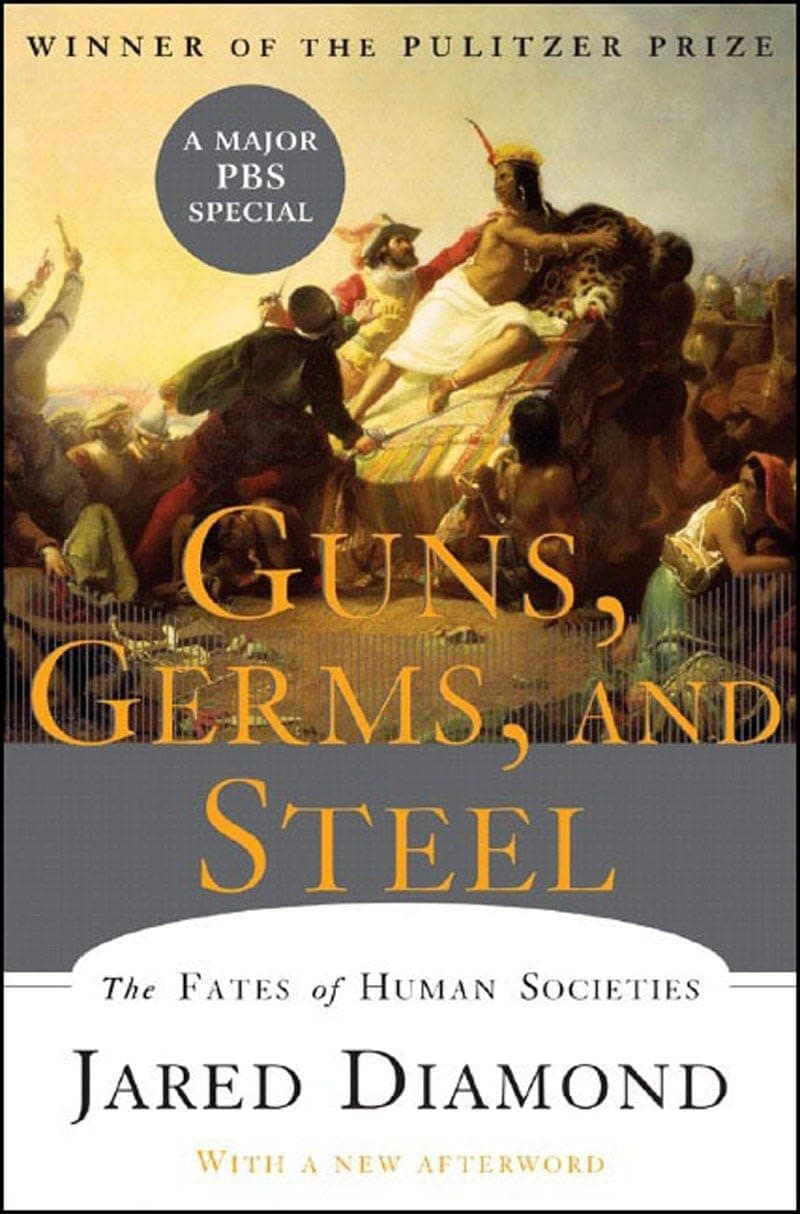
Should you read Guns, Germs, and Steel?
What works
Diamond redirects attention from supposed innate superiority toward crops, animals, disease, geography, and diffusion, giving readers a material vocabulary for unequal development.
What may not work for you
The continental scale suppresses local agency and historical contingency, and specialists have challenged both factual selections and the deterministic force of the thesis.
What may test your patience
Repeated comparisons of agriculture, axes, and domesticable species make the argument clear but also make the long middle feel like accumulated proof of one already familiar pattern.
Does the ending reward the effort?
The conclusion is strongest as a research agenda and weakest when it presents broad environmental causes as sufficient explanation for complex political history.
Reading Guns, Germs, and Steel closely
Guns, Germs, and Steel begins with Yali asking why some societies ended up with more cargo, weapons, and political power than others. Diamond rejects explanations based on intelligence or cultural worth and argues that geography, climate, and biology shaped which regions moved first into farming, cities, and complex states.
Across the chapters, he links domesticable plants and large animals, continental east west axes, and the spread of epidemic diseases into one long argument about how food surpluses and germs create advantages. The famous guns, germs, and steel are the visible tools of conquest, but the book keeps pointing back to deeper environmental conditions that made it easier for Eurasia and North Africa to develop those tools first.
Reading Guns, Germs, and Steel feels like following a long lecture that keeps circling back to the same question from different angles. The tone is accessible but dense, with plenty of case studies and summaries, so it suits readers who like narrative non fiction and are comfortable with a few slow chapters in exchange for a clear, memorable framework.
The book's influence makes its weaknesses important. Its environmental explanations can leave too little room for politics, culture, contingency, and human agency. That debate explains both why this Pulitzer-winning book became a common introduction to global inequality and why historians, anthropologists, and Indigenous scholars have challenged it.
Three useful comparisons
Sapiens
Sapiens is more agile and philosophical; Diamond is more material and evidentiary, though both compress enormous differences.
Best for: General readers wanting a provocative historical overview and willing to verify its broad claims through more focused scholarship.
SPQR: A History of Ancient Rome
SPQR narrows its scope and shows its source problems, offering a better model of how historical uncertainty appears on the page.
Best for: General readers wanting a serious Roman history attentive to evidence, citizenship, and social life rather than only battles.
The Selfish Gene
The Selfish Gene is narrower and more explicit about mechanism, useful if you want science without Diamond's civilizational scale.
Best for: General readers ready for a substantial, argument-driven introduction to evolution from the gene's-eye view.