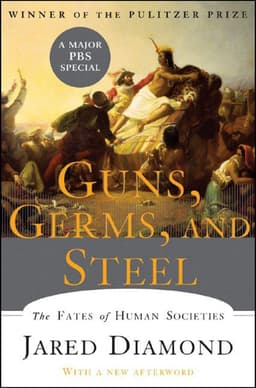
Author profile
Jared Diamond: books, reviews, and where to start
Jared Diamond writes large-scale accounts of human societies through geography, ecology, disease, and technology, producing influential syntheses that require close attention to what scale leaves out.
Biography and criticism
The explanatory power and danger of the continental map
Diamond's work made environmental history widely discussable. Its reach also drew sustained criticism from historians and anthropologists concerned with determinism, evidence, and local complexity.
From physiology and birds to human history
Jared Diamond was born in Boston in 1937, trained in physiology, and developed parallel expertise in ecology and ornithology, including fieldwork in New Guinea. The Third Chimpanzee and Guns, Germs, and Steel brought biological and geographical explanation into accounts of human inequality. The latter asks why some societies acquired technologies and political power that enabled conquest, rejecting racial superiority as an answer.
Diamond emphasizes domesticable plants and animals, continental axes, disease environments, and the diffusion of innovations. The framework is memorable because it relocates explanation from presumed differences in intelligence to material conditions.
Synthesis under criticism
Guns, Germs, and Steel won major awards and reached a vast readership, but scholars have criticized its broad causal claims, selective evidence, and limited treatment of contingency, culture, and agency. Collapse similarly uses comparative cases to discuss environmental choices while risking stories neater than contested histories permit.
Diamond writes clearly and builds chapters around large questions. That clarity should initiate further reading, not close inquiry. Begin with Guns, Germs, and Steel to understand his influence, then pair it with regional histories and Indigenous scholarship. The responsible use of Diamond is comparative: ask what geography helps explain, then identify the political decisions and historical actors the continental map made too small to see.
The books in context
How the work develops on the page
These notes connect the biography to specific choices in the books. Each title links to the full spoiler-free review.
This spoiler free review of Guns, Germs, and Steel starts with the moment that frames the whole book: Jared Diamond trying to answer Yali's question about why some societies ended up with more cargo, guns, and political power than others. Instead of blaming intelligence or culture, Diamond offers a big picture story where geography, climate, and biology shape which regions move first into farming, cities, and complex states.
Across the chapters, he links domesticable plants and large animals, continental east west axes, and the spread of epidemic diseases into one long argument about how food surpluses and germs create advantages. The famous guns, germs, and steel are the visible tools of conquest, but the book keeps pointing back to deeper environmental conditions that made it easier for Eurasia and North Africa to develop those tools first.
Reading Guns, Germs, and Steel feels like following a long lecture that keeps circling back to the same question from different angles. The tone is accessible but dense, with plenty of case studies and summaries, so it suits readers who like narrative non fiction and are comfortable with a few slow chapters in exchange for a clear, memorable framework.
This review also takes time to touch on the big debates around the book, including whether Guns, Germs, and Steel is still accurate and how fair its environmental explanations are to politics, culture, and human agency. The goal is to help you see both why this Pulitzer winning book became a classic introduction to global inequality and what its biggest critics want you to keep in mind while you read.
Diamond begins with a large question, breaks it into comparative variables, and returns repeatedly to maps and inventories; the method is transparent even when the synthesis overreaches.
Diamond redirects attention from supposed innate superiority toward crops, animals, disease, geography, and diffusion, giving readers a material vocabulary for unequal development.
The continental scale suppresses local agency and historical contingency, and specialists have challenged both factual selections and the deterministic force of the thesis.
Repeated comparisons of agriculture, axes, and domesticable species make the argument clear but also make the long middle feel like accumulated proof of one already familiar pattern.
The conclusion is strongest as a research agenda and weakest when it presents broad environmental causes as sufficient explanation for complex political history.
SPQR narrows its scope and shows its source problems, offering a better model of how historical uncertainty appears on the page.
The Selfish Gene is narrower and more explicit about mechanism, useful if you want science without Diamond's civilizational scale.
Asks why some societies ended up with more cargo, guns, and political power, then answers with geography, agriculture, and disease rather than genetics or culture.
Walks through plant and animal domestication, continental geography, and epidemic germs in clear, story driven chapters that connect ecology to world history.
Offers a simple, memorable framework that makes global inequality easier to talk about, even if you later move on to more specialised or critical studies.
Readers who enjoy big picture non fiction that blends geography, biology, and history into one long narrative about how the modern world came to look the way it does.
Fans of books like Sapiens, Homo Deus, Cosmos, or SPQR who want another grand explanation for why some regions developed guns, ships, and dense cities earlier than others.
Students and book clubs ready to discuss both what the book explains well and where historians and anthropologists argue that it oversimplifies or leans too hard on environmental determinism.
Trace how Diamond moves from Yali's question in New Guinea to his final chapters on global dominance, and note which steps in his argument feel strongest or most speculative to you.
Compare the role of geography in this book with arguments that emphasise institutions, politics, or economics, and discuss how each approach would explain the same historical examples.
List the main criticisms of Guns, Germs, and Steel that you encounter in other sources and decide whether they change how confidently you would recommend the book to someone new to world history.
This Guns, Germs, and Steel review looks at Jared Diamond's big picture argument that geography, agriculture, and disease shaped which societies ended up with guns, ships, and political power.
Read the complete reviewWhere to begin
A good place to start with Jared Diamond

Guns, Germs, and Steel
3.9 / 5Guns, Germs, and Steel asks an important anti-racist historical question, but its environmental explanation often becomes too totalizing for the evidence it summarizes.
Bibliography
Books by Jared Diamond
Reviewed titles open directly on Book Review Guide. Other editions and works remain marked until a full review is published.

Reviewed
Guns, Germs, and Steel
Not reviewed yet
Upheaval: Turning Points for Nations in Crisis

Not reviewed yet
Why Is Sex Fun?
Not reviewed yet
Upheaval
Not reviewed yet
The Third Chimpanzee
Not reviewed yet
International Cosmos Prize, 1998
Not reviewed yet
Seventeenth epode
Not reviewed yet
ha-Shimpanzah ha-shelishi
Not reviewed yet
The world until yesterday
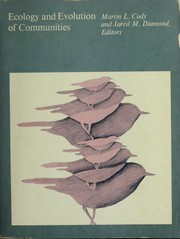
Not reviewed yet
Ecology and evolution of communities
Not reviewed yet
Abstracts of papers presented at the 1990 meeting on Evolution
Not reviewed yet
FROM EGALITARIANISM TO KLEPTOCRACY [SOC 205]
Not reviewed yet
Arm und Reich

Not reviewed yet
Avifauna of the Eastern Highlands of New Guinea
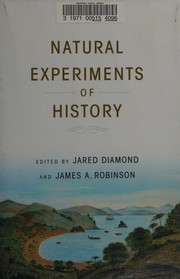
Not reviewed yet
Natural experiments of history
Not reviewed yet
Last Tree on Easter Island

Not reviewed yet
Vermächtnis
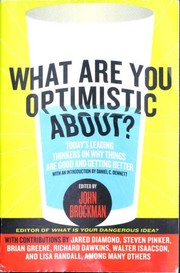
Not reviewed yet
What Are You Optimistic About?
Not reviewed yet
COLLISION AT CAJAMARCA [SOC 205]

Not reviewed yet
The Birds of Northern Melanesia
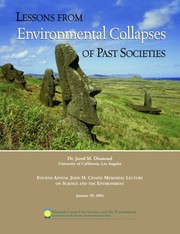
Not reviewed yet
Lessons from environmental collapses of past societies
Not reviewed yet
Roots Of Psychology
Not reviewed yet
Wild and the Weird
Not reviewed yet
Birds of Karkar and Bagabag Islands, New Guinea
Not reviewed yet
Horace
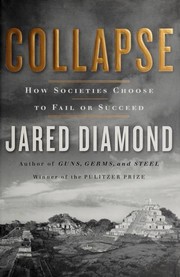
Not reviewed yet
Collapse
Not reviewed yet
Jared M. Diamond
Not reviewed yet
Inventer pour le XXIe siècle
Not reviewed yet
Community ecology
Bibliographic records: Open Library.
Reviewed bibliography
Jared Diamond books reviewed here
Every title below has a complete, spoiler-free review. Scores are our editorial ratings, not visitor averages.

20173.9 / 5
Guns, Germs, and Steel
The Fates of Human Societies
Guns, Germs, and Steel asks an important anti-racist historical question, but its environmental explanation often becomes too totalizing for the evidence it summarizes.
As an Amazon Associate, I earn from qualifying purchases.
Keep exploring