
Author profile
Yuval Noah Harari: books, reviews, and where to start
Yuval Noah Harari writes panoramic nonfiction about humanity, technology, and shared stories, offering memorable frameworks whose scale is both their appeal and their most important limitation.
Biography and criticism
The power and risk of the enormous synthesis
Harari can make millennia feel narratively connected. Readers should use that clarity as a map of questions, not a replacement for the specialized scholarship compressed beneath it.
A medieval historian writes a global survey
Yuval Noah Harari was born in Israel in 1976, studied history at the Hebrew University of Jerusalem, and completed doctoral work at Oxford on medieval military history. The lectures that developed into Sapiens moved far beyond that specialty, tracing Homo sapiens through cognitive, agricultural, scientific, and political transformations. Hebrew publication came before the English edition turned the book into a global bestseller.
Harari's central skill is compression through a strong proposition. He describes money, states, corporations, and religions as intersubjective stories capable of coordinating strangers. The framework is memorable because it links institutions usually taught separately. It can also flatten differences and make contested claims sound more settled than the evidence warrants.
Future speculation and public warning
Homo Deus projects from history toward data, biotechnology, algorithmic authority, and the possible erosion of humanist assumptions. 21 Lessons for the 21st Century gathers current political and technological concerns in a more modular form. Harari writes with calm confidence and uses striking examples, but the smooth narrative may hide leaps between description and speculation.
He has become a public commentator on artificial intelligence, war, democracy, and global cooperation. Readers should begin with Sapiens for the method and pair it with specialist histories, particularly where it makes claims about archaeology, anthropology, or biology. Harari is valuable not because every synthesis holds. He is valuable because he makes large questions discussable, provided the reader keeps asking what the elegant story had to leave out.
The books in context
How the work develops on the page
These notes connect the biography to specific choices in the books. Each title links to the full spoiler-free review.
This review of Sapiens focuses on the core idea behind the book: Yuval Noah Harari races through human history, from early hunters to hyper connected societies, asking how stories, money, and power reshape what it means to be human.
The book is framed around three major revolutions – cognitive, agricultural, and scientific – and shows how each one changed the way people work together, fight, trade, and search for happiness. Readers curious about accessible popular science can jump from Sapiens into resources in our popular science guide.
Harari is at his best when he traces how shared myths, laws, and institutions hold huge groups together. Even when you disagree with his conclusions, the clear structure and bold claims make Sapiens a great starting point for debates about progress, inequality, and the future of our species.
If you are in the mood for a big picture look at human history, you can add Sapiens to your Amazon cart and pair it with other nonfiction on our shelves to follow how Homo sapiens might change in the next century.
Harari opens chapters with vivid scenarios, names a large pattern, and moves rapidly across centuries to support it; the clarity is the source of both the book's appeal and its overreach.
Harari connects money, religion, empire, agriculture, and institutions through the idea of shared imagined orders, giving general readers a memorable framework for comparison.
The book moves from disputed evidence to confident conclusion too quickly, compressing regional difference and scholarly uncertainty into elegant global statements.
The later march through capitalism, science, and happiness broadens the argument faster than it deepens it, and the provocations begin to resemble conclusions in search of support.
The closing questions are useful but speculative; they work as an invitation to further reading, not as proof that the book's grand narrative has resolved its tensions.
Guns, Germs, and Steel focuses more narrowly on geography and unequal development, but carries its own major scholarly controversies.
Homo Deus extends Harari's method into possible futures and is even more speculative; read it for questions, not forecasts.
SPQR sacrifices universal scope for close attention to sources, uncertainty, citizenship, and one civilization; choose it for firmer historical method.
Sapiens races through human history from early hunters to hyper connected modern societies with bold, debate ready ideas.
Read the complete reviewThis review of Homo Deus looks at how Yuval Noah Harari turns from the past to the future: the book explores possible paths for humanity, from data driven decision making to bioengineered elites and new conceptions of religion and meaning.
Harari organises the book around emerging "religions" of data, biotechnology, and algorithms. Concepts like dataism, artificial intelligence, and genetic engineering are introduced in accessible language before he pushes them toward sharp ethical questions and thought experiments.
The narrative dips into capitalism, neuroscience, religion, and computer science, linking them into a single, very readable argument. Readers who have already explored human history in our Sapiens review will find Homo Deus a natural follow up focused on what might come next.
If you are curious about the future of humanity, you can add Homo Deus to your Amazon list and use it as a starting point for conversations about AI, biotechnology, and the limits of humanism.
Harari builds smooth chains from historical anecdote to technological possibility, often crossing from description into prediction without changing rhetorical tone.
The book identifies a genuine tension between humanist ideas of autonomous choice and technologies designed to predict, influence, or redesign behavior.
Dataism becomes an overly elastic label, future scenarios slide between metaphor and forecast, and historical simplifications carry more weight than they should.
The middle recaps themes from Sapiens before the future-facing argument fully begins; readers familiar with the earlier book may feel they are waiting for the promised subject.
The final questions are sharper than the predictions that precede them. The book closes productively if treated as provocation rather than a reliable map of what comes next.
21 Lessons narrows the horizon to present political and technological problems, though it remains broad rather than practical.
Read the complete reviewThis spoiler free review of 21 Lessons for the 21st Century by Yuval Noah Harari looks at how this essay collection tries to guide readers through the noise of AI headlines, political shocks, and constant notifications. Instead of telling a single story, Harari picks 21 questions about power, technology, and meaning and offers short, sharp lessons for people who feel lost in the twenty first century news cycle.
The book is organised into five parts that cover the technological challenge, the political challenge, despair and hope, truth, and resilience. Rather than offering a strict 21 Lessons for the 21st Century summary by chapter, this review groups the ideas by those parts so you can see how Harari moves from automation and artificial intelligence to nationalism, religion, fake news, education, and meditation. Chapters about work, data, and liberty focus on what happens when algorithms know us better than we know ourselves, while political essays probe nationalism, immigration, and global cooperation.
Later sections tackle terrorism, war, and despair, then turn to truth in an age of propaganda, post truth, and science fiction, before ending with resilience through education and mindfulness. Harari is strongest when he connects abstract trends like AI, big data, and ecological risk to everyday questions about jobs, news feeds, and anxiety. Some arguments feel broad or provocative on purpose, yet even when you disagree the framework makes it easier to talk about what really worries you in the twenty first century.
If you have already read Sapiens and Homo Deus and are wondering whether 21 Lessons for the 21st Century is worth reading after Sapiens, the answer depends on what you want next. It adds less new history or far future speculation and more present day guidance about how to think, vote, work, and raise children in a world of constant disruption. Read in that light, as a set of main ideas explained for citizens rather than as a prediction book, it rounds out the trilogy by sitting between past and future at the messy point where decisions are actually made.
Taken together, Sapiens shows where we came from, Homo Deus explores where we might be going, and 21 Lessons for the 21st Century tries to decide what to do right now with that knowledge. A simple best order to read Sapiens, Homo Deus, 21 Lessons is to start with Sapiens for background, move to Homo Deus for future possibilities, then finish with 21 Lessons as a practical, conversation ready guide to the present. If you want that kind of grounded companion, you can pick up 21 Lessons for the 21st Century on Amazon and then revisit our Sapiens review and Homo Deus review to see how Harari’s three books speak to each other.
Harari writes in short argumentative arcs built around a paradox, contemporary example, and broad historical analogy; the method is readable but can make complexity look settled.
Read the complete reviewWhere to begin
A good place to start with Yuval Noah Harari
Sapiens
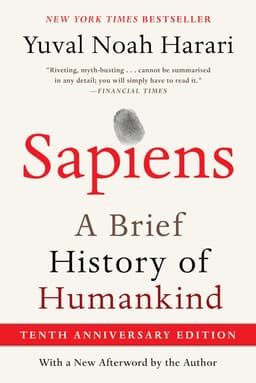
4 / 5Sapiens is a stimulating map of human history and a poor substitute for the specialized scholarship behind many of its largest claims.
21 Lessons for the 21st Century
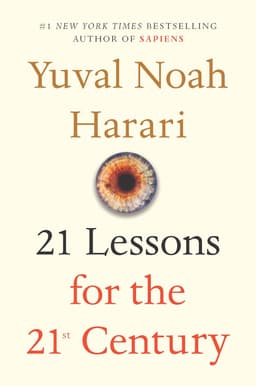
3.7 / 521 Lessons is an intelligent collection of public questions whose breadth makes it easier to browse than to trust as one sustained argument.
Homo Deus
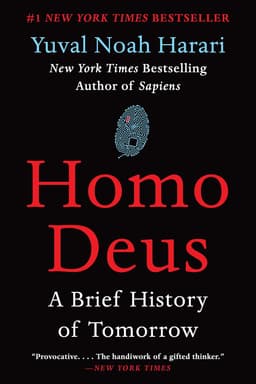
3.8 / 5Homo Deus poses worthwhile questions about data, biotechnology, and human authority, but presents speculation with more confidence than its evidence can bear.
Bibliography
Books by Yuval Noah Harari
Reviewed titles open directly on Book Review Guide. Other editions and works remain marked until a full review is published.

Reviewed
Sapiens

Reviewed
21 Lessons for the 21st Century

Reviewed
Homo Deus

Not reviewed yet
Nexus
Not reviewed yet
Unstoppable Us Volume 3
Not reviewed yet
Unstoppable Us Volume 2

Not reviewed yet
Unstoppable Us
Not reviewed yet
Ch'oyech'ŭk
Not reviewed yet
Untitled 332537
Not reviewed yet
ha-Kishuf ha-Yehudi ha-ḳadum
Not reviewed yet
Unstoppable Us : the Two-Book Boxed Set
Not reviewed yet
From Animals into Gods

Not reviewed yet
Large human history
Not reviewed yet
HOMO DEUS. BREVE HISTORIA DEL MAÑANA
Not reviewed yet
A brief history of humankind in the Israel Museum, Jerusalem

Not reviewed yet
Estuche Harari

Not reviewed yet
Homo Deus:the Brief History of Tomorrow

Not reviewed yet
Homo Deus. Una breu història del demà

Not reviewed yet
Operaciones especiales en la edad de la caballería
Not reviewed yet
De animales a dioses
Not reviewed yet
Animal Liberation Now

Not reviewed yet
Homo Deus. Scurta Istorie A Viitorului
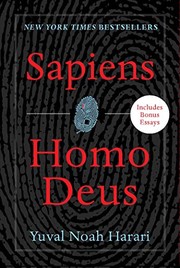
Not reviewed yet
Sapiens/Homo Deus Box Set w/Bonus Material
Not reviewed yet
Homo Deus - Tamil

Not reviewed yet
Yuval Noah Harari Seti
Not reviewed yet
Ultimate Experience
Not reviewed yet
Diario de Cómo Conquistamos la Tierra / Unstoppable Us, Volume 1
Not reviewed yet
Renaissance Military Memoirs

Not reviewed yet
Imparables
Not reviewed yet
Unstoppable Us, Volume 1
Not reviewed yet
Sapiens and Homo Deus : the e-Book Collection

Not reviewed yet
Obra completa : Estuche con
Not reviewed yet
Clean Meat
Not reviewed yet
Romeo Alaeff : in der Fremde
Not reviewed yet
Money

Not reviewed yet
Why We Love Dogs, Eat Pigs, and Wear Cows
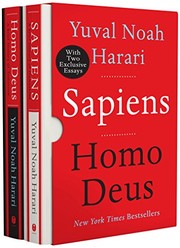
Not reviewed yet
Sapiens/Homo Deus box set

Not reviewed yet
The ultimate experience
Not reviewed yet
Ḳitsur toldot ha-enoshut
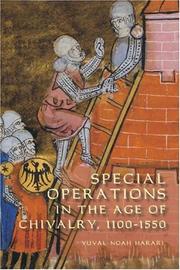
Bibliographic records: Open Library.
Reviewed bibliography
Yuval Noah Harari books reviewed here
Every title below has a complete, spoiler-free review. Scores are our editorial ratings, not visitor averages.

20183.7 / 5
21 Lessons for the 21st Century
Essays on Technology, Politics, and Meaning
21 Lessons is an intelligent collection of public questions whose breadth makes it easier to browse than to trust as one sustained argument.
As an Amazon Associate, I earn from qualifying purchases.

20173.8 / 5
Homo Deus
A Brief History of Tomorrow Review
Homo Deus poses worthwhile questions about data, biotechnology, and human authority, but presents speculation with more confidence than its evidence can bear.
As an Amazon Associate, I earn from qualifying purchases.

20114 / 5
Sapiens
A Brief History of Humankind Review
Sapiens is a stimulating map of human history and a poor substitute for the specialized scholarship behind many of its largest claims.
As an Amazon Associate, I earn from qualifying purchases.
Keep exploring