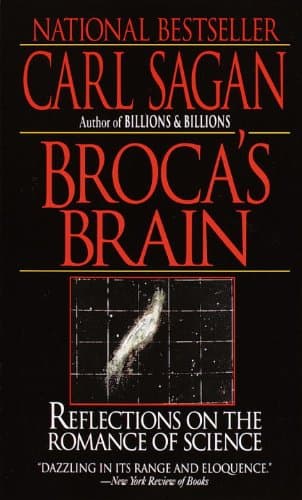
Should you read Broca's Brain?
What works
The strongest essays begin from something concrete, such as a preserved brain, a planetary claim, or a public controversy, and ask how knowledge was produced, which prejudices shaped it, and what scientists owe the people affected by their work.
What may not work for you
The range prevents a cumulative argument, planetary information reflects the late 1970s, and several debates receive far more space than a modern reader needs. Essays written for different occasions also repeat Sagan's defense of inquiry and extraterrestrial possibility.
What may test your patience
The collection becomes most demanding when long technical discussions of planetary or fringe-science claims follow the title essay's vivid human history. The detail matters as an example of testing, but readers may lose the thematic line if they expect each chapter to retain the same intimacy.
Does the ending reward the effort?
As an essay collection it accumulates rather than resolves. The best reward is a clearer view of Sagan's method: understand why a claim attracts people, reconstruct the evidence carefully, and make scientific authority answerable rather than merely replacing one priesthood with another.
Reading Broca's Brain closely
Broca's Brain takes its title from Paul Broca's preserved brain, encountered by Sagan among jars in a Paris collection. Broca helped establish links between language and particular brain regions, yet his career also carried assumptions about race, sex, and hierarchy that science once treated as respectable. The object therefore becomes more than a curiosity. It asks how knowledge should remember the insight and the prejudice of the person who produced it, and which certainties of our own period may look indefensible later.
The collection expands from that artifact into planetary exploration, the search for extraterrestrial life, robotics, UFO claims, Immanuel Velikovsky, theology, and the public romance of science. Its range is genuine rather than decorative. Sagan keeps returning to one question: how can people preserve the desire behind an extraordinary claim while testing the claim hard enough to distinguish discovery from error? He is usually more interested in why an idea attracts intelligent believers than in scoring an easy victory over them.
That method is clearest in the skeptical essays. Sagan reconstructs claims, identifies what evidence would follow if they were true, and compares those predictions with observation. He also insists that scientific institutions do not earn immunity from criticism. If research becomes a closed priesthood, the public has fewer tools to detect abuse and scientists lose the trust needed for difficult collective decisions. The obligation to explain is treated as part of professional responsibility, not publicity performed after the real work.
The book is not equally alive throughout. Planetary facts, mission expectations, computing examples, and debates from the 1970s need historical framing. A controversy that once demanded pages of technical rebuttal may now feel remote. Because the essays originated in different settings, arguments about wonder, extraterrestrial intelligence, and open inquiry return several times without building one continuous case. Readers expecting the designed sweep of Cosmos will feel the seams.
Those seams are also why Broca's Brain is useful after reading Sagan's major books. It shows the public thinker at work on particular problems rather than presenting one polished grand tour. The title essay remains excellent, the discussion of scientific accountability is unusually direct, and the mixture of skepticism with imaginative generosity anticipates The Demon-Haunted World. Read selectively at first. Begin with Broca, public understanding of science, fringe claims, and extraterrestrial intelligence, then return to the technical planetary pieces when their historical context interests you.
Paul Broca cannot be reduced to hero or villain
The preserved brain holds scientific achievement beside the prejudices that shaped nineteenth-century measurement and interpretation. Sagan neither discards Broca's discoveries nor treats later moral criticism as irrelevant to scientific history.
Skepticism begins by understanding the attraction
The essays do not improve a weak claim before knocking it down, but they do ask why it matters to people and what evidence it would predict. That patience makes criticism more useful than ridicule and exposes exactly where a proposal stops matching observation.
Scientists owe the public an explanation
Freedom of inquiry brings a duty to discuss methods, consequences, uncertainty, and possible abuse. Public literacy is not an optional celebration of science. It is part of the protection against authority becoming unaccountable.
Three useful comparisons
The Demon-Haunted World
The Demon-Haunted World turns Sagan's skeptical method into a far more coherent and practical book, with clearer tools for evaluating claims. Broca's Brain is the better choice for readers who enjoy intellectual history and planetary essays. Newcomers should begin with Demon-Haunted World and return here for the earlier workshop.
Best for: Come for practical critical-thinking tools and a patient response to misinformation, pseudoscience, and scientific illiteracy.
The Dragons of Eden
The Dragons of Eden pursues one large speculative question about the evolution of intelligence, while Broca's Brain changes subject and evidentiary scale from essay to essay. Dragons requires more correction from current neuroscience. Broca is easier to sample and more revealing about Sagan's habits as a public critic.
Best for: Readers interested in the history of popular neuroscience, evolution, dreams, intelligence, and scientific speculation who are willing to check major brain claims against current research.
Cosmos
Cosmos gives history, astronomy, evolution, and responsibility a designed narrative arc and is much more satisfying as one complete reading experience. Broca's Brain preserves the uneven energy of a working essayist responding to particular artifacts and controversies. Choose Cosmos for synthesis and Broca for range, friction, and historical context.
Best for: Curious general readers and older teens wanting a humane, accessible route into astronomy, scientific history, and cosmic perspective.
Make the next decision