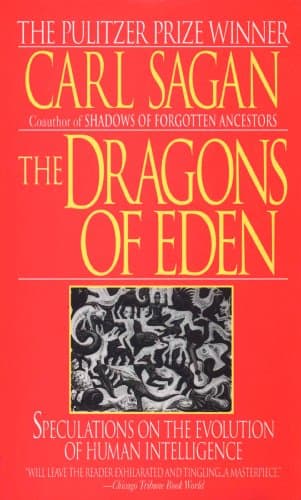
Should you read The Dragons of Eden?
What works
Sagan connects evolution, childhood, dreams, animal intelligence, myth, language, and computing without pretending that human thought appeared outside biological history. He repeatedly labels speculation and makes difficult questions inviting to a general reader.
What may not work for you
The triune-brain framework and several claims about hemispheres, instinct, memory, and cultural development have aged badly or become oversimplifications. Some comparisons move from suggestive resemblance to evolutionary explanation faster than the evidence can support.
What may test your patience
The extended anatomical survey and the sequence of speculative analogies in the middle require more caution than momentum. Readers must keep separating established observation, a once-influential model, and Sagan's own proposal instead of accepting the smooth prose as one level of certainty.
Does the ending reward the effort?
There is no single thesis to close like a narrative, but the final movement toward other intelligences and future minds expands the inquiry without claiming that human cognition is evolution's destination. The openness fits the book better than a tidy theory would.
Reading The Dragons of Eden closely
The Dragons of Eden is Carl Sagan's attempt to tell a connected story about the evolution of intelligence using the evidence and models available in the mid-1970s. He moves from the increasing complexity of nervous systems to childhood development, dreams, animal cognition, language, myth, and artificial intelligence. The ambition is exhilarating. Human thought is never presented as a substance dropped into nature from elsewhere. It is a biological achievement with deep ancestry, constraints, and possible relatives.
The subtitle matters: these are speculations. Sagan states that many proposals should be tested and may be disproved. The modern difficulty is that the prose can make different levels of confidence feel equally fluent. The triune-brain model associated with Paul MacLean supplies a major organizing idea, dividing functions among reptilian, paleomammalian, and neomammalian layers. Contemporary neuroscience treats that evolutionary ladder as a serious oversimplification. Brain regions did not arrive as three clean, independently operating minds stacked through time.
Other sections remain stimulating even when their conclusions need revision. Dreams become a possible theater for conflicts among older and newer systems. Childhood is discussed as a compressed route through capacities shaped across evolution. Sagan compares human intelligence with apes, cetaceans, and machines, widening the question beyond a ranking designed to keep our species alone at the top. The analogies invite inquiry, but several cultural and psychological claims travel farther than the evidence shown on the page.
The book also bears the assumptions of its period. Discussions of sex differences, hemispheric specialization, instinct, and social development require current context. A reader should not use it as an introductory neuroscience textbook or quote its brain anatomy without verification. Its Pulitzer Prize recognizes the power of its nonfiction writing, not permanent scientific correctness. The value now is partly historical: it records what an unusually gifted science communicator believed could be responsibly imagined at a particular moment.
Read The Dragons of Eden after Cosmos, not before it. Cosmos offers a broader and more durable example of Sagan's method. This book is for readers specifically interested in mind, evolution, and the history of popular neuroscience. Pair it with current work on comparative cognition and brain evolution, and keep a simple margin code for observation, accepted model, and speculation. With those protections, the book becomes more interesting rather than less. You can watch science moving, see why an elegant framework once attracted intelligent people, and practice the revision Sagan himself said experiment must permit.
The triune brain is history, not a current map
Sagan uses MacLean's framework to explain conflict among instinct, emotion, and reason. Modern evolutionary neuroscience does not support that clean three-layer progression. Treat the model as evidence of the book's intellectual moment and verify any anatomical claim before repeating it.
Speculation is part of the method
The book is strongest when a bold analogy generates a testable question rather than posing as an answer. Sagan openly accepts that experiment may overturn his ideas. Readers must keep his qualifiers visible when the surrounding rhetoric makes a proposal feel compelling.
Intelligence is not reserved for one species
Apes, cetaceans, other animals, and machines complicate a simple ladder with humans at the summit. Some particular comparisons have aged, but the refusal to define intelligence solely by resemblance to educated adult humans remains productive.
Three useful comparisons
The Selfish Gene
The Selfish Gene develops one evolutionary framework more rigorously and remains closer to mechanisms of selection, although its metaphors also need careful handling. Choose Dawkins for sustained biological argument. Choose Dragons for a wider, more speculative tour through brains, dreams, culture, animals, and machines.
Best for: General readers ready for a substantial, argument-driven introduction to evolution from the gene's-eye view.
Cosmos
Cosmos is broader, more historically cohesive, and the much safer first Sagan book today. Its astronomy has dated details, but its central explanatory structure remains stronger. Dragons is the specialist choice when the evolution of intelligence matters enough that you will also investigate where modern neuroscience has rejected its organizing models.
Best for: Curious general readers and older teens wanting a humane, accessible route into astronomy, scientific history, and cosmic perspective.
Broca's Brain
Broca's Brain ranges across independent essays and is more explicit about scientific responsibility, public criticism, and the history attached to physical objects. Dragons attempts one connected account of intelligence. Choose Broca for variety and skepticism, or Dragons for a sustained but scientifically older argument about the mind.
Best for: Readers who already enjoy Sagan and want essays on scientific history, planetary exploration, pseudoscience, intelligence, and the obligation to explain research to the public.
Make the next decision