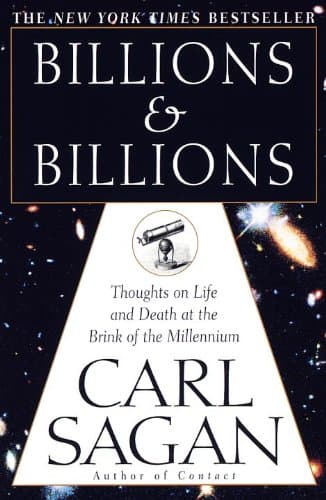
Should you read Billions and Billions?
What works
Sagan makes exponential growth, environmental risk, nuclear danger, and probability understandable without treating measurement as morally sufficient. The late personal chapters show the same habits of honesty applied to love, illness, and the limits of a single life.
What may not work for you
The collection crosses subjects so quickly that some ethical and political positions receive more clarity than depth. Several policy examples belong specifically to the 1990s, and the tone can shift abruptly from public argument to intimate testimony.
What may test your patience
The central policy essays accumulate hazards, treaties, technologies, and moral claims without the narrative continuity of Cosmos. Reading one or two at a time preserves their distinctions and prevents the urgency from flattening into a single repeated warning.
Does the ending reward the effort?
Completely. Sagan's account of illness refuses both false certainty and emotional detachment, and Ann Druyan's epilogue records his death without betraying that standard. The close is painful because the intellectual position and the marriage are allowed to remain one lived commitment.
Reading Billions and Billions closely
Billions and Billions opens by reclaiming a phrase associated with Carl Sagan even though he did not use it as the television catchphrase people remember. The joke becomes a lesson in scale. A billion cannot be pictured as a pile, but notation and exponential reasoning let human minds work with quantities far beyond direct experience. Sagan then asks what happens when political and environmental choices involve exactly those scales, while public language remains vague enough to hide the difference between a large problem and a rapidly multiplying one.
The middle essays move through population, energy, climate, ozone, nuclear danger, abortion, war, and the possibility of international cooperation. The subjects are not equally developed, and some policy details belong specifically to the 1990s. What unifies the strongest pieces is the refusal to treat measurement as an answer by itself. Numbers expose consequences and probabilities; they do not decide which risks may be imposed on other people. Sagan keeps asking for an ethical position that remains answerable to physical reality.
His public method is clearest when opposing sides rely on slogans. He looks for shared premises, separates empirical claims from moral claims, and tries to identify where uncertainty genuinely limits a conclusion. The approach can feel too compressed on subjects whose histories and inequalities need more room. It is still more valuable than pretending that scientific authority makes a difficult policy choice politically neutral. Sagan wants evidence to discipline conviction, including his own.
The final chapters change the book. Sagan writes about love, his illness, treatment, the possibility of death, and the emotional temptation to convert hope into assurance. He does not describe skepticism as fearlessness. He and Ann Druyan want him to live, pursue every rational medical option, and refuse to claim knowledge they do not possess. The abstract defense of honest uncertainty becomes intimate when certainty would be most comforting.
Ann Druyan's epilogue records Sagan's death and the life around it with extraordinary restraint. It does not turn loss into proof of a hidden order or pretend that disbelief makes grief easier. The result is one of the most moving endings in popular science because the marriage and the method are not separated. Billions and Billions is not the best first Sagan book; Cosmos and The Demon-Haunted World explain his public project more completely. It is the right later book for readers who want to see that project carried to the edge of one life.
Large numbers require moral clarity
Exponential notation makes scale manageable, but calculation also reveals who will bear a delayed or distributed cost. Sagan moves from arithmetic to policy because environmental and military risks become easier to ignore when nobody translates their magnitude into consequences.
Evidence cannot make values disappear
Science can estimate a risk, test a causal claim, or expose a false premise. It cannot decide by measurement alone which burdens are just. The essays are strongest when they preserve that boundary without allowing values to ignore facts.
The final chapters test the whole method
Illness creates every emotional reason to demand certainty. Sagan's refusal to manufacture it is not coldness. His hope, treatment, fear, marriage, and skepticism remain present together, and Druyan's epilogue honors that difficult consistency.
Three useful comparisons
Pale Blue Dot
Pale Blue Dot builds one sustained argument from planetary exploration toward long-term survival and is the stronger book for space policy. Billions and Billions is more varied and more personal, moving among environmental risk, war, ethics, illness, and love. Choose it when Sagan's final human perspective matters more than a cosmic tour.
Best for: Readers interested in space exploration, planetary science, and the moral implications of seeing Earth as one vulnerable world.
The Demon-Haunted World
The Demon-Haunted World offers the clearer practical method for testing claims and understanding why public skepticism matters. Billions and Billions assumes much of that outlook and applies it to late-century dangers and private mortality. Read Demon first for tools, then Billions for the person trying to live consistently with them.
Best for: Come for practical critical-thinking tools and a patient response to misinformation, pseudoscience, and scientific illiteracy.
Cosmos
Cosmos is Sagan's expansive invitation and remains the best first book for most readers. Billions and Billions is the farewell: shorter essays, more immediate policy questions, and a final movement that cannot be separated from his death. The two books frame his catalog better than either can substitute for the other.
Best for: Curious general readers and older teens wanting a humane, accessible route into astronomy, scientific history, and cosmic perspective.
Make the next decision