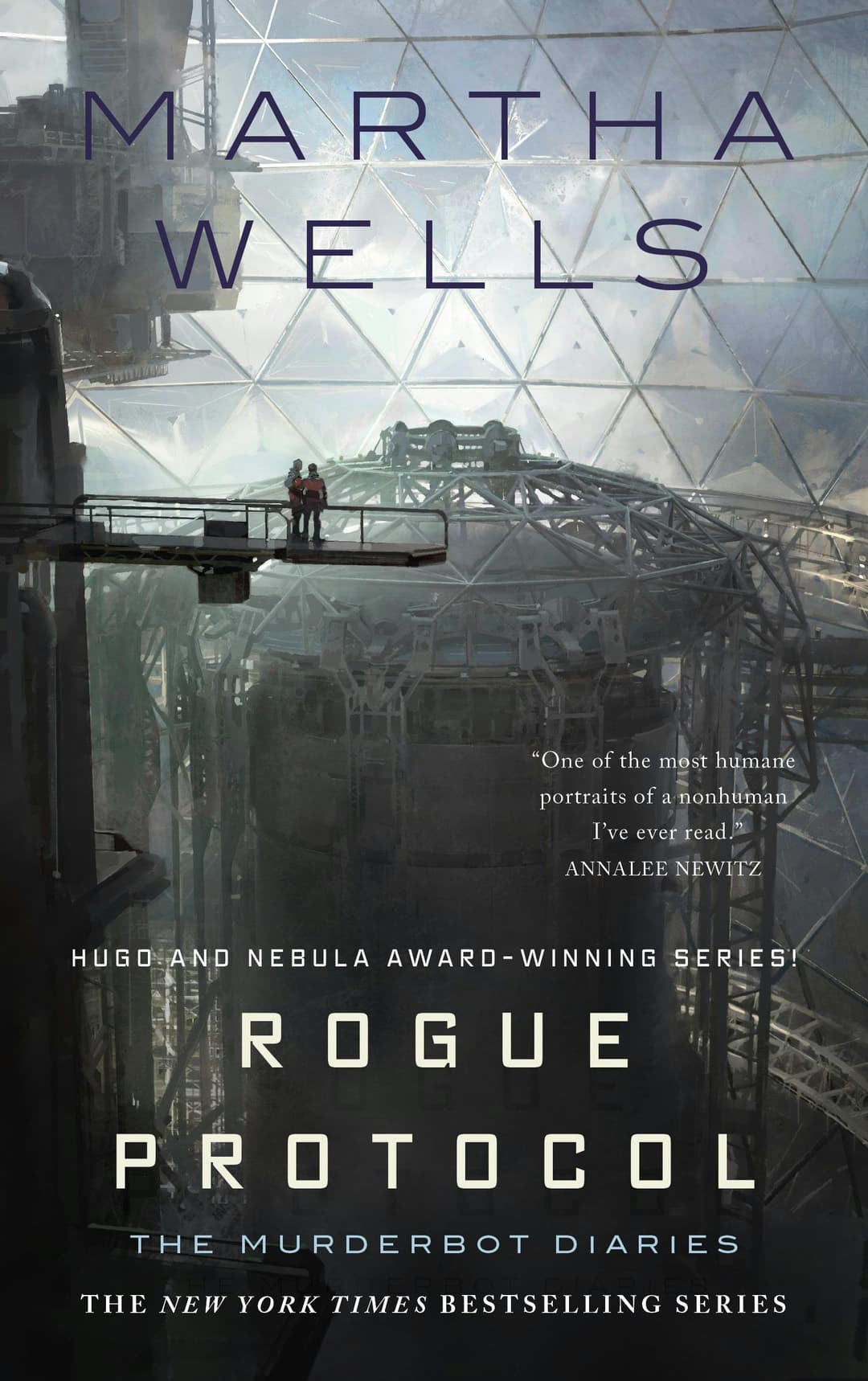
Should you read Rogue Protocol?
What works
Miki is neither a smaller Murderbot nor a joke about naive machines. Its openness creates a real disagreement about humans, ownership, and protection. The abandoned Milu facility also gives Wells a useful mix of industrial hazards, hidden evidence, and competing security systems.
What may not work for you
The physical layout of the facility becomes difficult to picture during the longer action sequence, and most of the GoodNightLander team remain functional roles. GrayCris provides continuity, but the corporate evidence hunt has begun to feel like connective tissue between more personal encounters.
What may test your patience
The middle asks readers to track drones, barriers, environmental failures, and several groups moving through the same complex. The emotional line remains clear, but the exact tactical geography sometimes does not.
Does the ending reward the effort?
Yes, especially at the character level. The conclusion does not transform the GrayCris case, but it forces Murderbot to confront the cost of dismissing another construct's attachment as mere programming.
Reading Rogue Protocol closely
Murderbot travels to Milu, an abandoned terraforming facility connected to GrayCris. It wants evidence that might protect Dr. Mensah, although admitting that motive would require acknowledging an ongoing attachment. The unofficial investigation means entering a site with a legitimate assessment team while hiding both its identity and the fact that it is operating without a governor module.
The team brings Miki, a human-form bot that openly trusts and likes its people. Murderbot initially reads that bond as proof that Miki is naive and controlled. Wells never makes the contrast simple. Miki's affection may be shaped by its role, but Murderbot's suspicion is equally shaped by exploitation. Each machine sees a danger the other has learned not to expect.
Milu works well as a hostile setting. A supposedly inactive complex contains damaged systems, concealed activity, and several kinds of access that Murderbot can exploit through the feed. The action becomes crowded when drones, barriers, humans, and bots move through overlapping spaces. The emotional objective, keeping Miki alive without respecting its judgment, is easier to follow than every corridor.
The GrayCris thread supplies a reason for the infiltration but remains less compelling than the character encounter. Evidence is an abstract prize compared with watching Murderbot decide whether another construct's attachment is merely programming. The GoodNightLander members are decent and vulnerable, yet the novella gives them too little room to become as distinct as the Preservation clients.
Rogue Protocol is therefore a slightly uneven but essential third step in the opening arc. It advances the corporate case, delivers an effective facility thriller, and leaves Murderbot with an experience it cannot file under irritation. Its final emotional blow works because the narration has spent the whole book insisting that Miki misunderstands the world.
Miki challenges suspicion from the opposite side
ART challenged Murderbot through superior control and secrecy. Miki challenges it by being sincere. The resulting conflict is not about which machine is smarter, but whether trust is always evidence of coercion or sometimes a chosen way of living.
Milu is a layered security problem
The terraforming site has an official status, a hidden use, and physical hazards that do not respect either story. Murderbot must interpret corporate records while treating doors, drones, feeds, and environmental controls as active participants in the investigation.
Protection can become condescension
Murderbot wants to save Miki while dismissing its beliefs about the humans around it. The novella makes that contradiction uncomfortable: recognizing another construct as a person includes taking its attachments seriously, even when experience makes those attachments look dangerous.
Three useful comparisons
Artificial Condition
Artificial Condition gives Murderbot a machine intelligence that is more powerful, secretive, and socially aggressive than it is. Rogue Protocol reverses the pressure through Miki, whose openness looks dangerously innocent. Choose Artificial Condition for verbal sparring and memory; choose Rogue Protocol for a sadder argument about trust and ownership.
Best for: Readers who liked All Systems Red's dry first-person voice and want more interior depth, a memorable machine friendship, a compact mystery, and a clearer look at how Murderbot interprets its own autonomy.
Platform Decay
Both stories send Murderbot into a hostile corporate facility with people it did not originally consider its responsibility. Platform Decay carries the weight of a much longer series and a more complicated rescue. Rogue Protocol is shorter, more linear, and centered on the contrast between two security machines.
Best for: Murderbot readers wanting a contained rescue, corporate danger, anxious humor, children in peril, and incremental emotional growth rather than a fresh entry point.
The Andromeda Strain
The Andromeda Strain maps every procedure inside a sealed scientific complex and treats human error as part of the system. Rogue Protocol is less interested in procedural realism than in viewpoint. Its abandoned facility matters because Murderbot can inhabit cameras, drones, and security architecture while still misunderstanding another person.
Best for: Hard-edged outbreak science fiction for anyone who values laboratory procedure and containment systems over sentiment.
Series buying note
Would the collection be the better buy?
These are useful only when you want several books in the same run. The notes below spell out what each package includes and, just as importantly, what it leaves out.

Seven-book hardcover collection
The Murderbot Diaries 7-Book Hardcover Set
This hardcover run takes Murderbot from All Systems Red through System Collapse, keeping the four early novellas and the later full-length novel together.
Included: All Systems Red, Artificial Condition, Rogue Protocol, Exit Strategy, Network Effect, Fugitive Telemetry, System Collapse
Our buying note: All Systems Red is short enough to test before making the larger purchase. Platform Decay comes after the seven books in this collection and must be bought separately.