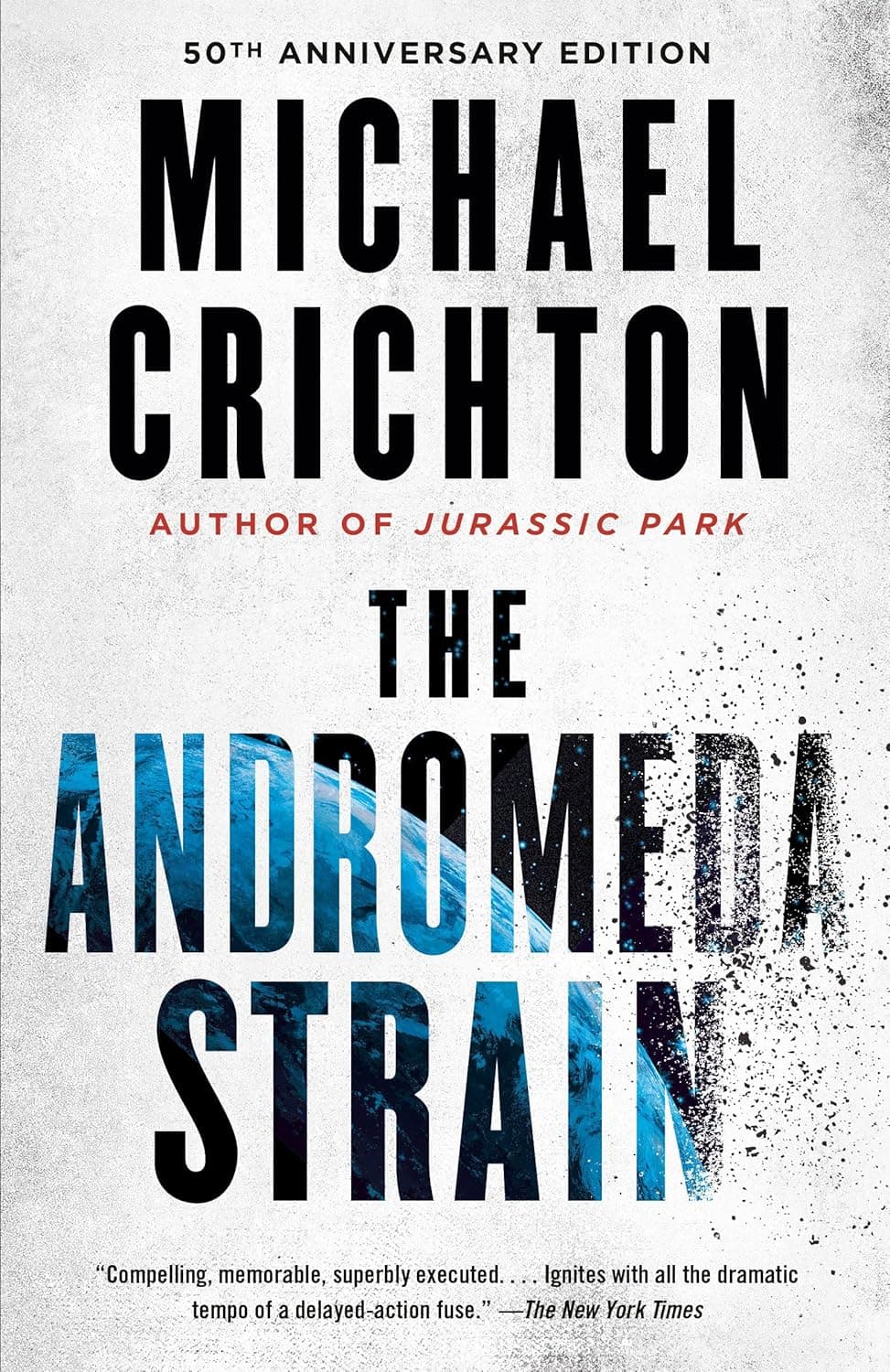
Should you read The Andromeda Strain?
What works
Wildfire's levels, tests, communication limits, and automated responses create a credible system whose apparent thoroughness becomes the source of suspense.
What may not work for you
The scientists are emotionally spare, women are largely absent from authority, and the final biological resolution arrives more abruptly than the investigation deserves.
What may test your patience
Equipment descriptions and test sequences dominate the middle; readers must enjoy method before the organism's behavior becomes legible.
Does the ending reward the effort?
Mostly. The crisis payoff uses established safeguards, but nature's final turn feels convenient beside the novel's procedural rigor.
Reading The Andromeda Strain closely
The Andromeda Strain begins when a military satellite returns near Piedmont, Arizona, and almost every resident dies. Two survivors, an infant and an older man, are taken with the satellite to Project Wildfire, an underground laboratory where a multidisciplinary team must isolate the responsible microorganism and determine what allows those two bodies to resist it.
Crichton tells the crisis like a reconstructed government report, using diagrams, transcripts, equipment descriptions, and procedural detail. That documentary voice can feel emotionally cool, but it makes small errors and delayed observations unusually tense. Scientists form hypotheses, discard them, and confront a biological agent that does not respect the assumptions built into their containment system.
Some computing and microbiology reflect 1969, and several characters receive less depth than the laboratory itself. The novel nevertheless remains highly readable because it understands that complex safeguards can fail through ordinary design decisions. It is a foundational technothriller for readers who enjoy scientific process, institutional systems, and suspense created by people trying to learn faster than a crisis changes.
Project Wildfire as protagonist
The layered laboratory, protocols, and automated defenses shape events almost as strongly as any scientist.
Science shown as revision
The team advances by testing explanations against anomalies rather than waiting for one heroic revelation.
Clinical style and human cost
Documentary distance increases plausibility but may frustrate readers seeking intimate characterization.
Three useful comparisons
Sphere
Sphere gives scientists more psychological conflict and a stranger enclosed mystery, but is less procedurally disciplined.
Best for: Its strongest audience likes underwater isolation, first-contact mystery, psychological suspense, and accessible scientific procedure.
As an Amazon Associate, I earn from qualifying purchases.
Jurassic Park
Jurassic Park adds vivid characters and action while expanding the same concern with complex-system failure.
Best for: Adult and mature teen readers who want a fast, violent dinosaur story with sustained attention to genetics, automation, and corporate denial.
As an Amazon Associate, I earn from qualifying purchases.
A Case of Need
A Case of Need applies medical reasoning to a human crime and social institution rather than an extraterrestrial organism.
Best for: Readers of medical thrillers interested in diagnosis, professional ethics, and the pre-Roe history of abortion care.
As an Amazon Associate, I earn from qualifying purchases.