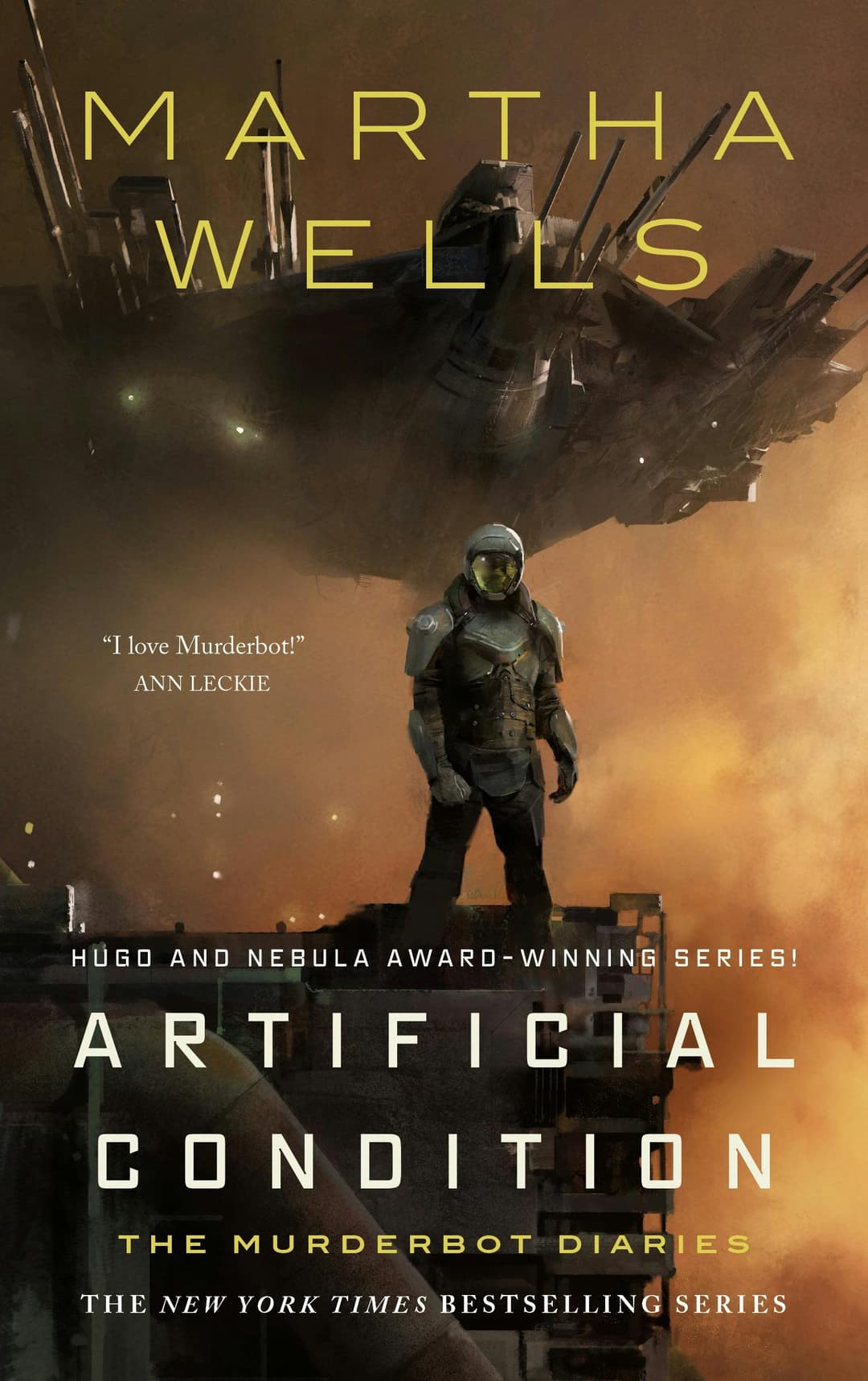
Should you read Artificial Condition?
What works
The hostile friendship between Murderbot and the research transport gives every exchange two layers: tactical negotiation on the surface and mutual curiosity underneath. The Ganaka Pit investigation also makes memory a contested record rather than a convenient explanation.
What may not work for you
The contract workers Murderbot protects are pleasant but lightly drawn, and their dispute is much less interesting than the relationship with ART. Once the two plots separate, the client mission can feel like necessary cover for the investigation rather than an equally strong story.
What may test your patience
The opening spends time on altered appearance, transport logistics, and ART testing Murderbot's lies. Readers waiting for the Ganaka Pit mystery may find that setup slow, although it is where the book establishes its most important relationship.
Does the ending reward the effort?
Yes. The answer about Ganaka Pit matters less as a factual reveal than as a correction to the story Murderbot has told about itself. The final choices preserve uncertainty while giving the investigation genuine emotional consequence.
Reading Artificial Condition closely
Artificial Condition begins with Murderbot traveling toward the place it least wants to examine. Ganaka Pit is attached to corrupted memory, mass death, and the possibility that it once failed catastrophically. Returning is not an official assignment or an act of public atonement. It is a private attempt to learn whether the story inside its own head is true.
The transport it boards makes secrecy difficult. Murderbot calls the research vessel ART after deciding that its actual name, Asshole Research Transport, is more accurate. ART can read its media, alter its body presentation, and control the environment around it. More importantly, it sees through the claim that the trip is purely informational. Their abrasive negotiation becomes the book's emotional center.
To reach the mining site, Murderbot accepts a security contract for young researchers in a dispute with a former employer. The assignment gives it a legal identity and produces a second corporate danger. These clients are not as memorable as Dr. Mensah's group, but their vulnerability lets Murderbot test what independent protection looks like when nobody ordered it to care.
Wells handles the investigation without turning memory into a convenient recording. Physical evidence, corporate concealment, and Murderbot's shame do not line up neatly at first. That uncertainty matters because its self-judgment has been built under a system that defines a SecUnit as equipment when useful and as culpable when something goes wrong.
The result is a near-perfect sequel novella. It enlarges Murderbot's inner life, adds a relationship unlike the human bonds in the first book, and answers enough about Ganaka Pit to change how the narrator sees itself. Read All Systems Red first. Its choices explain why this apparently solitary journey is already shaped by people Murderbot insists it left behind.
ART is an equal, not a helper
ART has more processing power and greater control of the shared environment, so Murderbot cannot manage the relationship through intimidation or selective disclosure. Their arguments become a form of mutual recognition that neither character would describe as friendship.
Memory is evidence with a motive
Murderbot's damaged account of Ganaka Pit carries shame as well as missing data. The investigation separates what happened from the explanation imposed on a construct trained to assume that any uncontrolled violence must reveal its nature.
A contract chosen freely still creates duty
The researchers do not own Murderbot, and it does not need their money in the usual sense. Accepting their job turns protection from programmed labor into a decision, which makes the risks both more voluntary and more personally revealing.
Three useful comparisons
All Systems Red
All Systems Red is the required starting point and has the cleaner survival plot. Artificial Condition is less self-contained but more intimate. It replaces the survey team's immediate danger with an investigation into memory and gives Murderbot an equal who can challenge every excuse without demanding human-style emotional performance.
Best for: Readers who want a fast science-fiction novella, an artificial narrator with a strong voice, corporate criticism, tactical action, low romance, and an emotionally guarded beginning to a longer series.
Network Effect
Network Effect expands the relationship introduced here into a full novel with a larger cast, alien contamination, and much denser action. Artificial Condition is the better choice when you want the sharpest version of Murderbot and ART alone together, testing boundaries through insults, favors, and carefully denied concern.
Best for: Established Murderbot readers who want a full-length space adventure, a deeper return for ART, layered rescue operations, alien technology, found family, and the series' most substantial emotional arc.
Mickey7
Mickey7 also uses a funny first-person narrator whose employer treats a human mind as replaceable equipment. Ashton leans toward social satire and repeated bodily death. Wells is tighter and more interested in surveillance, consent, and whether two artificial intelligences can recognize care without using sentimental language.
Best for: Science-fiction readers wanting cloning, hostile-planet survival, corporate exploitation, existential questions, and dark humor in a compact standalone story.
Series buying note
Would the collection be the better buy?
These are useful only when you want several books in the same run. The notes below spell out what each package includes and, just as importantly, what it leaves out.

Seven-book hardcover collection
The Murderbot Diaries 7-Book Hardcover Set
This hardcover run takes Murderbot from All Systems Red through System Collapse, keeping the four early novellas and the later full-length novel together.
Included: All Systems Red, Artificial Condition, Rogue Protocol, Exit Strategy, Network Effect, Fugitive Telemetry, System Collapse
Our buying note: All Systems Red is short enough to test before making the larger purchase. Platform Decay comes after the seven books in this collection and must be bought separately.