Should you read Mickey7?
What works
Mickey's weary narration makes cloning philosophy immediate, and the duplicate problem forces abstract questions about continuity into an awkward fight over food, shelter, and legal personhood.
What may not work for you
The colony and its leadership can feel schematic, while some alien-world possibilities receive less attention than Mickey's personal predicament.
What may test your patience
Backstory about earlier deaths interrupts the immediate danger, though those episodes clarify why Mickey treats mortality with such defensive humor.
Does the ending reward the effort?
Yes. The solution respects the novel's comic pragmatism without pretending its system of ownership and replacement has become humane.
Reading Mickey7 closely
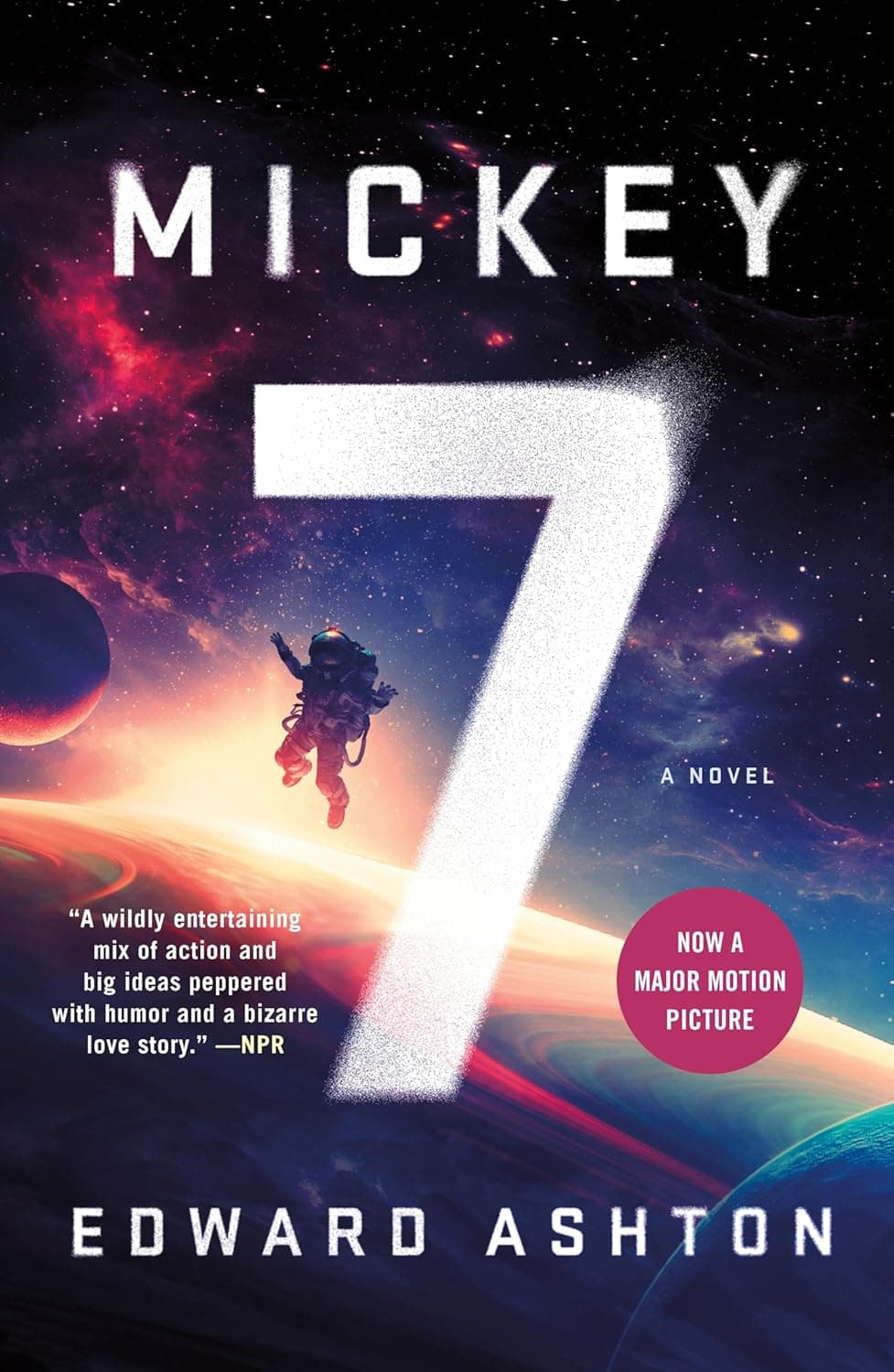
Mickey7 inspired Bong Joon-ho’s film Mickey 17. Its premise is simple and ugly: Mickey is an 'Expendable.' Whenever a mission is too dangerous or suicidal, Mickey gets sent in. If he dies, he is reprinted into a new body with his memories restored. It is immortality without dignity.
The tone is where this book truly shines. Instead of a grim, heavy dystopian slog, Ashton gives us a protagonist who is tired, cynical, and darkly funny. It reads like The Martian if Watney was less optimistic and more concerned with corporate bureaucracy than botany. The survival tension comes not just from the ice planet Niflheim, but from the fact that Mickey7 is hiding a secret: he didn't die when he was supposed to, and now there is a Mickey8. In this colony, redundancy is a capital offense.
Philosophically, the book punches above its weight. It tackles the 'Ship of Theseus' paradox head-on: if you are printed into a new body with uploaded memories, are you really the same person? Or just a copy who thinks they are? These questions make the stakes feel personal and urgent, elevating it from a standard space thriller to a piece of existential fiction.
Compare its survival mechanics with our science fiction collection or other dystopian worlds where human life is treated as a resource.
Three useful comparisons
The Martian
The Martian emphasizes ingenious problem solving and optimism; Mickey7 is more cynical about institutions and more interested in whether the rescued worker is still the same person.
Best for: Readers who enjoy problem solving, survival logistics, accessible science, and a protagonist who meets disaster with jokes.
Project Hail Mary
Project Hail Mary offers a larger scientific puzzle and warmer first contact, while Mickey7 keeps its science secondary to labor, identity, and bureaucratic absurdity.
Best for: The best fit is someone who likes optimistic hard science fiction, first contact, high-stakes problem solving, and an emotionally satisfying partnership.
After the Fall
After the Fall extends Ashton's interest in people treated as property through an alien occupation and a more openly satirical buddy relationship.
Best for: Science-fiction readers wanting alien occupation, buddy comedy, debt, wilderness survival, unequal friendship, and satire that keeps coercion visible beneath the banter.