Portrait of Edward Ashton

Author profile

Edward Ashton: books, reviews, and where to start

Edward Ashton writes science fiction about duplicated bodies, expendable labor, and institutions that turn extraordinary technology into another way to avoid valuing a person.

Biography and criticism

Identity under the pressure of replacement

Ashton's work joins a scientist's interest in mechanisms to a darkly comic suspicion of any organization that calls a human being disposable.

Science, teaching, and speculative fiction

Edward Ashton is an American scientist, educator, and novelist. His fiction career includes Three Days in April, The End of Ordinary, and the Mickey7 sequence. The books repeatedly place technical change inside institutions that already possess hierarchies and bad incentives. A breakthrough does not produce a clean future. It gives administrators, employers, and frightened communities new ways to define who can be sacrificed.

Mickey7 became his best-known novel through its expendable worker: a crew member whose body can be regenerated after death, with memories restored from a backup. The comic premise creates a serious identity problem. If two versions survive, neither feels like a copy from inside his own consciousness, while the colony treats both as an accounting error.

The ordinary voice inside an extreme premise

Ashton favors accessible prose and narrators who meet absurd systems with irritated practicality. The tone prevents philosophical questions from floating away from hunger, debt, friendship, and physical fear. Antimatter Blues expands Mickey's world without abandoning the fact that cosmic resources are controlled through very local incompetence.

After the Fall continues Ashton's interest in communities managing the consequences of survival technology. His strength is less the invention of a single unprecedented device than the social afterlife of the device. Readers should begin with Mickey7 for the cleanest statement of his concern: continuity of memory may persuade an institution that a death is reversible, but it does not make dying feel routine to the person ordered to do it.

The books in context

How the work develops on the page

These notes connect the biography to specific choices in the books. Each title links to the full spoiler-free review.

This spoiler-free Mickey7 review dives into the book that inspired Bong Joon-ho’s upcoming film, Mickey 17. The premise is brilliantly simple yet terrifying: Mickey is an 'Expendable.' Whenever a mission is too dangerous—or suicidal—Mickey gets sent in. If he dies, he is simply reprinted into a new body with his memories restored. It is immortality, but without the dignity.

The tone is where this book truly shines. Instead of a grim, heavy dystopian slog, Ashton gives us a protagonist who is tired, cynical, and darkly funny. It reads like The Martian if Watney was less optimistic and more concerned with corporate bureaucracy than botany. The survival tension comes not just from the ice planet Niflheim, but from the fact that Mickey7 is hiding a secret: he didn't die when he was supposed to, and now there is a Mickey8. In this colony, redundancy is a capital offense.

Philosophically, the book punches above its weight. It tackles the 'Ship of Theseus' paradox head-on: if you are printed into a new body with uploaded memories, are you really the same person? Or just a copy who thinks they are? These questions make the stakes feel personal and urgent, elevating it from a standard space thriller to a piece of existential fiction.

If you want to read the source material before Robert Pattinson brings it to the screen, you can grab your copy of Mickey7 on Amazon. Afterwards, compare the survival mechanics with our science fiction collection or dive into other dystopian worlds where human life is a resource to be managed.

Ashton lets Mickey explain technical and philosophical problems in the flat tone of an employee describing a terrible job, which keeps exposition from becoming solemn.

Mickey's weary narration makes cloning philosophy immediate, and the duplicate problem forces abstract questions about continuity into an awkward fight over food, shelter, and legal personhood.

The colony and its leadership can feel schematic, while some alien-world possibilities receive less attention than Mickey's personal predicament.

Backstory about earlier deaths interrupts the immediate danger, though those episodes clarify why Mickey treats mortality with such defensive humor.

Yes. The solution respects the novel's comic pragmatism without pretending its system of ownership and replacement has become humane.

The Martian emphasizes ingenious problem solving and optimism; Mickey7 is more cynical about institutions and more interested in whether the rescued worker is still the same person.

Project Hail Mary offers a larger scientific puzzle and warmer first contact, while Mickey7 keeps its science secondary to labor, identity, and bureaucratic absurdity.

After the Fall extends Ashton's interest in people treated as property through an alien occupation and a more openly satirical buddy relationship.

The 'Expendable' concept offers a fresh, dark look at labor, capitalism, and the value of a human life in space.

The book features the 7th iteration (Mickey7), while the movie is titled Mickey 17, suggesting a much longer history of death and rebirth for the character.

Director Bong Joon-ho is known for social satire (Parasite), likely leaning harder into the class struggle aspects of the colony than the book might.

Reading the book first gives you the internal monologue and philosophical questions that might be harder to convey on screen.

Readers who like high-concept sci-fi that asks 'what makes us human?' without getting bogged down in heavy physics.

Anyone prepping for the 2025 movie who wants to understand the lore of the Creepers and the Expendable program.

Mickey7 is an 'Expendable': a disposable employee sent on suicide missions to colonize an ice planet. When one version dies, a new body is printed with most of his memories. But when Mickey7 survives and returns to find Mickey8 already in his bed, he must hide his existence to avoid being recycled for protein.

Read the complete review

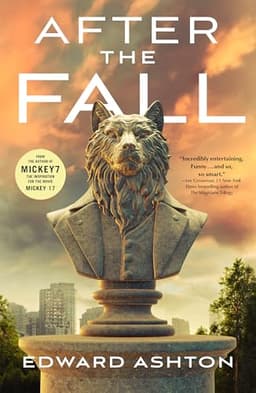
After the Fall imagines humanity one hundred and twenty years after defeat and a century after alien grays collected the survivors. John lives as a bonded human attached to Martok, a broke and impulsive gray who treats him better than most—until Martok uses John's bond as collateral for a wilderness business.

Edward Ashton turns alien invasion into buddy comedy and workplace satire without softening the ownership at its center. John and Martok may care for each other, but affection cannot erase a system that lets one friend legally gamble the other's life.

Ashton lets John describe humiliating ownership rules with dry practical precision, then allows moments of fear to expose what the jokes have been containing.

The wilderness scheme turns alien occupation into debt, work, bad planning, and reluctant loyalty, making systemic exploitation visible inside comic adventure.

The tonal ease can blunt the horror of human bondage, and the broader occupied society remains thinner than the central partnership.

The opening must establish alien economics and the uncomfortable terms of John and Martok's bond before the business disaster becomes active.

Mostly. The immediate crisis reaches a satisfying compromise, though affection cannot resolve the legal inequality the novel deliberately retains.

Mickey7 is tighter and more focused on copied identity; After the Fall expands Ashton's disposable-worker satire into ownership and cross-species friendship.

Project Hail Mary treats human-alien cooperation as an optimistic scientific partnership, while Ashton makes legal inequality and bad economics impossible to ignore.

Shards of Earth offers grander space-opera stakes and a larger crew; After the Fall is smaller, drier, and more openly satirical about labor.

The provocative question exposes how obedience is taught and normalized. John's relative comfort makes recognizing exploitation more complicated, not less necessary.

Dry humor, business failure, alien bureaucracy, and genuine vulnerability sit beside slavery and post-invasion trauma. Readers of Mickey7 will recognize Ashton's balance of bleak systems and comic voice.

A century after alien grays reduced humanity to bonded dependents, John learns the limits of friendship when his gray companion Martok wagers John's bond on a failed wilderness business.

Read the complete review

Where to begin

A good place to start with Edward Ashton

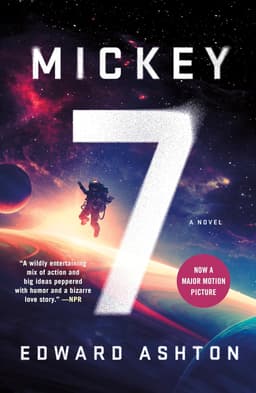
Cover of Mickey7
Our highest-rated review

Mickey7

4.3 / 5

Mickey7 turns disposable labor and copied identity into a brisk, funny survival novel whose modest scale is one of its strengths.

Cover of After the Fall
Most recently added

After the Fall

4.1 / 5

After the Fall is funniest when John and Martok behave like mismatched friends and sharpest when the law reminds them that one friend still owns the other.

Bibliography

Books by Edward Ashton

Reviewed titles open directly on Book Review Guide. Other editions and works remain marked until a full review is published.

Bibliographic records: Open Library.

Reviewed bibliography

Edward Ashton books reviewed here

Every title below has a complete, spoiler-free review. Scores are our editorial ratings, not visitor averages.

Cover of Mickey7

20224.3 / 5

Mickey7

A Novel

Mickey7 turns disposable labor and copied identity into a brisk, funny survival novel whose modest scale is one of its strengths.

Read the review
See current formats on Amazon

As an Amazon Associate, I earn from qualifying purchases.