
Author profile
Aisling Rawle: books, review, and bibliography
Aisling Rawle is an Irish novelist whose debut, The Compound, turns the grammar of reality television into a cold study of appetite, performance, and economic obedience.
Biography and criticism
A debut built from the logic of being watched
Her first novel converts a familiar entertainment format into a controlled social nightmare, where scarcity and visibility do most of the coercion.
County Leitrim, Dublin, and a first novel
Aisling Rawle was born in 1998 and raised in County Leitrim in the west of Ireland. She later moved to Dublin, and The Compound is her first published novel. The debut already has a remarkably settled understanding of its governing form: a group of attractive young adults wake in an isolated compound, accept rules whose author remains unseen, and learn that food, comfort, attention, and sexual status can all be converted into prizes.
The premise invites obvious comparisons with Love Island and Lord of the Flies, but Rawle's real subject is not a single program or a simple return to savagery. The contestants do not forget modern life. They reproduce it. They rank one another, manage their images, interpret intimacy as leverage, and continue performing for an audience they cannot see. The frightening element is how little coercion the system initially needs. Scarcity and visibility do most of the work.
Lily's useful moral vacancy
Rawle filters the novel through Lily, a narrator who is observant about hierarchy and evasive about responsibility. Lily notices who is desired, who is becoming disposable, and which emotional response will look convincing. She is not a conventional truth teller trapped among shallow people. Her detachment is part of the book's evidence. The reader is forced to decide when self-protection becomes collaboration and when fluent awareness of a system merely makes someone better at using it.
The prose suits that problem. It is economical, cool, and often funniest at the instant a character reveals something ugly without recognizing it as a confession. Rawle avoids decorating every act of cruelty with authorial outrage. Instead, practical decisions accumulate until the group has normalized conditions that would have seemed intolerable at the beginning. This gives The Compound its speed. Challenges and shifting alliances pull the story forward, while the flatness of the participants' moral vocabulary creates the deeper dread.
A satire of rewards, not screens
The novel's sharpest insight is that surveillance matters less than anticipation. The contestants imagine how their actions might be received, so an absent audience becomes a force inside every conversation. Desire is never entirely private. Generosity may improve a personal brand. Vulnerability can be a strategic disclosure. Even rebellion risks becoming another kind of content. Rawle therefore writes about a broader economy of attention in which people learn to package themselves before anyone explicitly orders them to do so.
Because only one novel is available, it is too early to declare a permanent Rawle style. The Compound does establish several strengths worth watching: disciplined withholding, an ear for status language, a willingness to center an unpleasant intelligence, and an ability to make repetition feel like social conditioning rather than stalled plot. Its limitations are connected to the same design. Deliberately flattened characters can frustrate readers who want emotional intimacy, and a controlled allegorical space cannot answer every political question it raises. As a debut, however, it shows a writer interested in mechanisms rather than slogans.
Reality television as a moral machine
The Compound does not treat reality television as a shallow subject attached to a serious dystopia. The format is the mechanism through which moral distance is produced. Rules can be announced as entertainment, scarcity can be staged as a challenge, and another person's distress can become useful footage. Contestants learn to perform legible reactions because privacy has no market value inside the game.
Rawle's sharpest decision is to give Lily enough self-interest to resist the expected arc of instant moral awakening. She notices injustice and continues calculating what recognition might buy. That tension keeps the satire from separating innocent participants from an obviously corrupt audience. Viewers, producers, and contestants all respond to incentives, though they do not possess equal power to refuse them. The prose is direct and contemporary, attentive to how people narrate themselves while being watched. As a debut, the novel sometimes makes the system more coherent than real media production would be, but its central insight is strong: surveillance becomes easiest to accept when attention has been recast as a prize.
Where to begin
The Aisling Rawle book reviewed here
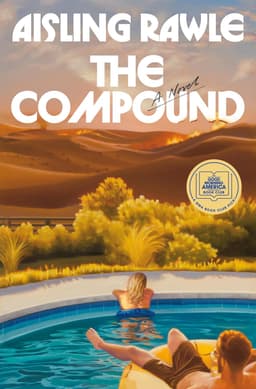
The Compound
4.3 / 5The Compound makes reality television frightening by showing how quickly contestants accept deprivation once comfort, visibility, and affection become prizes.
Bibliography
Books by Aisling Rawle
Reviews and book guides open on Book Review Guide. The full list comes from the linked bibliography source.
Reviewed
The Compound
Not reviewed yet
Compound
Bibliographic source: Open Library.
Books on this site
Aisling Rawle reviews and guides
20254.3 / 5
The Compound
A GMA Book Club Pick
The Compound makes reality television frightening by showing how quickly contestants accept deprivation once comfort, visibility, and affection become prizes.
As an Amazon Associate, I earn from qualifying purchases.
Keep exploring