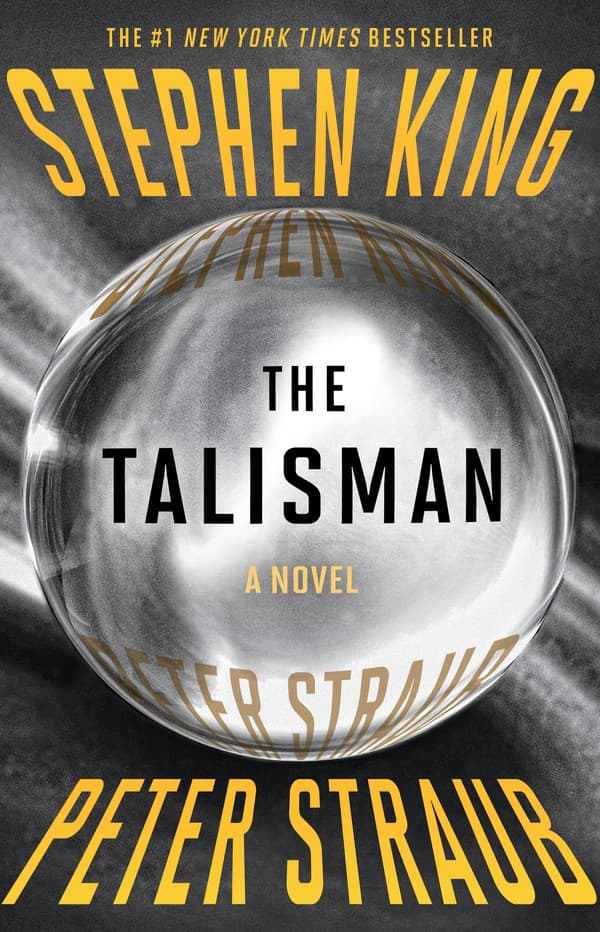
Original publication and editions
The Talisman was first published in November 1984. It is the first Talisman Trilogy novel by Stephen King and Peter Straub; the edition details here describe the 2018 Scribner trade paperback.
- Original publication
- November 1984
- Original publisher
- G.P. Putnam's Sons
- Series position
- The Talisman Trilogy, Book 1
- Reference edition
- Scribner trade paperback, April 17, 2018; ISBN 9781501192272; 800 pages
Primary sources: Stephen King: The Talisman, Scribner: 2018 trade paperback, Scribner: 2012 hardcover
Should you read The Talisman?
What works
The Territories offer wonder on a large scale, but Jack's need to save his mother keeps the quest personal. Wolf turns companionship into the novel's strongest emotional force.
What may not work for you
The episodic structure does not always justify its detours. The Oatley Tap sequence prolongs misery until the pressure starts to feel repetitive rather than newly revealing.
What may test your patience
A strong opening gives way to a difficult middle stretch before the final act accelerates. Expect changes of pace, especially when Jack is trapped instead of traveling.
Does the ending reward the effort?
Yes. The immediate quest reaches a triumphant, emotionally satisfying conclusion without closing down the possibilities of the wider world. It works as an ending to this novel, not merely an invitation to continue.
Reading The Talisman closely
The most persuasive thing about Jack Sawyer's quest is its size relative to him. He is twelve, his mother is dying, and the task asks him to travel through an America that offers little protection and Territories where wonder is no guarantee of safety. I liked that imbalance. Saving a parent is an understandable wish; having to shoulder it alone makes the fantasy feel frightening before its creatures arrive.
The parallel worlds are more than a succession of strange sights. Crossing between them keeps familiar people and dangers from remaining comfortably familiar, while the gritty American stops prevent the adventure from floating free of ordinary hardship. King and Straub find a shared voice here. The colloquial detail has weight, and the more lyrical passages make the Territories feel expansive without giving Jack an easy escape from the cost of traveling.
Wolf, the loyal werewolf companion, is the reason the emotional scale catches up with the physical one. His loyalty gives Jack someone to care for as well as someone to depend on. For me, that relationship matters more than the size of the mythology. Jack is resourceful, but the book is better when resilience means accepting another person's vulnerability than when it simply means surviving the next ugly adult.
The road is not consistently rewarding. The prolonged Oatley Tap stretch turns a convincing ordeal into a drag on the middle, and the episodic structure sometimes asks the reader to begin building momentum again after it has already been lost. The final act recovers that urgency and gives the immediate story a satisfying shape. My four-star recommendation comes with patience attached: the detours are a real limitation, but the friendship, combined voice, and emotional payoff make the long crossing worthwhile.
Fantasy, horror, and the age of its hero
This is a quest fantasy with a horror writer's tolerance for cruelty. Jack's age brings discovery into the foreground; it does not make the treatment of him gentle. The 1980s American setting also creates distance from a contemporary childhood. I would choose it for the friendship and fantastic geography, rather than as a comforting adventure simply because a child leads it.
The length depends on the edition
The 2018 Scribner trade paperback has 800 pages, while the publisher lists 784 for its 2012 hardcover, ISBN 9781451694918. Those are different editions, not competing universal lengths. Check the format behind a page count, and confirm which edition the retailer offers before ordering.
Where Jack goes next
Black House follows Jack as an adult; Other Worlds Than These concludes the trilogy. Neither needs to be read before this first novel. The Talisman Trilogy order guide explains the sequence and separates it from optional Dark Tower reading.
For a different route after the quest, compare our books like The Talisman. The Stephen King and Peter Straub hubs place the collaboration beside their other work.
Three useful comparisons
The Hobbit
The Hobbit is a shorter, warmer episodic quest. Bilbo grows through practical choices, while Jack must navigate a harsher American landscape and a far more personal rescue.
Best for: Families, younger readers, and adults wanting an accessible classic adventure with humor, danger, and moral weight.
The Hollow Places
The Hollow Places makes friendship the means of surviving a hostile otherworld too. Its adult narrator and compact cosmic-horror plot replace the childhood quest and epic scale.
Best for: Readers new to cosmic horror who want impossible spaces, body unease, friendship, and relief from unbroken bleakness.
Black House
Black House follows Jack into adult life and turns the collaboration toward supernatural crime. Read it second for the contrast, rather than expecting another westward childhood adventure.
Best for: Readers who want a grim supernatural thriller with procedural pressure and can accept stylized narration and Dark Tower lore. Read The Talisman first for Jack's history; skip this if danger to children or an extended opening would outweigh the mystery.
Make the next decision