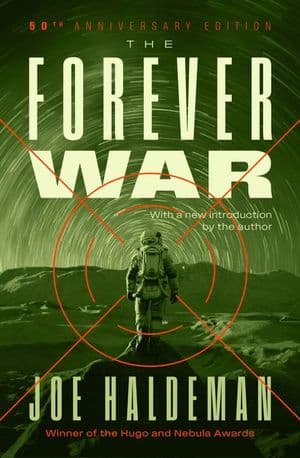
Should you read The Forever War?
What works
Relativity is not decorative science here. It gives physical form to a veteran's alienation, allowing a few subjective years of orders and combat to consume centuries at home while institutions keep treating Mandella as replaceable labor.
What may not work for you
Some speculation about sexuality, population policy, and social change now reads as blunt or dated, and the Taurans remain distant enough that the war's political foundations receive less scrutiny than its effect on soldiers.
What may test your patience
Training, equipment, and relativistic travel occupy substantial attention before the pattern of departure and return becomes clear. The military procedure is purposeful, but readers expecting continuous battlefield action may need to adjust to the episodic design.
Does the ending reward the effort?
Yes. The conclusion refuses to make endurance equal belonging, then finds a restrained personal answer to a problem that history and physics have made almost impossibly large.
Reading The Forever War closely
The Forever War follows physics student William Mandella after he is conscripted into an elite force created to fight the Taurans, an alien civilization encountered far from Earth. Training is lethal before the enemy ever appears. Combat then takes place across distances where relativistic travel changes the meaning of a tour of duty. Mandella may experience months while decades pass for the people who sent him, making survival a form of permanent exile.
Joe Haldeman's most important decision is to make the science serve the emotional argument. Time dilation is explained clearly enough to shape strategy, but its greater effect is personal. Each return places Mandella in a society with new customs, politics, language, and assumptions about what a normal human life should be. The military can retrain him for another campaign more easily than civilian culture can make room for the person who returns.
Mandella is not a natural warrior or a secret commander waiting to emerge. He follows orders, calculates risks, tries to keep people alive, and recognizes the absurdity around him without imagining that recognition will stop it. His bond with Marygay Potter matters because they share the same disappearing reference points. Even that relationship is vulnerable to orders and travel schedules that can separate two people by centuries without either choosing to leave.
The novel's speculation is not equally durable. Its treatment of sexuality and social policy reflects anxieties of the 1970s and can feel reductive now. The Taurans are also kept at such a distance that the political basis of the conflict remains intentionally thin, which strengthens the antiwar absurdity but limits them as a civilization. Readers should expect compressed campaigns and sharp jumps rather than a continuously escalating battlefield narrative.
What endures is the precision of the central wound. Military service consumes Mandella's time twice: first through danger, then by making the home he serves vanish while he is away. The ending provides real emotional closure without pretending that institutions can return what has been lost. Read it for its portrait of displacement and its skeptical soldier's voice, not for uncomplicated combat spectacle.
Relativity as emotional damage
The travel physics determines who can return, when they arrive, and whether anyone they knew can still exist. Haldeman makes a scientific constraint carry the same weight as memory, grief, and cultural estrangement.
Mandella is trained, not transformed into a believer
He becomes more capable without accepting the ideology around the war. That distinction keeps competence from becoming endorsement and allows the military scenes to remain exciting while the novel questions the structure producing them.
Coming home to somebody else's future
The return sequences are not rest stops. They are the book's clearest demonstrations of cost, showing that a veteran can be useful to the state and still be socially obsolete within the world supposedly defended.
Three useful comparisons
Dune
Dune treats war through dynasties, religion, ecology, and the danger of heroic myth. The Forever War stays with an ordinary conscript who has almost no control over the cause he serves. Choose Haldeman for a leaner, more personal account of institutions consuming individual time.
Best for: Readers willing to trade immediate intimacy for political, ecological, and religious ideas that become more connected with every chapter.
House of Suns
House of Suns also makes relativistic travel emotionally consequential, but its immortal clones think across millions of years and pursue a cosmic mystery. The Forever War is narrower and harsher. Its time scale matters because each return home erases another part of one soldier's cultural identity.
Best for: Choose it for an accessible standalone epic with deep time, clones, machine people, romance, pursuit, and galactic mystery.
Children of Time
Children of Time follows civilizations developing across deep time and finds exhilaration in radically different intelligence. Haldeman focuses on what such temporal distance does to one human relationship. Read it when you want the science of long voyages to produce loss, dislocation, and bitter institutional irony.
Best for: Readers who like big evolutionary ideas, nonhuman viewpoints, and long time scales more than a conventional hero's journey.
Make the next decision
Reading and buying guides featuring The Forever War
Series buying note
Would the collection be the better buy?
These are useful only when you want several books in the same run. The notes below spell out what each package includes and, just as importantly, what it leaves out.
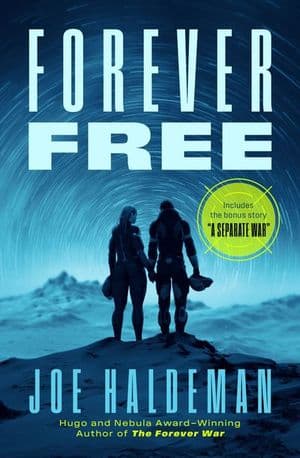
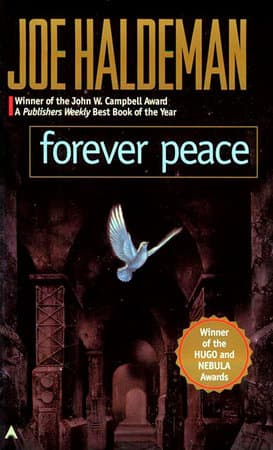
One-volume paperback omnibus
Peace and War: The Omnibus Edition
The omnibus places Haldeman's three war novels in one volume, but their relationship needs a little explanation before you buy.
Included: The Forever War, Forever Free, Forever Peace
Our buying note: Forever Free directly continues The Forever War. Forever Peace is a thematic companion set in a different continuity, not the middle chapter of one three-book plot.