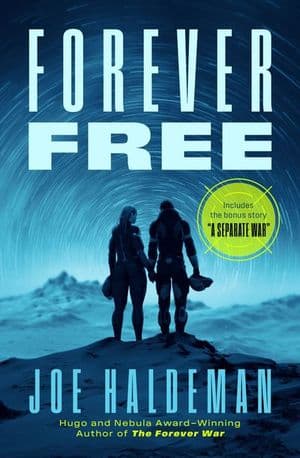
Should you read Forever Free?
What works
The opening understands that survival did not give the veterans ownership of their future. Colony labor, family life, aging, and oversight by posthuman civilization make their desire for one final independent decision emotionally persuasive.
What may not work for you
Once the escape plot changes direction, supporting characters lose definition and the novel's social questions yield to a metaphysical puzzle. The final explanation is too compressed to carry all the meaning placed on it.
What may test your patience
The difficult stretch is not the setup but the abrupt shift in the book's center of gravity. Readers invested in the veterans' political and domestic problem must decide whether to follow the stranger, more speculative novel that replaces it.
Does the ending reward the effort?
Only partly. It provides an answer and a sense of wonder, but it does not fully reward the careful attention previously given to autonomy, exile, and the community Mandella and Marygay helped build.
Reading Forever Free closely
Forever Free returns to William Mandella and Marygay Potter long after the war with the Taurans. They have chosen individuality over absorption into the postwar human group mind and live with other veterans on the cold world of Middle Finger. The colony offers family, work, and continuity, but not full independence. Decisions made elsewhere still define the limits of the life they are allowed to build.
The strongest pages are domestic and political. Mandella is older, a parent, and tired of having every apparent refuge supervised by a civilization that regards his kind of humanity as preserved history. Haldeman pays attention to cold, machinery, food, labor, and the negotiations required to turn frustration into a collective plan. The veterans are not trying to recover glory. They want one decision about their future that no institution can reverse.
Their answer depends on relativistic travel, returning to the physical idea that made The Forever War so painful. This time the time difference is not an accidental cost of orders but a tool the colonists hope to choose for themselves. That reversal is promising because it asks whether the same mechanism that stole Mandella's world can create distance from those who control him. The preparation also gives the group a concrete problem to solve together.
The novel then changes dramatically. Its later mystery is much larger and stranger than the conflict on Middle Finger, moving away from political autonomy toward metaphysical speculation. That turn will be fascinating to some readers, but it leaves several colonists thinly developed and resolves the earlier argument at a level where ordinary human choice has less force. The explanation arrives quickly relative to the size of the idea.
I would recommend Forever Free mainly to readers who already care about Mandella and Marygay and can accept an uneven, surprising coda. It does not match the discipline or emotional inevitability of The Forever War. It does, however, refuse to repeat the original war story and gives its veterans a credible postwar grievance. The beginning feels like a genuine extension of their lives; the ending feels like a different kind of science-fiction thought experiment attached to it.
Middle Finger is refuge, not freedom
The colony protects an older human way of life while remaining dependent on the civilization surrounding it. Haldeman understands how preservation can become another name for confinement when the preserved people do not control the terms.
Choosing the cost of relativity
Mandella once lost centuries because the military controlled his travel. The colonists' plan tries to claim that temporal distance deliberately, turning a source of trauma into a possible instrument of autonomy.
The divisive final turn
The late mystery enlarges the novel's scale so abruptly that the careful colony conflict stops being its main question. Wonder replaces political texture, and the compressed answer cannot give both modes equal weight.
Three useful comparisons
The Forever War
The Forever War is essential first and remains the more disciplined novel. It makes every jump in time deepen Mandella's estrangement. Forever Free begins with the consequences of that survival, offers more domestic texture, and then takes a far less grounded approach to humanity's place in the universe.
Best for: Readers interested in military science fiction as criticism rather than recruitment, hard-science consequences, veteran alienation, changing social norms, and a complete emotional arc.
House of Suns
House of Suns is the better choice for a cosmic mystery that patiently earns its enormous scale through character, pursuit, and deep-time history. Forever Free reaches similarly large questions in a much shorter space. Its direct connection to Mandella supplies emotion, but the speculative turn receives less development.
Best for: Choose it for an accessible standalone epic with deep time, clones, machine people, romance, pursuit, and galactic mystery.
Children of Time
Children of Time examines posthuman futures and changing definitions of personhood across a carefully developed evolutionary story. Forever Free is more personal at first and more abrupt later. Choose it to complete Mandella's arc; choose Tchaikovsky for a fuller exploration of transformed humanity and nonhuman civilization.
Best for: Readers who like big evolutionary ideas, nonhuman viewpoints, and long time scales more than a conventional hero's journey.
Series buying note
Would the collection be the better buy?
These are useful only when you want several books in the same run. The notes below spell out what each package includes and, just as importantly, what it leaves out.
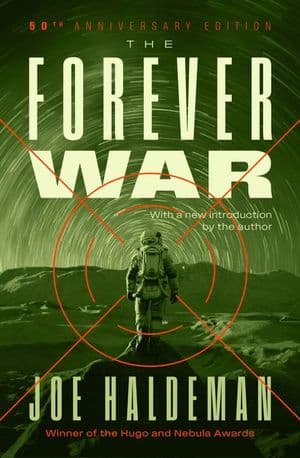
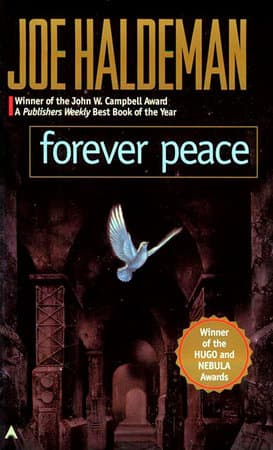
One-volume paperback omnibus
Peace and War: The Omnibus Edition
The omnibus places Haldeman's three war novels in one volume, but their relationship needs a little explanation before you buy.
Included: The Forever War, Forever Free, Forever Peace
Our buying note: Forever Free directly continues The Forever War. Forever Peace is a thematic companion set in a different continuity, not the middle chapter of one three-book plot.