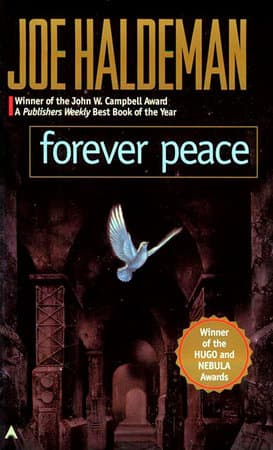
Should you read Forever Peace?
What works
The soldierboy operators are physically safe from the battlefield but mentally exposed to its violence, while the jack linking them lets Haldeman examine intimacy as both trauma and a possible route out of organized cruelty.
What may not work for you
The conspiracy draws several antagonists too broadly, the scientific catastrophe and social argument compete for space, and the proposed answer to human violence can feel cleaner than the difficult moral questions that produce it.
What may test your patience
The novel must connect Julian's combat shifts, his relationship with Amelia, the Jupiter Project, and the implications of mental linking. Those threads do not reveal their common direction immediately.
Does the ending reward the effort?
Partly. The conclusion is bold and thematically consistent, but its scale and confidence move faster than the book's best, more intimate observations about consent, trauma, and responsibility.
Reading Forever Peace closely
Forever Peace takes place in a future separate from William Mandella's. Julian Class is both a physicist and a military mechanic who remotely operates a powerful soldierboy in the Ngumi War. His body remains far from the combat zone, but the neural connection transmits the machine's senses and makes killing psychologically immediate. Safety at a distance does not spare him from responsibility, exhaustion, or the knowledge of what his unit can do to people on the ground.
The same linking technology joins mechanics to one another, giving them unusually direct access to another person's sensations and mental state. Haldeman uses that intimacy to ask whether sustained contact with another consciousness changes what violence is possible. The premise is at its best when Julian's professional life, relationship with Amelia Harding, and connections to other operators expose the difference between receiving someone's pain and freely consenting to share it.
A second problem develops around a vast physics project whose possible failure would be much larger than the ongoing war. These strands initially feel like separate novels: one about remote combat, one about linked minds, and one about scientific catastrophe. Their convergence is intellectually ambitious, but it requires substantial explanation and a widening political conspiracy. The book becomes less intimate as more people begin fighting to control what Julian and Amelia know.
The villains are the weakest part. Several are defined by rigid belief or institutional function rather than the psychological detail granted to Julian, and the late conflict compresses resistance that deserves more complexity. The proposed route toward peace is deliberately provocative, but it risks making a profound moral and political change look technologically neat. That tension is worth debating even when the answer does not fully persuade.
Forever Peace should be read as a thematic companion to The Forever War, not as the next chapter in the same story. It is broader, more hopeful, and less elegant. Its remote warfare now feels particularly sharp, while its account of empathy as a technical intervention remains productively uncomfortable. Readers who prefer a focused character arc should choose the earlier novel; readers interested in an argument about whether violence can be designed out of society will find more to engage with here.
Remote warfare is not remote experience
Julian's body is protected while his nervous system receives the battle. Haldeman separates physical risk from moral injury and refuses the comforting idea that distance makes mechanized violence clean.
The jack as intimacy and coercion
Connection can create understanding, but the military also controls when and why people connect. The same device that allows extraordinary closeness therefore raises questions about consent, privacy, and institutional power.
A scientific threat changes the scale
The Jupiter Project expands the novel beyond one war. Its danger gives Julian and Amelia an urgent reason to act, though the cosmic stakes sometimes pull attention from the more distinctive soldierboy material.
Three useful comparisons
The Forever War
The Forever War uses relativity to separate a soldier from home and offers the tighter emotional journey. Forever Peace is not a direct sequel. It builds a different future around remote bodies and connected minds, with a more openly utopian question about whether technology can change human violence.
Best for: Readers interested in military science fiction as criticism rather than recruitment, hard-science consequences, veteran alienation, changing social norms, and a complete emotional arc.
The Andromeda Strain
Both books place a scientific project beside a danger larger than its operators fully understand. Crichton is colder, more procedural, and committed to containment mechanics. Haldeman gives relationships and political resistance more room, then asks whether the same technology can alter society rather than simply avert catastrophe.
Best for: Hard-edged outbreak science fiction for anyone who values laboratory procedure and containment systems over sentiment.
Children of Time
Children of Time develops empathy through contact with a genuinely different intelligence across a long civilizational arc. Forever Peace stays near-future and human. Choose it for combat ethics and neural intimacy; choose Tchaikovsky for evolutionary worldbuilding and a larger encounter with otherness.
Best for: Readers who like big evolutionary ideas, nonhuman viewpoints, and long time scales more than a conventional hero's journey.
Series buying note
Would the collection be the better buy?
These are useful only when you want several books in the same run. The notes below spell out what each package includes and, just as importantly, what it leaves out.
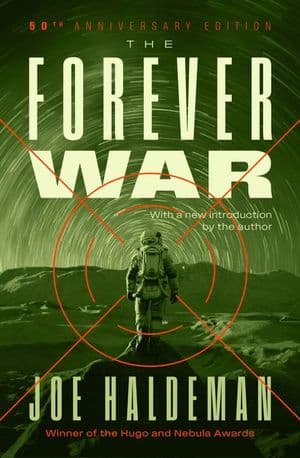
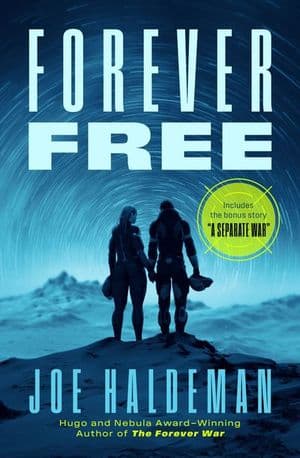
One-volume paperback omnibus
Peace and War: The Omnibus Edition
The omnibus places Haldeman's three war novels in one volume, but their relationship needs a little explanation before you buy.
Included: The Forever War, Forever Free, Forever Peace
Our buying note: Forever Free directly continues The Forever War. Forever Peace is a thematic companion set in a different continuity, not the middle chapter of one three-book plot.