Which book to buy
Murdle vs. Murdoku vs. The Killer Isn't Alice: Which Puzzle Book Should You Buy?
Written clues, illustrated crime scenes or one huge suspect list: three ways to be the detective.
The quick answer
Choose the kind of detective work you enjoy
Murdle suits written-clue deduction and a series of cases. Murdoku is the visual option, built around placing suspects in illustrated scenes. The Killer Isn't Alice is one much larger elimination challenge. I'd decide on that difference before worrying about which book has the most puzzles.
These three books put the solving in your hands, but buying one doesn't mean signing up for the same activity as the others. Do you want to work through a grid, work out where everyone stood, or keep narrowing one long list of suspects? That's the useful question here.
A collection of cases gives you fresh starts; Alice asks you to stay with one investigation. That's a bigger difference than the puzzle count when you're deciding what you want to sit down with.
The practical differences
Murdle, Murdoku and Alice side by side
Tap a title to jump to the book. Start with the kind of puzzle page you would enjoy working on.
| Book | What you work with | How the cases fit together | Reason to choose it |
|---|---|---|---|
| Murdle: Volume 1 | Written evidence and logic grids; 100 mysteries | Separate cases with recurring characters and a connecting mystery | You enjoy matching clues across categories. |
| Murdoku | Illustrated settings, position clues and sudoku-inspired restrictions; 80 cases | A fresh crime scene for each case | You would rather place people on a map. |
| The Killer Isn't Alice | A printed list of 46,600 suspects and 18 elimination clues | One central case to keep returning to | You want a sustained sorting-and-elimination project. |
Look at the solving
What each book asks you to do
All three ask you to take part. The difference is what ends up on the page in front of you.
1
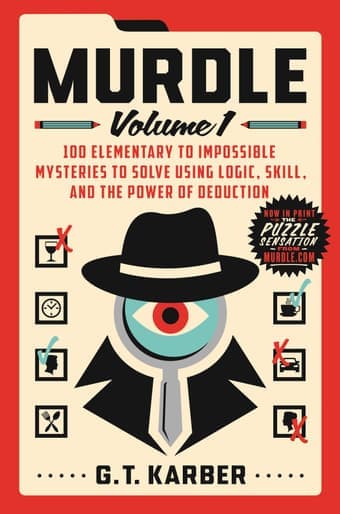
Murdle: Volume 1
G. T. Karber · 100 murder-mystery logic puzzles
Murdle uses written evidence and a logic grid to work out the culprit, weapon and location. Deductive Logico returns across the cases, and a larger mystery connects them. The draw for me is having a new problem to tackle without giving up the detective-story thread entirely.
Choose it when: You enjoy reading a statement and following what it rules out. Go for Murdoku instead if placing people in a scene sounds better than matching categories. Alice is the alternative when you want to stick with one big case, rather than move on to the next puzzle.
2
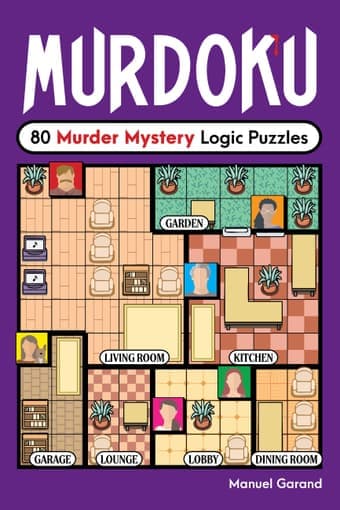
Murdoku: 80 Murder Mystery Logic Puzzles
Manuel Garand · 80 illustrated cases
Murdoku gives you suspects and clues about where they can stand in a drawn crime scene. Rooms and objects matter, alongside the restriction of one person per row and column. You use those limits to place the cast and identify the killer. The sudoku connection is a placement rule; this isn't a book of ordinary number grids.
Choose it when: You want to reason about a room as well as read clues. I find that a more useful reason to choose Murdoku than simply liking its pictures. Prefer Murdle when written category deduction is the attraction. Choose Alice when the idea of reducing one enormous suspect list appeals more than changing scenes.
3
The Killer Isn't Alice
Iris Starling · One extended elimination challenge
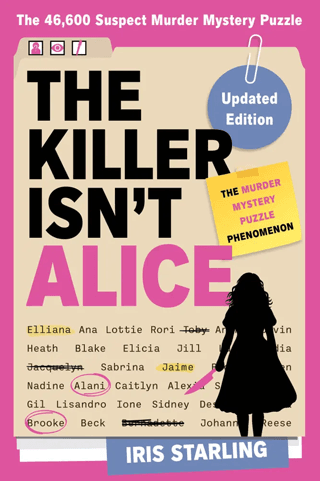
Alice leaves you 18 clues and a dossier of 46,600 possible suspects. You apply the conditions to the printed names until a single candidate fits. The main attraction is staying with that one problem: keeping track of eliminations, revisiting a clue and deciding what to check next. This is a different commitment from a collection of separate mysteries.
Choose it when: You want an ongoing project and don't mind careful scanning and record-keeping. My hesitation would be buying it for someone who wants a fresh little mystery each time they open a book. Murdle or Murdoku better fits that wish. Alice's solution is checked on the official website, rather than revealed at the back of the book.
What to know before choosing a gift
The murder theme alone doesn't tell me enough about a good gift. A person who likes written logic problems may welcome Murdle; someone who likes working with maps and positions has a clearer reason to try Murdoku. Alice makes more sense for someone who enjoys keeping notes on a project and returning to it.
Before wrapping one up, find out what the recipient already enjoys solving. A big puzzle count is less useful than knowing whether they like written clues or visual problems. Pencil or separate notes can also leave more room for correcting a mistake than permanent marks on the page.
Checking answers and using the companion sites
Murdoku includes step-by-step solutions in the book. Alice uses its official online answer checker, so someone expecting a completely offline activity should know that before choosing it. Its site also has clue clarifications; those can help without handing you the culprit.
Murdle and Murdoku both have official browser puzzles. Trying one can help you decide whether the way of thinking appeals before committing to a book. A web puzzle is a sample of the approach, not a promise that every printed case works exactly the same way.
Try an official Murdle puzzle · Try an official Murdoku puzzle · Alice's official answer checker
Which one would I point you toward?
For written deduction, start with Murdle. For visual placement, make it Murdoku. Alice is the one to consider when a single, stubborn case sounds like a good reason to keep a notebook nearby. I don't see a useful winner across all three; the book worth buying is the one whose actual solving sounds enjoyable to you.
Want more books after The Killer Isn't Alice?
The broader recommendations start with Murdle and Murdoku, then move into ten mysteries where you follow a story rather than carry out a printed elimination puzzle. That's a useful next stop when you want more choices, including a detective novel for a change.
Sources
Sources for this guide
Official pages for the books and their puzzle formats: