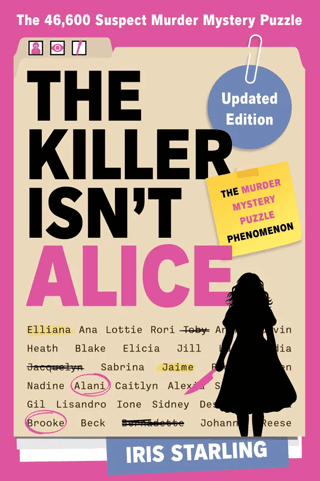
Updated edition guide
What changes in the September 2026 edition
The revised and expanded English-language edition releases September 1, 2026. Official sources say it keeps the same clues but changes every name and the culprit, updates the graphics, and adds a bonus puzzle; the review above covers the established solving format and clearly identifies the edition difference.
- Release date
- September 1, 2026
- Publisher format
- Trade paperback
- Puzzle changes
- All names and the culprit change while the clues remain the same.
- Added material
- Updated graphics and a new bonus puzzle.
- Original edition
- The creators say the original self-published edition is out of print.
Primary sources: Little, Brown publisher listing, Official updated edition page, Official puzzle site
Should you read The Killer Isn't Alice?
What works
The puzzle asks the solver to develop a method instead of merely answer riddles. Clues interact with page position, chapter labels, nearby names, spelling, and repeated entries, so efficiency improves when broad filters are applied before expensive page-by-page checks. The marked book becomes a visible record of the investigation.
What may not work for you
The experience is fragile. Misreading one rule or crossing out the wrong name can remove the culprit with no internal error check, and the book does not contain its own solution. Clarifications and answer verification live on the companion website, which is useful but makes a printed puzzle less self-contained than it should be.
What may test your patience
The first full pass through hundreds of pages of names is deliberately monotonous and can produce real eye strain. Momentum arrives only after several clues shrink the field enough for individual pages and candidates to feel meaningful. Anyone who dislikes repetitive checking should not mistake the murder framing for a narrative thriller.
Does the ending reward the effort?
The payoff is satisfying when a single candidate survives and the online submission confirms the reasoning. It is less satisfying if an error leaves no candidate or several, because recovery may require auditing the entire marked dossier. There is no story resolution comparable to the ending of a novel.
Reading The Killer Isn't Alice closely
The Killer Isn't Alice begins with the outline of a crime but removes nearly everything a conventional mystery uses to sustain interest. Alice is missing, a body has been found in her apartment, and she has left eighteen clues capable of identifying the real killer. Instead of scenes, interviews, motives, and suspects with personalities, the solver receives a dossier containing 46,600 names. The task is to eliminate 45,599 of them without accidentally removing the one person who satisfies every condition.
The puzzle becomes interesting when clues stop behaving like eighteen separate chores. Some eliminate large regions of the book through chapter or page position. Others depend on exact spelling, nearby names, duplicated entries, or information attached to a page. Applying them in printed order is possible but inefficient. The real act of deduction is deciding which filters reduce the work for later filters. A broad clue used early can save hundreds of checks; a delicate proximity clue is safer after the candidate set has collapsed.
This is a physical project. A pencil or erasable pen is safer than a permanent marker, colored highlighters can preserve which clue removed a candidate, and a separate checklist helps prevent two unfinished passes from becoming confused. Short sessions are better than exhausted scanning because the names begin to lose visual distinction after too many pages. The satisfying part is not reading the dossier. It is seeing an overwhelming field become a manageable set through a method the solver designed.
The format also has a severe failure mode. One misunderstood phrase or mistaken mark can eliminate the culprit, and the remaining pages do not warn that the system has broken. The companion website provides clue clarifications and accepts a proposed solution, but the answer is not printed in the book. That protects the puzzle from accidental spoilers and makes verification feel like submitting evidence, yet it also means the object cannot fully resolve itself without an external service. Counterfeit or misordered copies can be literally unsolvable, so edition and seller matter.
The established edition uses eighteen clues and was built as a 2026 solving experience. The updated English-language edition scheduled for September 1, 2026 keeps the clues but changes the names and culprit, improves the graphics, and adds a bonus puzzle, according to the official publisher and author pages. That makes it a fresh data set even for previous solvers. The concept is easy to explain and demanding to execute. It is excellent for patient annotators and a poor purchase for anyone expecting a story with 46,600 possible characters.
The real puzzle is choosing an order
A clue's value depends on when it is used. Page and chapter filters can remove large blocks cheaply, while proximity and spelling checks demand more attention. Planning the sequence turns raw persistence into an actual solving strategy.
Marking discipline matters
Use erasable marks or a consistent color system, record which clue is in progress, and stop when accuracy begins to slip. The book offers little protection against a false elimination, so the solver's notation becomes part of the puzzle apparatus.
Buy an authentic, complete edition
The official FAQ warns that unauthorized spiral-bound and photocopied copies may contain duplicated, missing, faint, or misordered pages. Because page position and exact names are evidence, a printing defect is not cosmetic. It can make the case impossible to solve.
Three useful comparisons
The Tainted Cup
The Tainted Cup embeds evidence inside a complete fantasy detective story, using an eccentric investigator, a memorable assistant, and biological worldbuilding. The Killer Isn't Alice removes almost all narrative and makes the reader perform the filtering directly. Choose Bennett for character and inference; choose Starling for a physical, multi-session elimination task.
Best for: Mystery readers who want a fair trail of clues and fantasy readers who enjoy learning a world through an investigation.
The Impossible Fortune
The Impossible Fortune treats detection as a social activity among familiar amateur sleuths, with friendship and comic conversation carrying as much weight as the case. Starling offers no recurring ensemble and almost no dialogue. Its pleasure comes from private procedure, exact checking, and the marks accumulating on paper.
Best for: Established Thursday Murder Club readers who want a warm ensemble mystery with wit, mortality, friendship, and danger kept below hard-boiled intensity.
The Housemaid
The Housemaid produces suspense by controlling what its narrator and reader know, then reinterpreting earlier scenes through twists. The Killer Isn't Alice gives the rules up front and hides one answer inside a huge data set. Pick McFadden for a fast psychological story; pick Starling when you want to do the detective work with a pen.
Best for: Choose it for a fast domestic thriller with unreliable impressions, class tension, abuse themes, and a major perspective reversal.