Mystery puzzle books
7 Murder Mystery Puzzle Books That Make Great Gifts (2026)
A crime novel lets you follow the detective. These books hand you the clues and leave the solving to you.
A murder-mystery puzzle book asks a different question from a crime novel. Instead of wondering whether you can guess the ending before the detective explains it, you have to make the evidence work yourself. That might mean crossing a possibility off a grid, studying a room or finding a connection between two pieces of prose.
For a gift, I find that distinction more interesting than the murder theme alone. Seven books can all promise a mystery and still produce seven quite different evenings at a table. Here is what is inside each one, from short detective logic puzzles to a story that has to be put back together.
More books after The Killer Isn't Alice · Murdle, Murdoku and Alice compared in detail
A quick overview
Seven different ways to investigate
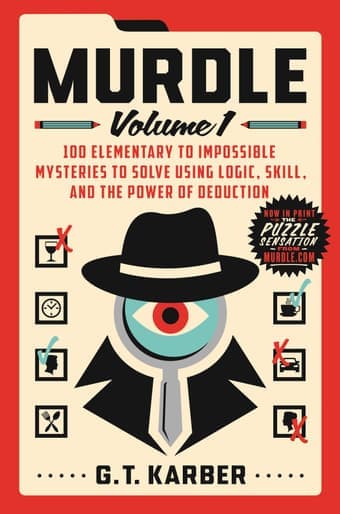
- Murdle: Volume 1: written clues and logic grids across 100 cases.
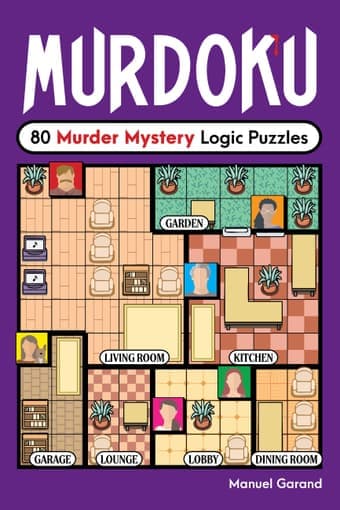
- Murdoku: 80 illustrated crime scenes built around spatial deduction.
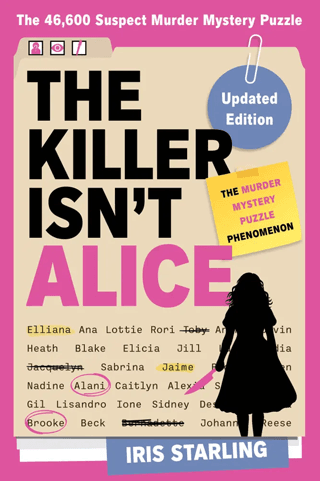
- The Killer Isn't Alice: one extended suspect-elimination challenge.
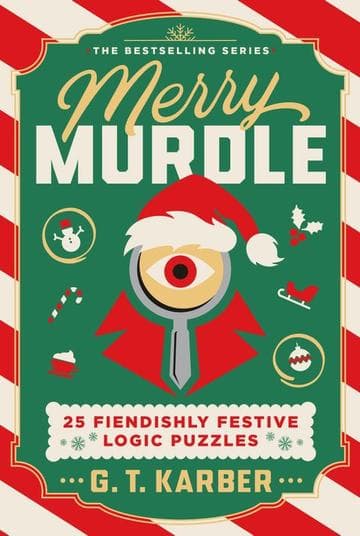
- Merry Murdle: 25 festive mysteries using deduction grids.
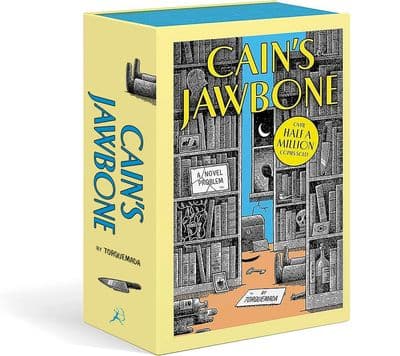
- Cain's Jawbone: reconstructing a scrambled literary murder mystery.
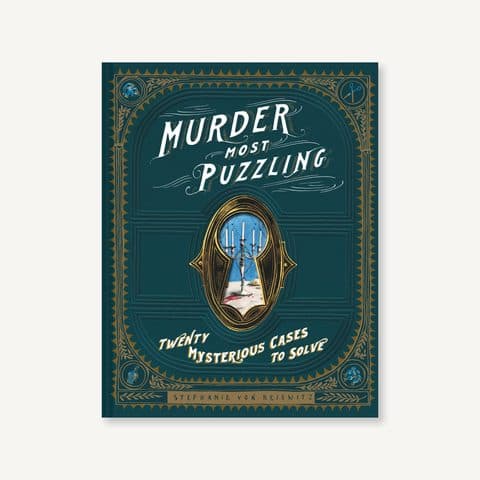
- Murder Most Puzzling: 20 illustrated cases with visual and story clues.
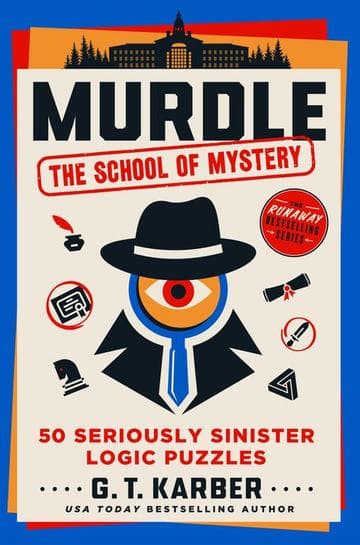
- Murdle: The School of Mystery: 50 logic puzzles set at a detective school.
Some of these books offer a new case whenever you turn the page. Others ask you to stay with one stubborn problem, keeping notes and returning to clues. The murder theme is the common ground; what you actually spend your time doing varies considerably.
The activity at a glance
What the seven puzzle books contain
The counts below describe the main puzzles, not how long they take. One extended investigation is a different kind of commitment from a collection of smaller cases.
| Book | What you actually do | Puzzle structure | Type of clues | Cases or main challenge |
|---|---|---|---|---|
| Murdle: Volume 1 | Connect suspects, weapons and locations on a grid | Separate cases with a connecting mystery | Written statements and deductions | 100 cases |
| Murdoku | Work out where suspects can stand in a crime scene | A succession of illustrated mysteries | Positions, surroundings and spatial restrictions | 80 cases |
| The Killer Isn't Alice | Eliminate names until one suspect fits every condition | One sustained elimination puzzle | 18 clues applied to a large suspect list | One central case |
| Merry Murdle | Complete deduction grids from festive case clues | Individual cases in a holiday setting | Written clues about suspects and circumstances | 25 cases |
| Cain's Jawbone | Reconstruct the order of a scrambled narrative | One literary puzzle containing multiple murders | Connections hidden in the wording | 100 pieces to order |
| Murder Most Puzzling | Study scenes and story details to explain a crime | A collection of illustrated investigations | Visual evidence and accompanying text | 20 cases |
| Murdle: The School of Mystery | Match suspects, weapons and locations using logic | Cases within a detective-school mystery | Written clues, grids and illustrated material | 50 cases |
Inside the books
Seven murder mysteries you help solve
These are different approaches to the activity, rather than a ranking from easiest to hardest.
1
Murdle: Volume 1
G. T. Karber · 100 murder-mystery logic puzzles
Each Murdle case gives you suspects, possible weapons, locations and a set of clues. The grid is where those clues become useful: a statement can establish a connection or rule one out, and the consequences narrow the remaining combinations. You are doing the deduction that a detective would normally explain at the end of a chapter.
The hundred cases have recurring fictional elements, with Deductive Logico and a larger mystery connecting them. I like the balance in that structure: each case supplies a defined problem, while the collection has more continuity than a stack of unrelated brainteasers. The main activity is following written evidence across categories, rather than searching an illustration for something hidden.
2
Murdoku
Manuel Garand · 80 illustrated mysteries
Open Murdoku and the crime scene is in front of you. Its eighty mysteries give you illustrated environments and clues about where the characters can or cannot be. Rooms, furniture and other details constrain the possible positions, so the picture belongs to the reasoning rather than simply decorating the case.
The Sudoku connection is spatial: placement restrictions help you work out where everyone fits and identify the killer. It is not ordinary numerical Sudoku. Compared with Murdle, which organizes deductions across a category grid, Murdoku asks you to think inside the scene. A position that looks plausible has to survive both the written clues and the layout around it.
3
The Killer Isn't Alice
Iris Starling · One extended elimination challenge
The Killer Isn't Alice gives you eighteen clues and a large list of possible suspects. Each condition removes candidates who cannot be the killer; the task is to keep applying those conditions until a single name remains. Rather than serving up a fresh crime every few pages, the book keeps your attention on one substantial problem.
Much of the work lies in careful scanning, note-taking and checking which candidates still meet the conditions. That sustained attention is the defining feature, rather than a conventional plot unfolding around a detective. There is also a practical detail: the solution is checked through the official online answer checker, so verifying the final answer involves visiting the companion site.
4
Merry Murdle
G. T. Karber · 25 festive logic mysteries
Merry Murdle brings the familiar case clues and deduction grids into a Christmas setting. Across twenty-five murder-mystery puzzles, you examine the evidence, consider the suspects and work out which possibilities can coexist. Deductive Logico returns, with festive details giving the investigations their comic flavor.
The holiday setting makes the gift connection straightforward, but the activity remains a collection of individual logic problems. It is not one enormous continuous investigation in the manner of Alice. There is less here by puzzle count than in Murdle: Volume 1; the distinction is the concentrated seasonal atmosphere, rather than a different basic way of solving.
5
Cain's Jawbone
Edward Powys Mathers · A scrambled literary murder mystery
Cain's Jawbone makes the narrative itself the puzzle. One hundred pieces of text are out of order, and reconstructing the sequence is how you uncover the murder story. The wording contains clues to the connections. Reading a passage therefore means asking both what it tells you and where it belongs.
What interests me is how completely that changes the act of reading: the story cannot simply carry you forward because you have to establish what comes next. Its reputation rests on how demanding that reconstruction is. Unlike Alice's explicit elimination conditions, the prose does not hand over a tidy procedure for each step; close reading and uncertainty are part of the challenge.
6
Murder Most Puzzling
Stephanie von Reiswitz · 20 illustrated murder mysteries
Murder Most Puzzling places twenty cases inside richly illustrated scenes, with story clues alongside the visual evidence. You act as a companion to amateur sleuth Medea Thorne, looking closely at the details and working out what they imply about the crime. The illustrations are central to the investigation, not a pause between stretches of detective prose.
The playful gothic atmosphere gives the cases a macabre sense of humor. Its visual approach differs from Murdoku's: instead of placing suspects according to spatial restrictions, you inspect what the scene and its accompanying text reveal. This is observation and interpretation across a collection of mysteries, rather than one long exercise in eliminating names.
7
Murdle: The School of Mystery
G. T. Karber · 50 murder-mystery logic puzzles
The School of Mystery sets fifty logic puzzles at Deduction College. Each mystery supplies suspects, weapons, locations and clues, with a grid for testing the connections. The school setting adds tunnels, secret societies and illustrated material to the investigations, while a larger enigma runs through the collection.
The change from Murdle: Volume 1 is chiefly the fictional frame: detective training gives these cases a shared home and a darker academic atmosphere. Individual puzzles sit within the larger school mystery, so the collection combines smaller problems with an ongoing thread.
Written clues, pictures and one larger problem
Murdle and The School of Mystery use grids to organize written deductions. Merry Murdle brings that approach into a holiday setting. Their connecting fiction gives the cases atmosphere and continuity, but the immediate work still happens one problem at a time.
Murdoku and Murder Most Puzzling both make images essential, in different ways. In Murdoku, the scene restricts where people can stand. In Murder Most Puzzling, you inspect visual details alongside story evidence. One is a placement problem; the other asks you to interpret the illustrated case.
Alice and Cain's Jawbone require a longer relationship with the same central challenge. Alice narrows a field of names using explicit conditions. Cain's Jawbone asks you to recover the sequence of a story through its language. They share sustained attention, but the kind of uncertainty is very different.
Giving someone a mystery to work on
A puzzle book is a present the recipient has to take part in. A collection of cases offers stopping points and fresh starts; one extended problem leaves more to hold in mind between sessions. That difference says more about the experience than a large number on a cover.
Christmas is built into Merry Murdle, while the other books have a more general mystery setting. The useful distinction is what ends up on the table: a deduction grid, an illustrated scene, a suspect list or pieces of a story waiting to be connected.
The pleasure they share
What draws me to this group is how differently a book can give the reader responsibility for the answer. A tiny contradiction in a clue, an impossible position in a room and a sentence that suddenly belongs beside another can all move an investigation forward. The interesting part is the work between opening the book and knowing why an answer fits.
Inside The Killer Isn't Alice · Further puzzle books and narrative mysteries after Alice
Sources
Sources for this guide
Official descriptions of the books and their puzzle mechanics, checked October 20, 2026:
Keep reading