Puzzle book reading order
Murdoku Books in Order (2026): Original, Back in Time and Around the World
One illustrated grid is enough to hide a killer. Across three books, Manuel Garand takes that idea through five historical eras and across seven continents.
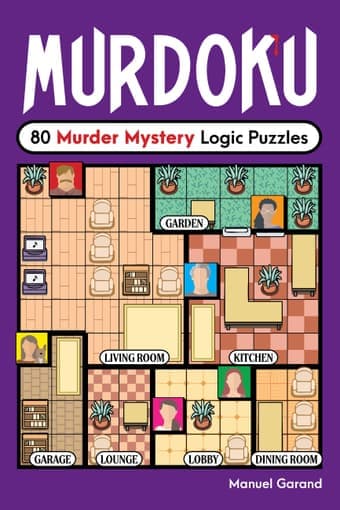
I’ve read all three Murdoku books. The thing they share is that a clue sends you back to the picture. If someone was in a particular room, you need to see where that room begins and ends. As soon as you place someone, the occupied row and column can change what’s possible for everybody else.
Publication order
What order do the Murdoku books go in?
- Murdoku (October 28, 2025)
- Murdoku: Back in Time (May 19, 2026)
- Murdoku: Around the World (October 27, 2026)
Three main Murdoku volumes have been published in the U.S. as of November 2026. They’re all by Manuel Garand, with 80 cases in each. Around the World is the latest.
Do you need to read Murdoku in order?
No. Each volume gives you the rules you need and a fresh set of cases. You won’t need the solution to a crime in one book to follow the next. Back in Time gives its cases a time-travel premise, but you can start there without having placed a single suspect in the original.
The original gives you a straightforward introduction to the layout and the row-and-column rule. If you’re starting in a later book, its opening puzzles give you somewhere to practice before taking on the more involved scenes.
Volumes 1 to 3
What changes from one Murdoku book to the next?
1
Murdoku
Manuel Garand · 80 illustrated cases
The original gives you a cast, a set of written clues, and an illustrated crime scene divided into squares. If a clue puts a suspect in the kitchen, you can cross off every square outside it for that person. Once you know where someone stands, nobody else can use that row or column. A placement on one side of the scene can leave a suspect across the room with only one possible square.
You also have to place the victim. In a standard case, the culprit is whoever was alone with them in the same area. That makes a doorway, a piece of furniture, or the boundary between two rooms relevant to the solution. The opening cases give you room to practice that chain of deductions. Later ones make you combine more clues before anyone’s position is certain. The worked solutions show how those steps fit together.
2
Murdoku: Back in Time
Manuel Garand · 80 cases across five eras
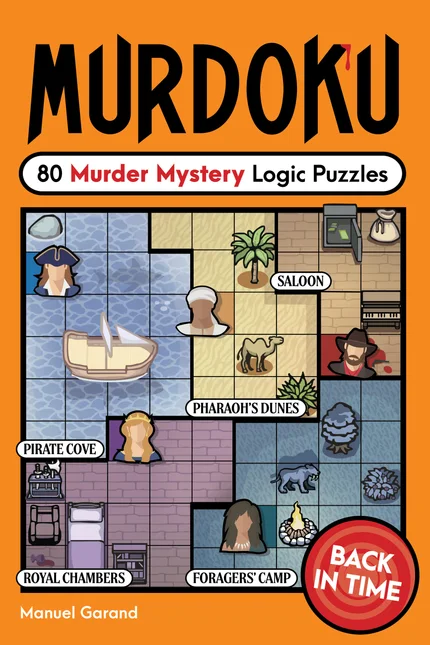
A time portal sends the second book through the Stone Age, ancient Egypt, the Middle Ages, the Golden Age of Piracy, and the Old West. In the Temple of Anubis or Smugglers’ Cove, the same deduction still works. Use the written evidence to narrow down the squares that could hold each person, then check how those possibilities fit together.
What changes is how you read each setting. A camp or a temple doesn’t divide up space the way a house does, and the busier illustrations give clues more objects to point to. Some cases add rules of their own. The period setting makes a difference when it changes which squares a clue leaves open, even though the familiar placement rule still does much of the work.
3
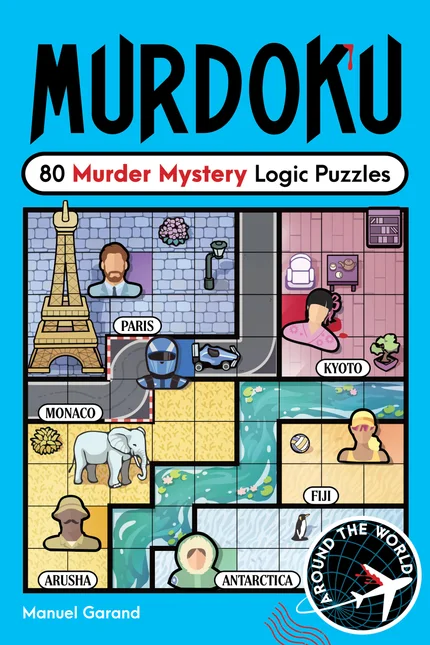
Murdoku: Around the World
Manuel Garand · 80 cases across seven continents
The third book ranges from a race in Monaco to a garden in Japan and a research station in Antarctica. Some investigations take place across several grids. Before you can settle on a square, you may have to decide which part of the crime scene a suspect could have been in.
A case spread across locations gives you more than one set of possibilities to keep in view. If a clue rules someone out of one scene, you have to carry that result into the other scenes before working out their position. The deductions are still about where people can be. The extra work is keeping the locations straight while the evidence for one case is scattered between them.
Side by side
How the three Murdoku books compare
All three teach the placement rules and can be started independently. Here’s what changes on the page.
| Volume | Where the cases go | What you keep track of |
|---|---|---|
| Murdoku | Familiar places such as a bakery, a casino, or an opera house | People and objects within one illustrated crime scene |
| Back in Time | Five historical eras | More detailed scenes and case-specific rules |
| Around the World | Locations on all seven continents | Suspects and clues across several grids in some cases |
Does the difficulty change between books?
The original and Back in Time both build from easier puzzles to harder ones. The second book has its own opening stretch. It doesn’t drop you straight into problems at the level of the original’s hardest cases.
An extra grid can make a case harder by giving you more places to rule out. A single scene can be demanding too, especially when several people could fit in the same small area and you need to test the clues together. Difficulty depends on the case and on what you find harder to keep straight.
Is Murdoku the same as Murdle?
Both use deductive clues to solve crimes. In Murdle, you use a logic grid to match categories such as suspects, weapons, and locations. In Murdoku, the grid is the crime scene itself, and the written clues tell you where people might be standing. The same placement idea runs through all three Murdoku books, whether the drawing is a single house, a historical scene, or a case split across several locations.
Sources
Sources for this guide
Manuel Garand’s rules and sample scenes, plus the U.S. publisher’s listings for each volume.
Keep reading