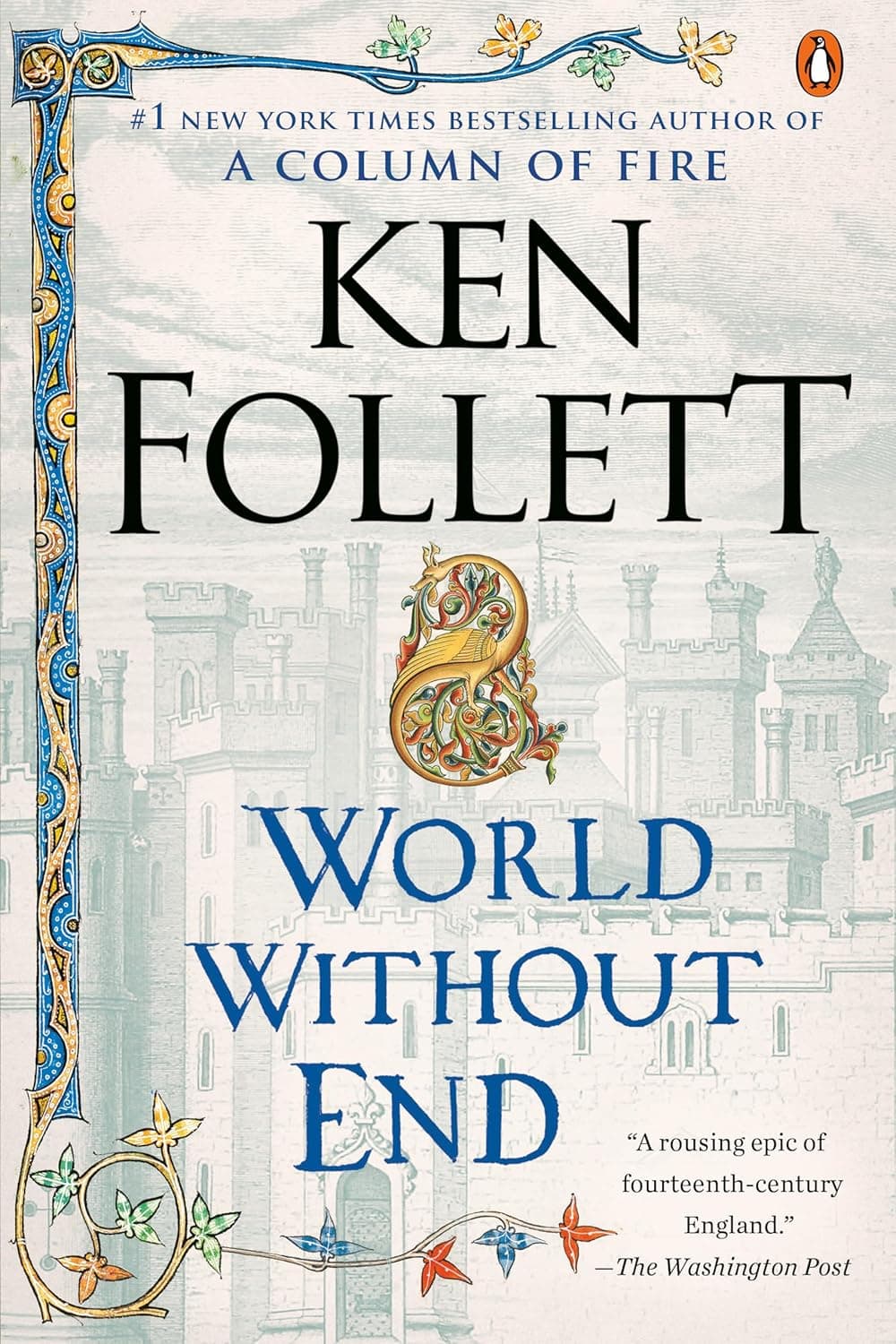
Should you read World Without End?
What works
Caris, Merthin, hospitals, bridges, guilds, and the Black Death make practical innovation collide with church and commercial authority.
What may not work for you
Antagonists are broad, sexual violence recurs, coincidences are heavy, and the length magnifies familiar patterns from The Pillars of the Earth.
What may test your patience
Several cycles of separation, obstruction, and renewed building make the middle feel engineered to postpone outcomes.
Does the ending reward the effort?
Yes. Caris and Merthin's work and relationship reach clear conclusions, and the town keeps the changes they fought for after decades of obstruction.
Reading World Without End closely
World Without End returns to Kingsbridge two centuries after The Pillars of the Earth. Its tradespeople, healers, builders, and schemers face plague and war while fighting over who gets to shape the town's future.
Stonework, wool guild rivalries, legal loopholes, and battlefield logistics all change what the characters can do. Merthin's bridge is an engineering problem and a fight over who controls trade. Caris's medical work threatens authorities who would rather preserve their position than test whether a treatment works.
The new cast carries the story. Caris pushes against the limits placed on women while trying to practice medicine, Merthin channels his talent into daring engineering projects, Gwenda claws for a better life in a world that keeps closing doors, and Ralph uses violence as a way to climb. Their paths intersect, drift apart, and collide again so that even when the narrative jumps to royal courts or far off campaigns, Kingsbridge remains the center of gravity.
The chapters are short, but the repeated separations, blocked projects, and cruel turns still make the middle drag. The Black Death changes the argument by forcing medical practice, church authority, and town survival into the same emergency. The ending then shows which laws, treatments, and buildings outlast the people who resisted them.
What stands out in World Without End
Merthin's bridge and other building projects make engineering inseparable from trade and civic power.
Caris's medical work puts observation and treatment into conflict with church authority.
The Black Death changes labor, law, worship, and relationships instead of serving as historical scenery.
Three useful comparisons
The Pillars of the Earth
Pillars is the stronger, fresher foundation and should be read first.
Best for: Settle in for a long, accessible medieval saga about cathedral building, family, politics, violence, romance, and clear heroes and villains.
A Column of Fire
A Column of Fire moves Kingsbridge into religious espionage and international politics.
Best for: Choose it for Ned's intelligence work, Margery's divided loyalties, religious conflict, secret printing, and a story that moves repeatedly between England and continental Europe.
Between Two Fires
Between Two Fires treats plague-era medieval life as a shorter, far darker religious horror pilgrimage.
Best for: Go here for medieval horror, plague, faith, demons, violence, and a damaged knight's redemptive journey.
Make the next decision