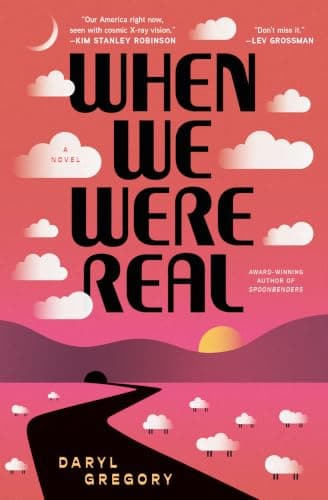
Should you read When We Were Real?
What works
The glitch tour converts metaphysical crisis into tourism, commerce, friendship, and private fear, keeping the premise close to recognizable human behavior.
What may not work for you
Some travelers exist mainly to represent a response to the revelation, and the ensemble's digressions can loosen the road narrative.
What may test your patience
The bus gathers personalities and personal histories before the journey's emotional direction becomes more important than its spectacular destinations.
Does the ending reward the effort?
Yes. It finds meaning in chosen attention and companionship without disproving the simulation or inventing a cosmic answer the premise cannot supply.
Reading When We Were Real closely
When We Were Real begins after humanity learns that reality is simulated and the world responds with confusion, tourism, denial, and new forms of commerce. Two friends join a bus trip to visit visible glitches, carrying private fears that make the cosmic question feel personal.
Daryl Gregory treats the road trip as an ensemble comedy and an existential reckoning. The simulated-world premise creates spectacle, but the novel's real interest is how people love, lie, grieve, and make plans when reality itself no longer guarantees meaning.
A glitch tour with human stakes
Each stop offers a new violation of ordinary physics, while the passengers' relationships prevent the trip from becoming a catalogue of clever effects.
Three useful comparisons
Eversion
Eversion builds reality uncertainty as a tightening structural mystery; When We Were Real reveals its premise early and studies how ordinary people continue afterward.
Best for: Pick this for standalone science fiction, unreliable reality, exploration, artificial intelligence, and a strong late reveal.
Mickey7
Mickey7 turns identity philosophy into one worker's survival problem, while Gregory spreads existential uncertainty across a comic traveling community.
Best for: Science-fiction readers wanting cloning, hostile-planet survival, corporate exploitation, existential questions, and dark humor in a compact standalone story.
House of Suns
House of Suns offers cosmic scale, deep time, and grand mystery; When We Were Real remains deliberately contemporary, social, and intimate.
Best for: Choose it for an accessible standalone epic with deep time, clones, machine people, romance, pursuit, and galactic mystery.