Short fiction and a possession novel
Daryl Gregory was born in 1965 and developed his career through short fiction before his first novel, Pandemonium, appeared in 2008. Ordinary people are taken over by familiar archetypes, but the narrator cannot tell whether the event controlling his life is supernatural, psychological, or cultural. Gregory takes an idea that could remain a clever puzzle and makes it part of an older family argument.
The Devil's Alphabet uses altered human populations to explore homecoming and community, while Raising Stony Mayhall reworks the zombie story through a protagonist whose personhood the genre would usually deny. Gregory's speculative devices rarely arrive as neutral inventions. They create categories that institutions and families immediately use to decide who counts.
Brains, drugs, and collective belief
Afterparty centers on a drug capable of producing religious certainty, joining neuroscience to the political and emotional uses of belief. Harrison Squared and We Are All Completely Fine approach cosmic horror through damaged survivors who understand that sharing a room does not guarantee a shared account of what happened. Gregory can handle frightening imagery, but he is especially good at the social awkwardness after horror, when people must negotiate whose explanation becomes official.
His prose is clean, quick, and often comic. Humor does not dismiss the speculative problem. It shows how people use familiar behavior to approach something for which they have no stable language. Gregory avoids the chilly distance associated with some idea-driven fiction by giving concepts embarrassing domestic consequences.
The family may be the strangest system
Spoonbenders follows a once-famous family of psychics whose powers, frauds, resentments, and loyalties cannot be separated neatly. It is one of Gregory's warmest novels and a strong example of his belief that a group can contain genuine love and sustained damage at the same time. No revelation about whether a power is real can solve the older question of how relatives keep assigning one another roles.
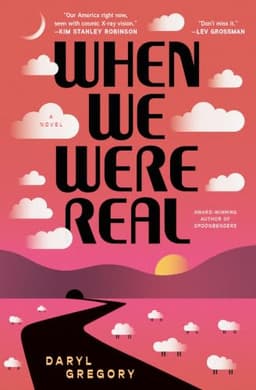
When We Were Real expands toward a world transformed by knowledge that reality is artificial. Gregory resists making that revelation only a metaphysical game. People travel, grieve, make money, seek spectacle, and try to decide whether a constructed world can still contain authentic obligation. The road structure allows the book to collect responses without pretending one answer settles them all. Spoonbenders is the best starting point for character and family; Afterparty for science-fiction pressure; Pandemonium for the compact early statement of his concerns.
The speculative premise enters the family system
Gregory rarely leaves a large idea in the laboratory. A drug that produces religious certainty changes friendship, medicine, commerce, and self-understanding. A psychic ability becomes family reputation and inherited work. Knowledge that reality is artificial changes tourism, grief, and what people sell one another. The premise matters because a group must continue living after it becomes true.
His narrators often approach impossible experience with jokes or practiced explanations. This keeps the prose mobile and creates a useful suspicion: the person most fluent in the story may be the person who needs that version most. Gregory's reveals work when they expose an emotional arrangement, not just a hidden technical fact.
Spoonbenders is especially good on the difference between fraud and falsehood. A family may exaggerate powers, exploit a public act, and still contain abilities outsiders wrongly dismiss. The uncertainty prevents easy moral sorting. Love does not make the family honest, and dishonesty does not prove every attachment counterfeit.
When We Were Real enlarges the social canvas but retains this concern. Once reality itself has been explained, people do not become philosophers full time. They mourn, take trips, seek attention, make money, and wonder whether constructed experience can still obligate them. Gregory's answer is practical: origin may be uncertain, but the consequences experienced by another mind remain real enough to demand a response.
Exposition through a person who needs the theory
Gregory often gives the explanation of an impossible event to someone with an emotional investment in that explanation. A scientist, performer, addict, relative, or believer may be accurate about mechanics while using the theory to avoid another truth. Exposition then becomes characterization. The reader listens not only for how the phenomenon works but for why this speaker needs it to work in precisely that way.
This method gives his novels unusually sociable big ideas. The premise is discussed, marketed, joked about, folded into family legend, and misunderstood in public. In Spoonbenders, psychic ability cannot be separated from show business and inherited resentment. In When We Were Real, knowledge about the nature of reality becomes part of tourism and ordinary grief. Gregory moves lightly across complex material because dialogue carries much of the load. The cost is that an emotionally agile cast can occasionally make adjustment look too easy. His best endings restore weight by asking what remains after everyone has learned the clever explanation.