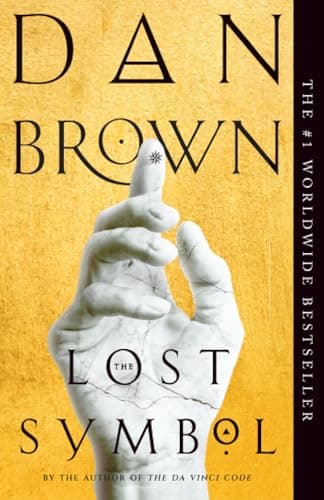
Should you read The Lost Symbol?
What works
Masonic spaces, the Capitol, hidden architecture, and Katherine's consciousness research create a coherent symbolic geography.
What may not work for you
The chase circles, Mal'akh is excessive, noetic science is oversold, and characters repeatedly explain symbolism under implausible urgency.
What may test your patience
Multiple captures, escapes, and lectures delay the hidden chamber after its broad purpose is already easy to anticipate.
Does the ending reward the effort?
The final symbolic revelation is thematically apt but smaller than the physical and conspiratorial escalation used to reach it.
Reading The Lost Symbol closely
The Lost Symbol brings Robert Langdon to Washington, D.C., where an apparent invitation from his mentor Peter Solomon becomes a kidnapping and a trail of Masonic symbols. The Capitol, monuments, hidden chambers, and ritual imagery turn the city into Brown's next puzzle map.
Compared with the European settings of the earlier novels, this installment concentrates on American founding mythology, Freemasonry, and noetic science. Its single-night structure is propulsive, although repeated revelations and extended explanations make it feel longer than the clock suggests.
Washington as a symbolic city
Brown uses architecture and monuments to connect public national identity with private ritual. Familiar landmarks become clues without requiring prior knowledge of Freemasonry.
Series order
It is Robert Langdon book three after Angels & Demons and The Da Vinci Code. The case stands alone, so new readers can follow it, but earlier books establish Langdon's methods and recurring skepticism.
Three useful comparisons
The Da Vinci Code
The Da Vinci Code has a cleaner puzzle chain, stronger partnership, and more satisfying final route.
Best for: Best for a fast art-history conspiracy if you can treat its factual claims as entertainment that needs verification.
Origin
Origin offers more contemporary technology and a smoother travel thriller, though similar philosophical overstatement.
Best for: Langdon fans wanting Spanish art and architecture, artificial intelligence, religion, and a smooth modern chase.
The Secret of Secrets
The Secret of Secrets returns to Katherine Solomon and consciousness with greater emotional continuity.
Best for: Langdon readers wanting Prague, Katherine Solomon, consciousness research, secret knowledge, and another fast international pursuit.
Series buying note
Would the collection be the better buy?
These are useful only when you want several books in the same run. The notes below spell out what each package includes and, just as importantly, what it leaves out.
Seven-book paperback collection
Dan Brown 7-Book Collection
The package mixes five Robert Langdon adventures with Dan Brown's two standalone thrillers, Digital Fortress and Deception Point.
Included: Angels & Demons, The Da Vinci Code, The Lost Symbol, Inferno, Origin, Digital Fortress, Deception Point
Our buying note: Despite the marketplace title, this is not the complete current Langdon sequence. It omits The Secret of Secrets, so check the seven listed titles before ordering.