Review summary
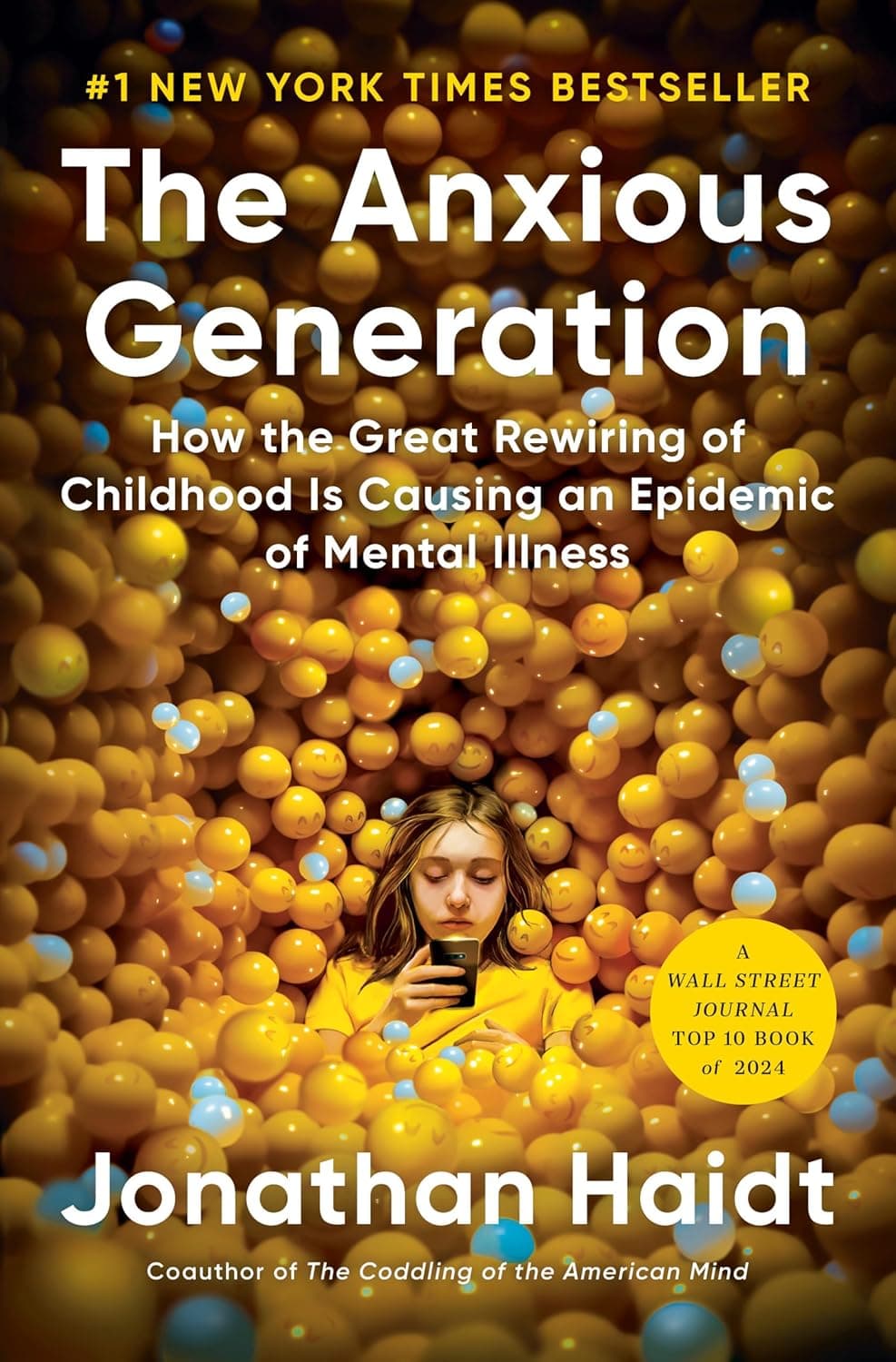
This spoiler free review of The Anxious Generation by Jonathan Haidt walks through why this narrative nonfiction book that how the great rewiring of childhood is causing an epidemic of mental illness still hooks readers. This The Anxious Generation review looks at how Jonathan Haidt links the shift from play based childhoods to phone based childhoods with rising teen anxiety and depression, and which practical norms parents and schools might try in response.
Full review
This spoiler free review and summary of The Anxious Generation by Jonathan Haidt focuses on his core claim that a phone based childhood has replaced a play based childhood, and that this great rewiring of daily life is tightly linked to rising anxiety and depression in teens. Haidt walks readers through graphs, timelines, and case studies to argue that the mental health curve bends sharply upward from around 2010, right when smartphones and social media became normal parts of adolescence.
The early chapters explain what childhood looked like before this shift. Haidt describes unsupervised outdoor play, walking to friends' houses, and local exploration as the training ground where kids learn to handle risk, conflict, and boredom. He frames this as an age of free range or play based childhood. Then he contrasts it with what he calls the phone based childhood, where many hours move indoors onto glowing screens, where social status updates never stop and parents feel pressure to monitor everything from a distance.
For parents who search for The Anxious Generation explained or key ideas from The Anxious Generation parents should actually apply, the most practical parts of the book are Haidt's four norms. He suggests no smartphones before roughly age fourteen, no social media before sixteen, phone free schools, and a conscious effort to restore unsupervised play and offline community for kids. The examples are written in plain language and feel aimed at busy parents, teachers, and school leaders rather than academic specialists.
Haidt also spends time on the data itself, which is where many of the criticisms live. He highlights correlations between social media use and teen mental health problems, especially for girls, and uses international comparisons to argue that this is not only an American story. Critics of The Anxious Generation point out that meta analyses often find much smaller or inconsistent links between screen time and well being, and they worry that over focusing on phones could distract from other pressures like school stress, family finances, or global news. The book acknowledges some of this pushback, but readers who want a full tour of the debate will still need to sample outside reviews and research.
If you read with those caveats in mind, The Anxious Generation works well as a parent friendly map of the problem and a starting point for family rules. Haidt blends moral psychology, stories from families, and straightforward advice so that adults who feel overwhelmed by tech can still come away with a short list of actions. If you want to dig deeper after this The Anxious Generation book review for parents, you can add The Anxious Generation to your Amazon cart and pair it with other nonfiction on youth mental health and technology to compare arguments and decide what fits your household or classroom best.
The Anxious Generation Review Highlights
Frames the shift from a play based childhood to a phone based childhood as a central explanation for rising teen anxiety and depression.
Combines charts, timelines, and case stories so that busy parents can follow the argument without needing a statistics background.
Offers clear norms and conversation starters that turn a dense debate about smartphones and social media into concrete family and school decisions.
Who Should Read The Anxious Generation
Parents, caregivers, and teachers who want a structured overview of how social media, smartphones, and overprotective parenting might be affecting kids born after the late 1990s.
School leaders and counselors looking for a readable summary to share with colleagues or parent groups when discussing phone free schools and online safety policies.
Older teens and young adults who are comfortable with non fiction and want to see how adults are talking about their phone use and mental health, especially in the United States and other wealthy countries.
Helpful Resources For Parents And Educators
Use the book as a base text for a parent discussion group, comparing Haidt's suggested norms with your local school policies and community expectations.
Pair The Anxious Generation with other titles on youth mental health and digital life so you can weigh different interpretations of the same data instead of relying on a single voice.
Invite teens to respond to selected chapters, asking which parts feel accurate, which feel exaggerated, and what boundaries around phones and social media might actually feel realistic to them.
Key ideas
- A rapid shift from play based to phone based childhood around the early 2010s coincides with a sharp rise in anxiety, depression, and self harm among teens, especially girls.
- Children need unsupervised play, exploration, and gradual exposure to real world risks to build resilience, and these experiences are often crowded out by time spent on social media and phones.
- Even if researchers still debate how strong the causal links are, families, schools, and governments can act now by setting clearer norms around age of first smartphone, access to social media, and phone free spaces.
If you liked this, read next
FAQ
- What is The Anxious Generation about?
- The Anxious Generation is a non fiction book by social psychologist Jonathan Haidt that argues a combination of overprotective real world parenting and underprotected online life has rewired childhood. He links the rise of smartphones and social media to an epidemic of anxiety, depression, and self harm among teens, and suggests cultural norms that might reverse some of the damage.
- Who should read The Anxious Generation?
- The book is written mainly for parents, teachers, and policy makers who worry about teen mental health and are looking for both a clear explanation and concrete steps. It also works for older teens and students in education or psychology courses who want to see a strong version of the argument that phones and social media play a central role in recent mental health trends.
- How strong is the evidence in The Anxious Generation?
- Haidt presents many charts and studies that show correlations between heavy social media use and poor mental health, especially for adolescent girls. Some researchers agree that there is a real effect, while others argue that the data are mixed and that the effect sizes are smaller than the book suggests. Readers should treat this as one influential case in an ongoing scientific debate rather than a final verdict.
- Is The Anxious Generation worth reading for parents in the smartphone era?
- If you feel overwhelmed by phones, apps, and constant notifications in your family, The Anxious Generation is a useful place to start because it turns vague worries into specific patterns and proposals. You may not agree with every conclusion, but the book gives you language, examples, and norms you can adapt to your own household, school, or community.
Reader-focused angles
This review intentionally answers longer questions readers often ask, such as the anxious generation summary and key ideas for parents and teachers, the anxious generation age recommendation and who should read this book, the anxious generation criticism and how strong the evidence really is, and key arguments from the anxious generation parents can actually apply at home and in school, so the guidance fits naturally into the analysis instead of living in a keyword list.
Each section of the review is written to speak directly to those searches, making it easier for book clubs, educators, and new readers to find the specific perspectives they need.
Reading guide
- Track Haidt's timeline from the 1980s to the 2010s, noting when he believes overprotective parenting grows and when smartphones and social media become widespread, then compare this with your own memories or your community's experience.
- List the four main norms Haidt recommends and discuss, as a family or book club, which ones feel doable now, which ones would need school or government help, and what compromises might still protect kids' mental health.
- Pay attention to the sections where Haidt discusses criticism of his thesis and make a short list of questions you want to investigate further so that The Anxious Generation becomes a starting point, not the last word, in your thinking.
As an Amazon Associate, I earn from qualifying purchases.