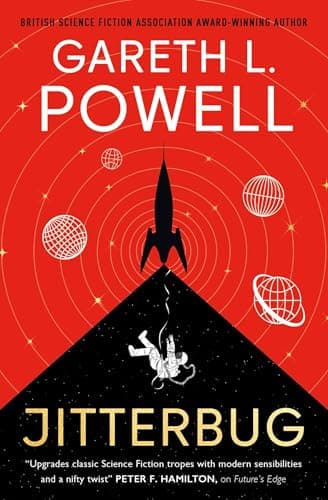
Should you read Jitterbug?
What works
The action retains emotional consequence, and machine perspectives are treated as relationships with memory and need rather than convenient tactical interfaces.
What may not work for you
Rapid changes of location and scale leave some connective scenes thin, while secondary figures receive less recovery time than the crises around them warrant.
What may test your patience
The opening introduces its human and artificial viewpoints in quick succession, so loyalties take longer to settle than the external threat.
Does the ending reward the effort?
Yes for the central choices. The interstellar problem remains larger than any single victory, but the emotional commitments are clear.
Reading Jitterbug closely
Jitterbug delivers Gareth L. Powell's familiar combination of cinematic space opera and vulnerable characters. A widening interstellar crisis pushes people and machines into decisions whose scale is galactic even when their motives remain intimate.
The novel moves quickly through pursuit, discovery, and escalating danger, but its strongest moments come from damaged relationships and artificial minds trying to determine what they owe to one another. Readers seeking momentum without abandoning emotional consequence are the natural audience.
Large stakes, intimate center
Powell keeps the scale readable by tying abstract danger to a small group whose loyalties and losses give each decision weight.
Three useful comparisons
Shards of Earth
Shards of Earth offers denser factions and more alien variety; Jitterbug moves faster and places artificial minds closer to its emotional center.
Best for: Go here for a found-family crew, diverse aliens, political factions, salvage work, and large-scale space-opera danger.
House of Suns
House of Suns is more intricate, mysterious, and concerned with deep time, while Jitterbug favors immediate relationships and action.
Best for: Choose it for an accessible standalone epic with deep time, clones, machine people, romance, pursuit, and galactic mystery.
Revelation Space
Revelation Space demands more patience for archaeology, physics, and competing agendas; Powell provides a more accessible and openly heartfelt route into large-scale space opera.
Best for: Patient readers wanting hard science fiction, archaeology, deep time, morally difficult characters, and cosmic danger.