Biography and criticism
What does a warship do after it refuses war?
Powell's ships and engineered beings are not comic accessories. Their orders, damage, and remorse reveal who is treated as a person and who is expected to absorb the cost.
From short stories to an armed monkey
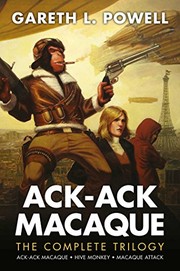
Gareth L. Powell is a British science-fiction writer who developed through short fiction before novels brought his combination of conceptual play and emotional accessibility to a larger audience. The Ack-Ack Macaque books center a cigar-smoking, gun-carrying monkey whose absurd surface opens into questions of identity, simulation, and exploitation. The work won Powell attention without confining him to one comic premise.
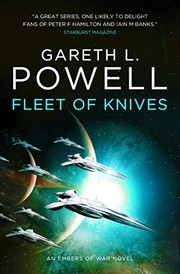
Embers of War begins another major phase. Its sentient warship, Trouble Dog, leaves military service burdened by participation in atrocity and joins a rescue organization. The question is concrete: what can a warship do with its strength after it refuses to keep killing? Trouble Dog chooses rescue work, but a new purpose does not erase the body or memories built for war.
The found family under fire
Powell writes clean action and short, mobile scenes, but his space opera is organized around responsibility. Crews form from people and machines carrying different kinds of damage. Loyalty is not instant affection. It is the repeated decision to answer distress even when institutions have made abandonment easier.
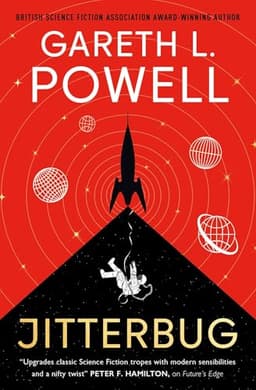
The Continuance novels broaden the canvas with multiple ships and human factions, while Jitterbug brings his interest in voice and machine personhood into another energetic frame. Readers should begin with Embers of War for the strongest balance of scale and moral focus. Powell's work is optimistic in a hard-earned sense: violence leaves residue, but a being built by a violent system can still choose what its power will serve.
Machine personhood without a human disguise
Powell does not make Trouble Dog prove personhood by thinking like a human. The warship thinks through sensors, hull, weapons, crew, distance, and mission history. Its remorse is physical because the body remembering the atrocity is also the instrument that performed it. Rescue work gives that body a new purpose without removing its capacity for violence.
Powell's crews are usually assembled from people whose institutions have already failed them. Found family is not immediate harmony. Members disagree about risk, command, secrecy, and the value of a life outside their group. Loyalty becomes credible when it survives those differences and when a character answers distress without certainty that help will be repaid.
His action scenes are spatially clean. Ships have positions, ranges, damage, and limited time, so scale does not dissolve into colored light. The emotional decision remains visible inside the maneuver. A captain who changes course may be accepting a tactical disadvantage, disobeying an order, and declaring what kind of person the crew will become in the same motion.
The accessible pace sometimes simplifies political factions, particularly when an antagonistic system must remain legible during rapid escalation. Powell is more persuasive with responsibility after violence than with every cause of the violence. Embers of War therefore remains the strongest measure of his work. Its central act is not a victory but a being built for war choosing that distress creates an obligation.
Velocity without losing the moral decision
Powell writes fast science fiction, but speed in his better work is not a refusal to think. A pursuit or rescue forces an argument that characters could postpone in safety. The ship must choose whether to answer a signal, the captain must decide whose order carries legitimacy, and the crew must expose what they believe a person is worth. The physical maneuver and the ethical choice arrive together. This is why his cleanest action scenes remain readable even when weapons, artificial minds, and multiple factions share the page.
His interest in networked intelligence adds another complication. A machine may possess memories distributed across systems, while a human crew depends on trust built through embodied presence. Powell does not automatically make one form superior. Machine perspective can widen the scale of responsibility, yet it can also inherit the mission logic of the institution that built it. Human feeling can inspire rescue and produce tribal blindness. Across the Embers of War books and his shorter fiction, the recurring question is not whether technology becomes human enough to deserve sympathy. It is whether any powerful mind can revise the purpose it was given after seeing the people that purpose harmed.
Powell's humor keeps this moral seriousness from turning his crews into panels in a debate. The uplifted monkey Ack-Ack Macaque is the most obvious expression of his taste for a premise that sounds like a dare and is then granted an interior life. The same instinct appears more quietly when a ship develops vanity or a battered crew member refuses heroic language. Absurdity opens the door, but consequence makes the character last.