
Author profile
Percival Everett: books, review, and bibliography
Percival Everett keeps changing genre so publishers and readers cannot turn one successful book into the only kind of story they will let him tell.
Biography and criticism
A career built against the assigned shelf
The westerns, satires, mysteries, experiments, and historical rewritings are not random detours. Together they refuse the idea that one Black writer must provide a single representative voice.
Decades of deliberate range
Percival Everett was born in Georgia in 1956, studied philosophy and later fiction, and has combined a prolific writing career with teaching. Since Suder in 1983, he has published novels, stories, poetry, and experimental work across forms often treated as separate markets. Western landscapes, family conflict, abstraction, detective structures, and philosophical games recur without becoming one brand.
Erasure offers the sharpest early statement of his quarrel with literary expectation. Thelonious Ellison, a Black novelist whose difficult work is dismissed as insufficiently marketable, writes a grotesque parody of the stereotyped novel the industry rewards. The parody becomes a success, trapping him inside the performance meant to expose the system.
Rewriting the story without obeying it
The Trees brings racial terror, dark comedy, and a police investigation into the same book. James retells Adventures of Huckleberry Finn through Jim and gives him the intelligence and control of language that white narration kept offstage. Everett does more than update the vocabulary. Jim changes how he speaks according to who is listening because that performance helps keep him alive.
Everett's prose can be spare, playful with form, or suddenly violent. The humor makes an absurd system visible just when everyone inside it has accepted the system as normal. James is the easiest current starting point; Erasure is the key to his publishing satire; Telephone gives a stronger taste of his experiments. Read more than one Everett novel. The differences between them are part of what he is doing.
Why Everett keeps changing the terms
Everett changes genre before the market can decide that one successful book has revealed the only authentic version of him. A western, campus satire, philosophical experiment, detective story, or historical rewrite may work differently, but each asks who gets to classify another person. The range is his way of refusing the job of representing everybody.
Erasure makes the refusal explicit. Monk's parody succeeds because the market recognizes its stereotype faster than it recognizes the difficult work he values. The joke turns painful when publishers and critics praise the fake performance as authentic. Everett does not let Monk stand safely above them. Grief inside his family and his own vanity complicate the contempt.
James revises a familiar story in a different way. Jim changes how he speaks according to who is listening because language can protect him. His intelligence gives him room to act, but it cannot make enslavement less dangerous. Every change of voice matters to the plot, and the novel asks what had to be hidden so Huck's education could stay at the center of the old version.
Everett can move from a joke to violence or grief before the reader finds a comfortable place to judge from. The change is deliberate. Satire exposes an absurd system, but his characters still have to live under it after the joke lands. Across several novels, the target is larger than one stereotype. Everett is also attacking the wish to put a final label on someone and stop paying attention.
Why the sentences change with the genre
Everett changes more than the subject when he changes genre. A satire may use clipped exchanges that become steadily more absurd. A western leaves more unsaid in the landscape and silence. A philosophical novel can make every conversation a fight over what counts as real. James shows his precision, but one book cannot show how deliberately he avoids a single house style.
Changing the terms also stops his characters from becoming tidy examples of an approved idea. In Erasure, Monk's parody exposes the publishing market, but his family life keeps him from standing safely above the joke. In James, changing how he speaks gives Jim room to act but cannot guarantee his safety. Everett often refuses to tell us exactly how to judge a scene. A joke can turn into violence or grief without a polite transition, because the people being classified still have to live with what the category does to them.
Where to begin
The Percival Everett book reviewed here
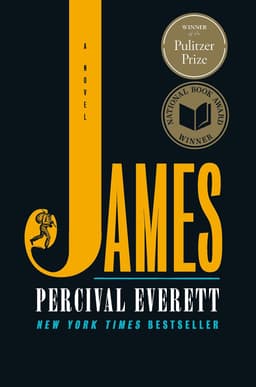
James
4.8 / 5James is a formally daring retelling that restores intelligence, fear, and agency to a character American literature taught generations of readers to underestimate.
Reading order and buying help
Reading guides featuring Percival Everett
Bibliography
Books by Percival Everett
Reviews and book guides open on Book Review Guide. The full list comes from the linked bibliography source.
Reviewed
James
Not reviewed yet
Parts of Brain
Bibliographic source: Open Library.
Books on this site
Percival Everett reviews and guides
20244.8 / 5
James
A Novel
James is a formally daring retelling that restores intelligence, fear, and agency to a character American literature taught generations of readers to underestimate.
As an Amazon Associate, I earn from qualifying purchases.
Keep exploring