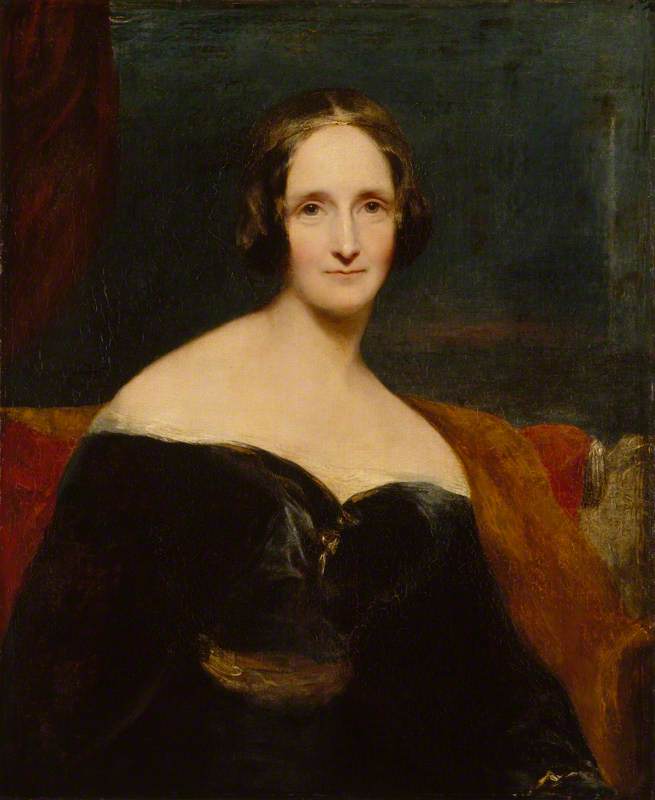
A daughter of radical argument
Mary Wollstonecraft Godwin was born in London in 1797 to philosopher William Godwin and feminist writer Mary Wollstonecraft, who died shortly after childbirth. Mary grew up within the pressure of famous ideas and a complicated household. As a teenager she began a relationship with poet Percy Bysshe Shelley, traveling with him through scandal, debt, family rupture, and repeated bereavement.
During the 1816 stay near Lake Geneva with Percy Shelley, Lord Byron, John Polidori, and others, a ghost-story challenge contributed to the idea that became Frankenstein. The anonymous 1818 edition was later revised in 1831, and differences between editions reflect changing context rather than one final transparent intention.
The failure after creation
Victor Frankenstein's crime is not curiosity alone. It is abandonment. He creates a dependent being, recoils from its body, and refuses the relationship his act produced. The creature learns language and develops a conscience by watching other people, then meets rejection again and again. His suffering helps explain the violence but does not excuse it.
Walton, Victor, and the creature all want our sympathy, and each arranges the story to make his own choices look different. Later novels including The Last Man, a pandemic story about isolation and political failure, show how much more Shelley wanted to do. After Percy's death, she supported her family by writing and edited his work while her own choices remained tightly constrained. Frankenstein is the beginning, not the whole career. Read The Last Man next if you want to meet Shelley without a century of movie monsters standing between you and the page.
The wider career obscured by the creature
The Last Man deserves a central place in Shelley's career because it reverses the crowded act of creation in Frankenstein. A plague empties the world, and the surviving narrator must write when the imagined audience has nearly disappeared. Politics, ambition, friendship, and national identity do not vanish immediately under catastrophe. People continue performing familiar roles after those roles have lost the systems that gave them meaning.
Mathilda, withheld from publication during Shelley's lifetime, explores grief, confession, and destructive family desire in a much narrower frame. Lodore and Falkner examine family power and women's limited routes through dependence. These books are uneven, but they disprove the story that Shelley produced one accidental masterpiece during a famous holiday and spent the rest of her life guarding a dead poet's papers.
Editing Percy Bysshe Shelley's work was an act of devotion, but it was also a job that required strategy. Mary had to manage family pressure, reputation, money, and the public image of the poet. Her choices shaped what later readers could know, even while critics treated her own books as secondary. It is a situation her fiction understands well: after somebody dies, the person arranging the story has real power.
Shelley's prose can be elevated, emotionally direct, and openly argumentative. It may feel distant at first, until you hear what the speaker needs from the person listening. Walton, Victor, the creature, and the last man all tell their stories to someone they hope will finally understand them. The question is whether telling the story can create the relationship their actions failed to sustain.
Frames, revisions, and the problem of sympathy
Frankenstein reaches us through one account inside another. Walton records Victor, Victor reports the creature, and the creature explains how he learned to judge both himself and humanity. Each speaker wants to be believed and chooses the moment when his own responsibility supposedly begins. Our sympathy keeps moving, but Shelley never asks us to stop judging what they do. The creature's eloquence reveals suffering Victor refuses to hear; his later violence still prevents suffering from becoming an excuse.
The differences between the 1818 and 1831 editions also matter. Shelley's revisions change how much weight falls on fate, choice, family, and Victor's upbringing, so the edition you pick changes the book you read. Her later fiction keeps returning to the stories people tell after catastrophe. The survivor may be the last human alive, an isolated daughter, or the witness to a ruined household. Every one of them wants connection, and every one of them also wants control over the account. Shelley knows that nobody is ever 'just telling what happened.'