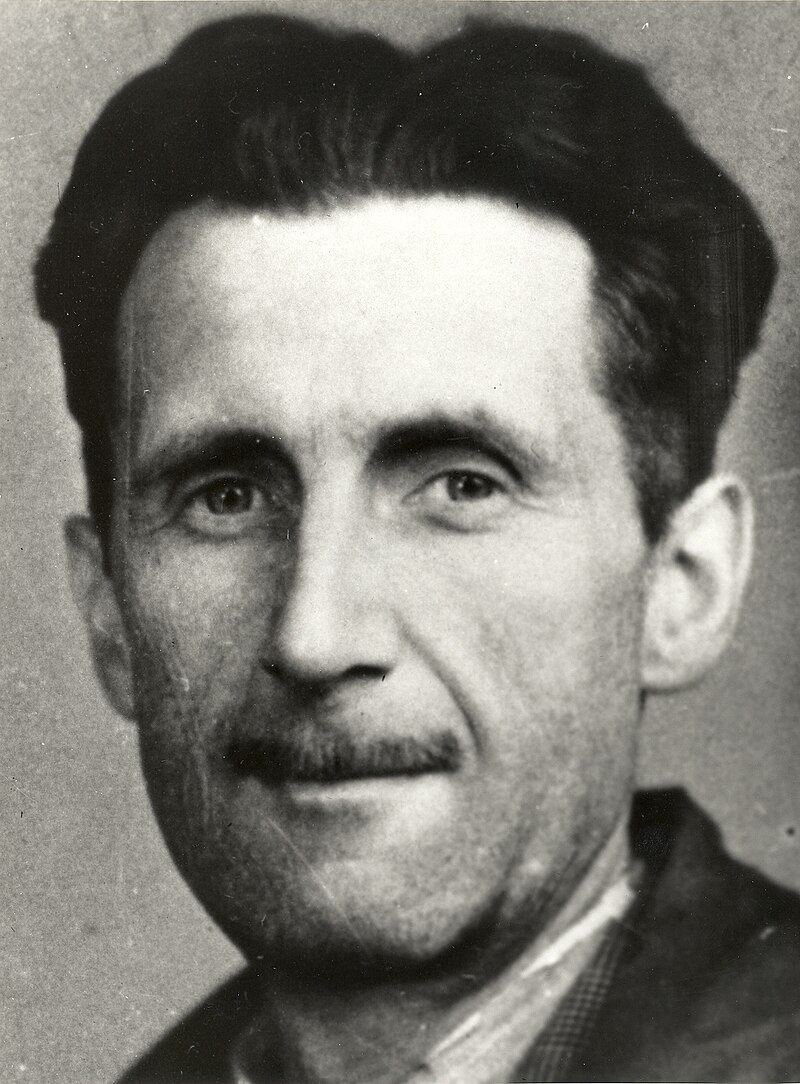
Portrait of George Orwell

Author profile

George Orwell: books, reviews, and where to start

George Orwell made political language, class humiliation, imperial violence, and the corruption of revolutionary hope subjects of prose whose apparent simplicity was carefully made.

1903-1950writerpoet

Biography and criticism

Plain style against dishonest power

Orwell's name has become a label claimed across politics. Returning to the essays, reportage, and novels reveals a more specific democratic socialist, witness, and self-critic.

Empire, poverty, and chosen descent

George Orwell was born Eric Arthur Blair in India in 1903 and educated in England. He joined the Indian Imperial Police in Burma, where service inside colonial rule produced lasting disgust and material for essays and the novel Burmese Days. After leaving, he lived among poor and itinerant people in Paris and England, experiences reshaped in Down and Out in Paris and London. The pen name separated the emerging writer from his family identity without erasing the privileges that allowed chosen poverty to end.

The Road to Wigan Pier combines industrial observation with an argumentative examination of English class and socialist politics. Homage to Catalonia records his service in the Spanish Civil War, injury, and flight after Soviet-aligned forces suppressed the anti-Stalinist left. Spain gave Orwell direct evidence that a cause he supported could corrupt truth while claiming historical necessity.

The fable and the nightmare

Animal Farm compresses revolutionary history into a fable whose slogans change as power consolidates. Its clarity allows wide use, sometimes detached from Orwell's own socialism. Nineteen Eighty-Four expands the attack on totalitarian power through surveillance, controlled history, torture, and Newspeak. The novel's bleakness lies not merely in being watched but in the state's ambition to control the terms through which a private mind recognizes reality.

Orwell's essays model the style he advocated: concrete nouns, active verbs, visible examples, and suspicion of phrases that conceal agency. The simplicity is not neutrality. It is moral arrangement. He selects details so that responsibility cannot disappear into abstraction. Orwell died of tuberculosis in 1950, shortly after Nineteen Eighty-Four. The novel is unavoidable, but essays such as Shooting an Elephant, Politics and the English Language, and Notes on Nationalism are necessary correctives to the vague adjective Orwellian. They show a writer testing his own side as rigorously as an enemy.

The books in context

How the work develops on the page

These notes connect the biography to specific choices in the books. Each title links to the full spoiler-free review.

1984 turns surveillance, censorship, and the manipulation of language into an intimate story about a man trying to stay human inside a system that rewrites truth itself. This review focuses on the novel’s mood, ideas, and impact without spoiling individual scenes or the ending.

The pacing alternates claustrophobic routine with jarring shocks, so every tiny act of tenderness feels like rebellion. The romance is the hinge: human intimacy versus institutional control. Read it alongside Sunrise on the Reaping to compare media spectacle, propaganda, and survival.

For context without spoilers, browse essays and archives at the Orwell Foundation. If you want a palate cleanser after the finale, jump to our hopeful community-centric picks under the historical fiction tag.

Orwell uses plain declarative sentences and repeats official slogans until their grammar begins to feel normal. That deliberate simplicity lets each contradiction become more disturbing rather than more complicated.

The novel makes political control intimate. Winston cannot trust a newspaper, a childhood memory, a lover, or even the words available to describe what has been taken from him.

The long extract from Goldstein's book stalls the narrative and restates ideas the surrounding story has already made vivid. Julia is also less fully imagined than Winston.

The political treatise in the middle is where the momentum nearly disappears. Its analysis matters, but the shift from lived danger to abstract explanation is severe.

Yes. The ending is emotionally brutal because it completes the novel's argument at the level of one mind, not merely at the level of a regime.

Brave New World imagines control through pleasure, conditioning, and abundance rather than fear and scarcity. Choose it for a colder social satire; choose 1984 for the destruction of truth under direct coercion.

The Handmaid's Tale narrows authoritarian rule through one woman's bodily and domestic experience. Its voice is more fragmented and intimate, while 1984 maps the machinery of ideological control more explicitly.

Fahrenheit 451 is shorter, faster, and more lyrical, with censorship tied to distraction as well as state force. It is the more accessible entry; 1984 is the harsher and more systematic warning.

Pairings like Animal Farm for language politics and The Night Circus as an atmospheric counter-programming break.

1984 turns surveillance, censorship, and manipulation of language into a novel that feels written for today: an intimate love story against a system that rewrites the truth.

Read the complete review

Animal Farm is George Orwell’s classic political fable where animals seize control of a farm, only to watch their revolution twist into something grimly familiar. This overview revisits the novel without spelling out every plot turn, focusing instead on why the story still bites decades after publication.

Orwell’s trick is voice. The prose stays simple on purpose, which makes the manipulation feel disturbingly normal. When commandments change overnight or statistics glow on the barn wall, you feel how numbers and words can launder failure into triumph. It’s the kind of classic that earns its syllabus spot without feeling like homework.

If you’re mapping reading paths, pair this with our 1984 review to compare how Orwell treats soft persuasion versus hard surveillance. For historical framing without spoilers, the Orwell Foundation hosts accessible context and essays.

Orwell writes in the calm register of a children's tale while inserting small administrative changes into familiar sentences. The tonal restraint makes the violence and deceit land without rhetorical emphasis.

The fable keeps every political change visible. A commandment is altered, a ration is renamed, or an enemy is revised, and the animals' shrinking language shows exactly how power consolidates.

The allegorical roles limit psychological complexity, especially for animals outside the central leadership. Readers unfamiliar with the Russian Revolution may also miss some of the sharper correspondences.

There is little conventional drag, but the repeated cycles of labor, shortage, and official explanation are intentionally wearying. That repetition is the experience of the farm, not a promise of a new plot turn.

Completely. The final image resolves the fable in one visual comparison and shows that the revolution has preserved the structure it claimed to destroy.

1984 follows the same concern with rewritten truth from inside a mature police state. Read it next for greater psychological depth and a much heavier experience.

The Handmaid's Tale also shows ideology becoming daily routine, but gives its oppressed narrator a private, unstable voice. Choose it when personal memory matters more than allegorical clarity.

The Trial replaces recognizable political allegory with opaque bureaucracy. It is less explanatory and more dreamlike, making helplessness itself the central mystery.

Animal Farm distills 20th-century history into a fierce fable: animals seize the farm, ideals get corrupted, and a relentless mirror shows how power is manufactured.

Read the complete review

Where to begin

A good place to start with George Orwell
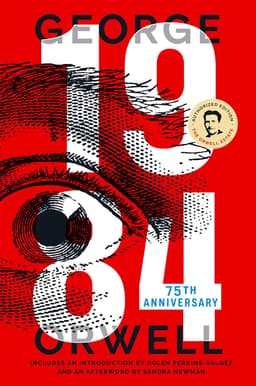
Cover of 1984
Our highest-rated review

1984

4.7 / 5

1984 is blunt in places, but its account of power invading language, memory, and private thought remains frighteningly exact.
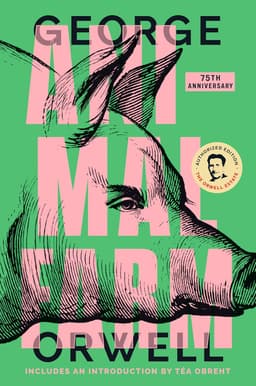
Cover of Animal Farm
Another route in

Animal Farm

4.5 / 5

Animal Farm turns a revolution into a compact tragedy about how slogans, fear, and selective memory make betrayal look like continuity.

Reading order and buying help

Reading guides featuring George Orwell

Idea-led readingAccessible books, big ideasWeekend readingWeekend reads

Bibliography

Books by George Orwell

Reviewed titles open directly on Book Review Guide. Other editions and works remain marked until a full review is published.

Cover unavailable

Not reviewed yet

1984-1

Cover unavailable

Not reviewed yet

Marca

Bibliographic records: Open Library.

Reviewed bibliography

George Orwell books reviewed here

Every title below has a complete, spoiler-free review. Scores are our editorial ratings, not visitor averages.

Cover of 1984

19834.7 / 5

1984

A Dystopian Novel

1984 is blunt in places, but its account of power invading language, memory, and private thought remains frighteningly exact.

Read the review
See current formats on Amazon

As an Amazon Associate, I earn from qualifying purchases.