Best Harry Potter Box Sets to Buy in 2026
I’d buy the regular seven-book paperback set for someone meeting Harry at Hogwarts for the first time. The hardcover and stenciled-edge sets also tell the whole story. Jim Kay and MinaLima give the first three books distinct illustrated treatments, so I’d start a gift decision with how much of the series the reader already has.
The choices
Five Harry Potter box sets
Complete sets · All seven novels
Each set follows Harry from his first year at Hogwarts to Deathly Hallows.
1
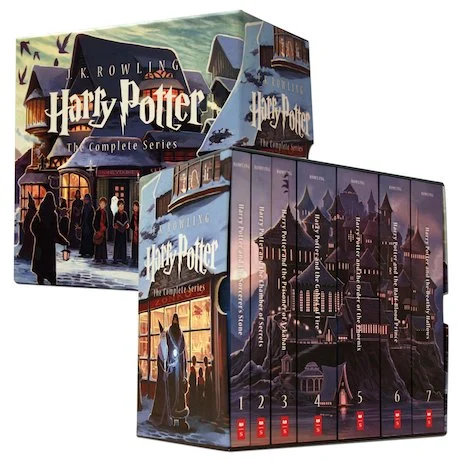
Harry Potter Paperback Box Set
Books 1 to 7 · Complete series · Paperback
All seven novels sit together in a slipcase. The paperbacks are easier to hold through a long chapter than the hardcovers, a difference that matters by the time Harry reaches his later years at Hogwarts.
See more
This is the set I’d give a reader who wants to disappear into the story and carry one book around at a time. The U.S. box begins with Sorcerer’s Stone, the novel published as Philosopher’s Stone in the U.K.
2
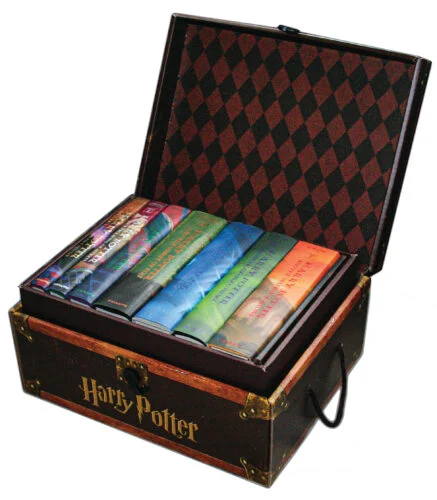
Harry Potter Hardcover Box Set
Books 1 to 7 · Complete series · Hardcover
All seven novels come in hardcovers in a trunk-shaped box. The rigid boards offer more protection on the shelf and the books have more weight in the hand. Expect to notice that most when you pick up one of the longer volumes.
See more
This makes sense as a gift when a family wants a set that lives on the shelf and passes between readers. It gives younger readers the same text and reading order as the paperbacks.
3
Harry Potter Deluxe Stenciled Edges Box Set
Books 1 to 7 · Complete series · Deluxe paperback
These seven paperbacks have gold foil on the covers and colorful stenciled page edges. The edge design changes from book to book, with icons tied to each novel. You can see the differences with the books closed.
See more
It gives a complete set some of the visual interest a fan might want from a gift, while keeping paperback bindings. The edge treatment and foil are the reasons to choose it over the regular slipcase set.
Illustrated sets · Books one to three
Both sets end with Prisoner of Azkaban. You’ll need other volumes to finish the story.
4
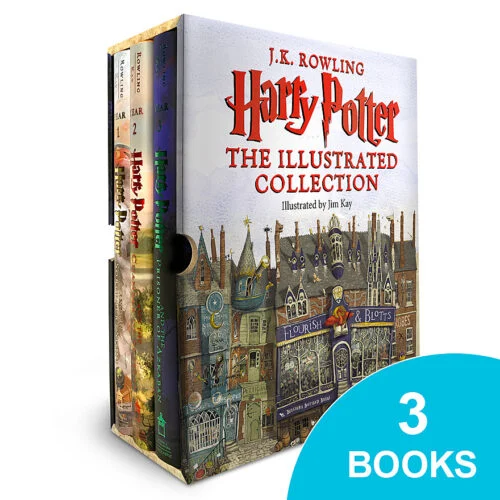
Harry Potter: The Illustrated Collection
Books 1 to 3 only · Jim Kay · Illustrated hardcovers
Jim Kay’s full-color illustrations let you linger over places Harry barely has time to take in. The slipcase shows Diagon Alley, and inside the set the pictures give the first three books room for character portraits and scenes to look at together.
See more
I’d lean toward Kay for reading aloud with a child who likes to stop and look at the pictures. This slipcase ends with Prisoner of Azkaban, even though illustrated volumes beyond it were published separately.
5
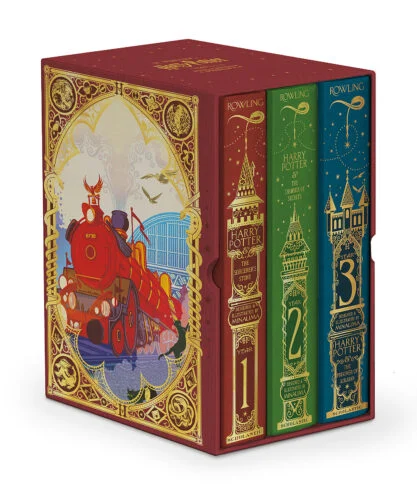
Harry Potter MinaLima Box Set
Books 1 to 3 only · MinaLima · Interactive hardcovers
MinaLima uses color, lettering and paper engineering throughout the first three books. Scholastic lists eight pieces to handle in each volume. In Prisoner of Azkaban, you can unfold the Marauder’s Map and see how the Time-Turner is represented in paper.
See more
These are the full texts of the first three novels. The moving pieces give a shared read places to pause and explore, and those pieces will benefit from gentler handling. You’ll still need books four through seven to reach the end.
My first pick
The regular paperback set for a first read
It gives a new reader every main novel in a lighter binding, including the longer books near the end.
Side by side
Compare the five Harry Potter collections
The book count is the place to start. The presentation changes how you handle the books and what you can look at while reading.
| Collection | Books included | Complete series | Illustrations | Presentation | Main difference |
|---|---|---|---|---|---|
| Regular paperback | 1 to 7 | Yes | Standard edition artwork | Paperbacks in a slipcase | Lighter volumes for everyday reading |
| Regular hardcover | 1 to 7 | Yes | Standard edition artwork | Hardcovers in a trunk-shaped box | Rigid covers and heavier volumes |
| Deluxe stenciled edges | 1 to 7 | Yes | Standard edition art with decorated edges | Paperbacks with gold foil | A different icon pattern for each book’s edges |
| Jim Kay Illustrated | 1 to 3 | No | Jim Kay’s full-color artwork | Illustrated hardcovers in a slipcase | Pictures to linger over during a read-aloud |
| MinaLima | 1 to 3 | No | Full color and paper engineering | Interactive illustrated hardcovers | Eight interactive pieces in each book |
For a new reader
I’d stick with the full paperback set. Harry’s first year has the feel of a school mystery. By the last books, he’s dealing with loss, loyalties and a world much wider than the school. Having all seven volumes gives a new reader time to grow into that change.
All seven novels in reading order · My review of the first Harry Potter novel
For a Christmas gift
For someone who already has reading copies, the stenciled edges are visible whenever the books are shelved with the page edges facing out. I’d consider the hardcover set for a household starting a shared shelf. A reader who already owns all seven can also enjoy an illustrated set without needing it to supply the end of the story.
Jim Kay or MinaLima?
Kay draws a place to look at. MinaLima gives the reader things to unfold and turn. I’d choose Kay for a listener who wants to pause on a scene, and MinaLima for someone excited to open the map. The sets stop at the same point in Harry’s story.
My review of Prisoner of Azkaban · J. K. Rowling’s books · Fantasy alternatives for adult Harry Potter readers
Quick answers
Questions before buying a Harry Potter set
Which Harry Potter box sets include all seven books?
The regular paperback, the regular hardcover and the Deluxe Stenciled Edges set include all seven main novels. The Jim Kay and MinaLima sets compared here contain the first three.
Are Sorcerer’s Stone and Philosopher’s Stone different books?
They are the U.S. and U.K. titles of the first Harry Potter novel. The Scholastic sets use the U.S. title, Sorcerer’s Stone.
Are the illustrated books abridged?
The Jim Kay editions present the novels with full-color illustrations. Scholastic explicitly describes the MinaLima editions as complete and unabridged. In each set, the limit is at book three.
Sources for this guide
Sources & references
Scholastic’s product descriptions and MinaLima’s edition notes establish the book counts, formats, and illustration details.
Keep reading