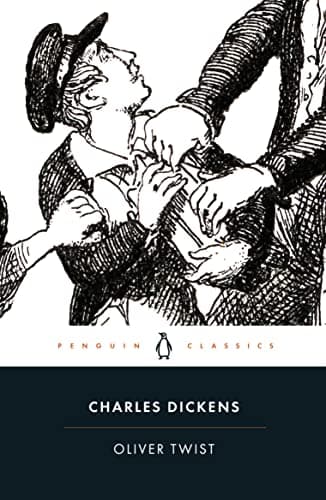
Should you read Oliver Twist?
What works
Workhouse language, hunger, Fagin's den, the streets, and Nancy's divided loyalty make respectable cruelty and criminal danger part of one economy.
What may not work for you
Antisemitic representation is serious and pervasive, coincidences control Oliver's identity, and virtue is distributed too neatly by birth.
What may test your patience
The later effort to explain Oliver's parentage slows the stronger social and criminal story with inheritance machinery.
Does the ending reward the effort?
The central villains and Oliver's future receive clear closure, but the tidy family revelations weaken the institutional critique.
Reading Oliver Twist closely
Oliver Twist begins with a child born into a system designed to manage poverty more efficiently than it relieves suffering. After the workhouse and an abusive apprenticeship, Oliver reaches London and is welcomed by the Artful Dodger into Fagin's group of young thieves before he understands what they expect from him.
The novel mixes social protest, crime melodrama, grotesque comedy, and moments of real terror. Oliver himself remains unusually innocent, so much of the complexity belongs to characters around him, especially Nancy, whose compassion and vulnerability reveal how limited the available choices can be for someone trapped by poverty and violence.
Dickens's anger at institutions that blame the poor still feels direct, and the London scenes carry memorable energy. Some coincidences and idealized characters reflect nineteenth-century melodrama, while Fagin's portrayal relies on antisemitic stereotypes that modern readers should approach critically. Recognizing those elements makes for a more honest reading than ignoring them.
Childhood inside an uncaring system
The workhouse treats hunger as a moral failure and charity as a reason for humiliation. Dickens exaggerates officials into comic monsters, but the satire keeps returning to a serious question: what happens when institutions protect rules and reputations instead of vulnerable children?
Crime, coercion, and moral choice
Fagin's group offers food and companionship while turning children into tools. Nancy becomes crucial because her decisions show that goodness can survive within coercive circumstances, even when social judgment refuses to see the difference between exploitation and willing criminality.
Dated elements and the reading experience
The plot is accessible and often fast, though coincidences and sentimental contrasts are prominent. Readers should be prepared for antisemitic language and caricature in Fagin's characterization, as well as harsh depictions of domestic abuse, child cruelty, and urban poverty.
Three useful comparisons

Great Expectations
Great Expectations has the stronger protagonist, subtler class psychology, and more controlled first-person form.
Best for: An accessible Dickens novel about class, guilt, love, money, and a narrator learning to read his own past.
As an Amazon Associate, I earn from qualifying purchases.
David Copperfield
David Copperfield offers a fuller life, warmer relationships, and similar attention to childhood vulnerability.
Best for: Readers ready for a long Victorian life novel about childhood, work, friendship, love, memory, and becoming a writer.
As an Amazon Associate, I earn from qualifying purchases.
Bleak House
Bleak House gives institutional failure far greater social breadth and formal ambition.
Best for: Patient readers wanting Victorian London, legal satire, family mystery, dual narration, disease, and a vast connected cast.
As an Amazon Associate, I earn from qualifying purchases.