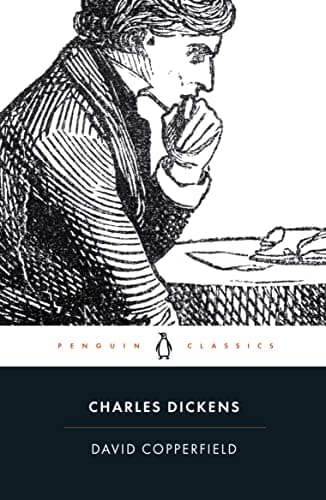
Should you read David Copperfield?
What works
Childhood fear, work, friendship, marriage, writing, and memory create a full life, while figures such as Betsey Trotwood and Mr. Dick retain comic and emotional independence.
What may not work for you
The idealization of Agnes is limiting, Dora is treated tenderly but paternalistically, and several comic subplots extend well past necessity.
What may test your patience
The novel repeatedly leaves David's central development for secondary households and financial complications; some are brilliant, others delay momentum.
Does the ending reward the effort?
Yes. David's professional and emotional maturity feels accumulated across mistakes rather than granted by one revelation.
Reading David Copperfield closely
David Copperfield tells his own life from early childhood to adulthood, looking back on the people and experiences that taught him how easily affection, ambition, and self-deception can become entangled. His mother's vulnerability, a cruel stepfather, disrupted schooling, and child labor give the opening an immediacy that draws on parts of Dickens's own youth.
As David grows, the novel expands into a large social world of friends, guardians, employers, relatives, and romantic attachments. Betsey Trotwood, Mr. Micawber, Uriah Heep, and many others are heightened enough to be instantly memorable, yet their recurring presence also makes the book feel like a life in which relationships change meaning over time.
The novel is long and episodic, but its first-person voice provides unity. David learns to identify obvious cruelty before he learns to recognize his own mistaken ideals, particularly in love and friendship. That slower moral education is why the book works as more than a sequence of colorful Victorian episodes.
Memory as a form of self-portrait
Adult David narrates childhood feeling with unusual closeness while occasionally revealing what the child could not understand. The gap between experience and hindsight lets Dickens preserve vulnerability without pretending that memory is perfectly neutral.
A crowded life rather than a compact plot
Characters disappear and return across years, carrying debts, loyalties, resentments, and consequences with them. The coincidences are unmistakably Dickensian, but the cumulative effect suggests how a person is formed by a whole network rather than one decisive event.
Three useful comparisons
Great Expectations
Great Expectations is tighter, darker, and sharper about shame; David Copperfield offers more life and warmth.
Best for: An accessible Dickens novel about class, guilt, love, money, and a narrator learning to read his own past.
As an Amazon Associate, I earn from qualifying purchases.
Bleak House
Bleak House is formally more ambitious and institution-centered, with a larger social mystery.
Best for: Patient readers wanting Victorian London, legal satire, family mystery, dual narration, disease, and a vast connected cast.
As an Amazon Associate, I earn from qualifying purchases.
Jane Eyre
Jane Eyre gives childhood deprivation and adult independence a more Gothic, concentrated first-person shape.
Best for: Readers who want an intense first-person classic combining romance, moral independence, work, and Gothic secrecy.
As an Amazon Associate, I earn from qualifying purchases.