Portrait of R. F. Kuang

Author profile

R. F. Kuang: books, reviews, and where to start

R. F. Kuang writes ambitious speculative and satirical fiction about empire, language, academic power, race, publishing, and the stories institutions use to call extraction merit.

Born 1996writernovelist

Biography and criticism

Translation, ambition, and institutions that consume talent

Kuang's books change genre rapidly, but their central conflict remains recognizable: brilliant people enter systems that value what they can produce while resisting what they know.

Historical study becomes epic fantasy

Rebecca F. Kuang was born in Guangzhou in 1996, moved to the United States as a child, studied history and Chinese studies, and pursued graduate work connected to modern Chinese literature and languages. The Poppy War, published in 2018, draws on twentieth-century Chinese history within a military fantasy centered on Rin, whose pursuit of power moves from escape to atrocity.

The trilogy rejects the fantasy that suffering automatically makes a leader just. Rin's intelligence and rage remain understandable while her decisions become catastrophic. Babel later turns translation into a magical and economic technology supporting British empire, making the apparent elegance of scholarship inseparable from extraction.

The university and the publishing feed

Yellowface abandons epic fantasy for first-person satire. June Hayward steals a dead friend's manuscript and narrates each new appropriation as fairness, creating comedy through the speed with which self-interest manufactures moral vocabulary. Katabasis returns to academia through a journey into Hell, where abuse has been normalized as rigor and ambition confuses proximity to power with intellectual worth.

Kuang writes clear argument and strong premises, sometimes stating thematic conclusions more directly than characters can complicate them. That explicitness gives the books public urgency and risks turning opponents into functions. Yellowface is the most accessible entry; Babel the fullest expression of language and empire; The Poppy War the beginning for violent epic scale. Kuang's career is compelling because she treats success itself as evidence: who designed the test, who can afford to take it, and what must the winner learn not to see?

The books in context

How the work develops on the page

These notes connect the biography to specific choices in the books. Each title links to the full spoiler-free review.

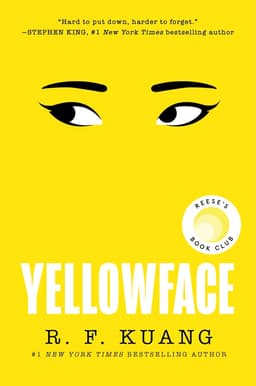
In this spoiler free Yellowface by R. F. Kuang review, the hook is brutally simple: June Hayward is a writer with little traction, while her friend Athena Liu is a literary star. After a sudden tragedy, June walks away with Athena’s unpublished manuscript and a choice that turns into a full identity swap, complete with a new author name and a story the public is ready to celebrate.

Kuang writes the publishing world like a pressure chamber where branding, optics, and incentives quietly reward the worst instincts. The brilliance is the narration: June is relentlessly self justifying, always explaining why the line she crossed was not really a line. That voice makes the book funny in a bleak way, because you can hear the lies harden into something she needs to survive.

As the book succeeds, attention becomes the threat. Online whispers become threads, threads become dogpiles, and June starts living inside a feedback loop she cannot control. Yellowface nails the paranoia of being watched and reinterpreted in public, while still keeping the moral center clear: the story is not about a misunderstood genius, it is about what happens when success is built on theft and fear.

If you want a fast, talkable novel that doubles as a sharp look at cultural appropriation, reputation, and who gets credit, Yellowface delivers. If you are ready to read it, you can pick up your copy on Amazon, then browse our satire and thriller shelves for more books that mix momentum with uncomfortable questions.

Kuang uses June's parenthetical corrections and escalating rationalizations to reveal the thought she is trying to hide at the exact moment she denies it.

June's self-justification turns appropriation, envy, marketing, and online punishment into one continuous voice rather than a checklist of publishing controversies.

Some industry antagonists are broad enough to make June's paranoia temporarily seem more reasonable, and the social-media cycles can repeat their point.

The middle revisits accusation, denial, and reputational recovery several times, which is thematically apt but less surprising than the opening theft.

Yes. The ending understands that exposure cannot cure a narrator whose real talent is converting consequence into new material.

James reclaims narrative authority from a canonical text with historical and emotional gravity; Yellowface examines a thief who calls appropriation collaboration.

The Great Gatsby is more lyrical and indirect about self-invention, while Yellowface makes status hunger contemporary, verbal, and painfully explicit.

The Compound turns visibility into a controlled survival game; Yellowface shows a writer repeatedly choosing the attention that terrifies her.

A razor sharp publishing satire that stays propulsive, not preachy, so the story keeps moving while the critique lands.

A surprisingly accurate portrayal of online backlash as an environment that changes what people do, not just what they feel.

Readers who like contemporary books that spark debate about art, ethics, identity, and who profits from which stories.

This Yellowface review stays spoiler free while following a failed writer who steals a dead friend’s manuscript, then watches success curdle into paranoia as the internet starts asking the wrong questions.

Read the complete review

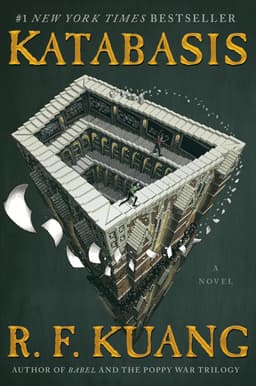
Katabasis turns an academic career crisis into a literal descent through Hell. Alice Law has built her future around analytic magick and the approval of her Cambridge supervisor. When that supervisor dies, she follows him into the underworld to recover both his soul and the recommendation on which her career depends. Her rival Peter Murdoch joins the expedition, making cooperation unavoidable.

The premise is playful, but the ambition underneath it is not. Kuang uses the journey to examine how intelligent people learn to treat exploitation as rigor, exhaustion as proof of worth, and proximity to authority as a substitute for a life. Alice and Peter can analyze systems with extraordinary precision while remaining unreliable judges of what those systems are doing to them.

Hell is organized through competing rules, arguments, and traditions rather than a single religious map. That makes the setting feel like an extension of academic life: every court has its logic, every authority has a theory, and surviving requires understanding who gets to define the terms. Readers who enjoy footnotes, philosophical detours, and magic explained through language and reasoning will find more to savor than readers seeking a simple quest.

The relationship between Alice and Peter supplies the emotional movement. Their rivalry is intellectual, professional, and personal, with resentment complicated by the fact that each understands the other’s ambition better than anyone else. The novel asks whether being truly seen is enough to create trust when both people have been trained to compete.

Kuang lets Alice analyze a magical rule with exacting clarity while misreading the emotional bargain beneath it, so intellectual fluency and self-deception occupy the same sentence.

Alice and Peter's rivalry joins intellectual recognition to resentment, while the underworld's competing rules turn academic interpretation into a practical survival skill.

The references, debates, and explanatory footnotes sometimes halt the descent, and the supervisor's importance can overshadow lives beyond the academic hierarchy.

Yes. The conclusion makes ambition answer to a choice about complicity rather than rewarding the expedition with a simple academic restoration.

The Will of the Many introduces its political hierarchy through faster infiltration and a more immediately accessible hero; Katabasis is denser, more argumentative, and more narrowly academic.

A Sorceress Comes to Call uses fairy-tale horror and social manners with lighter movement; Katabasis builds difficulty through theory, allusion, and professional obsession.

Death of the Author also examines institutions that claim creative and intellectual work, but uses family, disability, publishing, and a novel inside the novel rather than a quest.

The descent lets Kuang make academic metaphors physical without abandoning their institutional meaning. Recommendation letters, supervision, citation, and professional scarcity may sound mundane beside demons and dead souls, but the novel treats them as parts of the same struggle over authority.

The prose is readable, but the book is dense with references to classical underworlds, philosophy, literary theory, and the mechanics of analytic magick. You do not need specialist knowledge, though readers who enjoy stopping to think through an argument will have an easier time than those looking for uninterrupted action.

Katabasis suits readers who liked Babel’s interest in institutions and language but are open to a stranger, more satirical journey. It also works for dark academia fans who want the genre to question the labor, hierarchy, and obsession beneath its beautiful libraries.

Cambridge magician Alice Law descends into Hell to recover her dead supervisor’s soul and the recommendation letter her career depends on, reluctantly joining forces with academic rival Peter Murdoch.

Read the complete review

Where to begin

A good place to start with R. F. Kuang

Cover of Yellowface
Our highest-rated review

Yellowface

4.5 / 5

Yellowface is funniest when June is one sentence away from admitting the truth and instead invents a more flattering moral universe for herself.

Cover of Katabasis
Most recently added

Katabasis

4.3 / 5

Katabasis makes Hell feel like the logical final department of an institution that taught brilliant students to confuse abuse with rigor.

Bibliography

Books by R. F. Kuang

Reviewed titles open directly on Book Review Guide. Other editions and works remain marked until a full review is published.

Bibliographic records: Open Library.

Reviewed bibliography

R. F. Kuang books reviewed here

Every title below has a complete, spoiler-free review. Scores are our editorial ratings, not visitor averages.

Cover of Katabasis

20254.3 / 5

Katabasis

A Novel

Katabasis makes Hell feel like the logical final department of an institution that taught brilliant students to confuse abuse with rigor.

Read the review
See current formats on Amazon

As an Amazon Associate, I earn from qualifying purchases.

Cover of Yellowface

20234.5 / 5

Yellowface

A Novel

Yellowface is funniest when June is one sentence away from admitting the truth and instead invents a more flattering moral universe for herself.

Read the review
See current formats on Amazon

As an Amazon Associate, I earn from qualifying purchases.