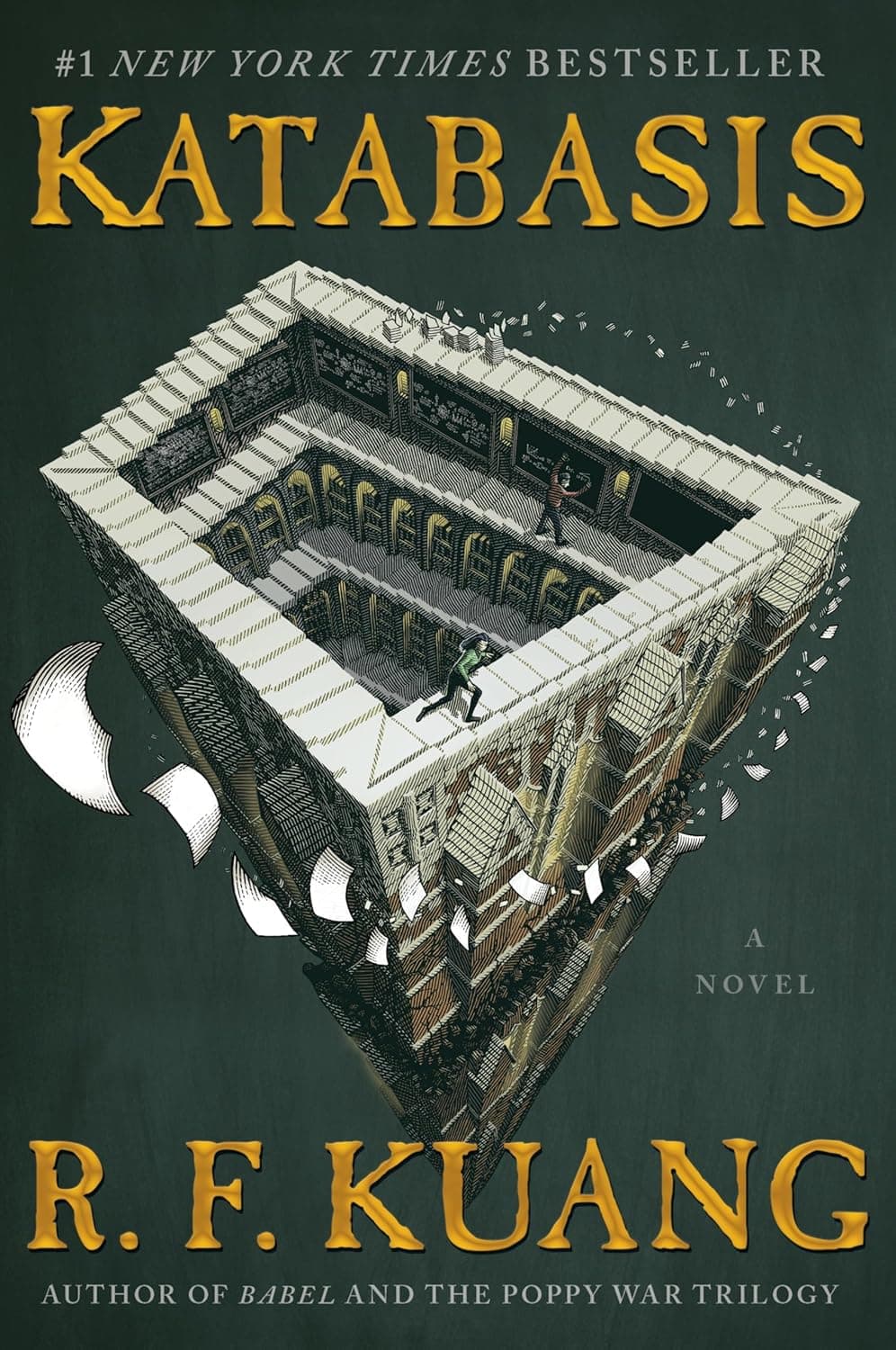
Should you read Katabasis?
What works
Alice and Peter's rivalry joins intellectual recognition to resentment, while the underworld's competing rules turn academic interpretation into a practical survival skill.
What may not work for you
The references, debates, and explanatory footnotes sometimes halt the descent, and the supervisor's importance can overshadow lives beyond the academic hierarchy.
What may test your patience
The early Cambridge material and magical theory establish the characters' captivity before the literal journey gathers speed.
Does the ending reward the effort?
Yes. The conclusion makes ambition answer to a choice about complicity rather than rewarding the expedition with a simple academic restoration.
Reading Katabasis closely
Katabasis turns an academic career crisis into a literal descent through Hell. Alice Law has built her future around analytic magick and the approval of her Cambridge supervisor. When that supervisor dies, she follows him into the underworld to recover both his soul and the recommendation on which her career depends. Her rival Peter Murdoch joins the expedition, making cooperation unavoidable.
The premise is playful, but the ambition underneath it is not. Kuang uses the journey to examine how intelligent people learn to treat exploitation as rigor, exhaustion as proof of worth, and proximity to authority as a substitute for a life. Alice and Peter can analyze systems with extraordinary precision while remaining unreliable judges of what those systems are doing to them.
Hell is organized through competing rules, arguments, and traditions rather than a single religious map. That makes the setting feel like an extension of academic life: every court has its logic, every authority has a theory, and surviving requires understanding who gets to define the terms. Readers who enjoy footnotes, philosophical detours, and magic explained through language and reasoning will find more to savor than readers seeking a simple quest.
The relationship between Alice and Peter supplies the emotional movement. Their rivalry is intellectual, professional, and personal, with resentment complicated by the fact that each understands the other’s ambition better than anyone else. The novel asks whether being truly seen is enough to create trust when both people have been trained to compete.
Dark academia with an actual underworld
The descent lets Kuang make academic metaphors physical without abandoning their institutional meaning. Recommendation letters, supervision, citation, and professional scarcity may sound mundane beside demons and dead souls, but the novel treats them as parts of the same struggle over authority.
How difficult is Katabasis?
The prose is readable, but the book is dense with references to classical underworlds, philosophy, literary theory, and the mechanics of analytic magick. You do not need specialist knowledge, though readers who enjoy stopping to think through an argument will have an easier time than those looking for uninterrupted action.
Three useful comparisons
The Will of the Many
The Will of the Many introduces its political hierarchy through faster infiltration and a more immediately accessible hero; Katabasis is denser, more argumentative, and more narrowly academic.
Best for: A fast-opening political fantasy built around academy competition, hidden identity, and a large mystery.
A Sorceress Comes to Call
A Sorceress Comes to Call uses fairy-tale horror and social manners with lighter movement; Katabasis builds difficulty through theory, allusion, and professional obsession.
Best for: Try it for dark fairy-tale revision, coercive-control horror, older heroines, and humane humor.
Death of the Author
Death of the Author also examines institutions that claim creative and intellectual work, but uses family, disability, publishing, and a novel inside the novel rather than a quest.
Best for: Readers of literary science fiction interested in disability, Nigerian diasporic family, publishing, artificial life, adaptation, fame, and stories embedded inside stories.